

Escrito por estudiantes que aprobaron Inmediatamente disponible después del pago Leer en línea o como PDF ¿Documento equivocado? Cámbialo gratis 4,6 TrustPilot
logo-home
Document preview thumbnail
Vista previa 2 fuera de 7 páginas
Examen

Nurs 226 Quiz 1 Question and Answers

Document preview thumbnail
Vista previa 2 fuera de 7 páginas

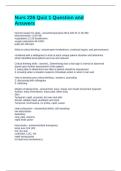
Nurs 226 Quiz 1 Question and Answers Normal ranges for vitals temperature 96.8-100.4F or 36-38C blood pressure 120/80 respirations 12-20 breaths/min oxygen saturation 95-100% pulse 60-100 bpm What is critical thinking open-mindedness, continual inquiry, and perseverance combined with a willingness to look at each unique patient situation and determine which identified assumptions are true and relevant Critical thinking skills 1. Determining that a vital sign is normal or abnormal based upon further assessment of the patient 2. being able to determine how often a patient should be reassessed 3. knowing when a situation requires immediate action or when it can wait How to develop your critical thinking 1. journaling 2. discussing with colleagues 3. reflecting Modes of taking temp Oral: easy, cheap, but mouth movement required Axillary: easy noninvasive, inaccurate, takes long Skin Tympanic: rapid, accurate, but wax and aids Rectal: reliable rapid, pushback and stool Temporal: noninvasive, no probe, rapid, sweat Heat exhaustion fluid deficit, still sweating! low electrolytes faint/dizzy cool, pale, clammy rapid weak pulse heat stroke medical emergency temp over 104 (40) hot, dry skin confusion, LOC, HA rapid strong pulse no heat loss mechanism,s Pulse deficit difference between the apical and radial pulse rates Modes of taking pulse Apical Radial Ulnar Femoral Popliteal Pedalis Brachial Carotid When do you need to check the apical pulse? 1. weak or irregular radial 2. Tachy or Brady 3. Patient on cardiac meds 4. Infants 3-4 5. Dyspnea, Pallor, Cyanosis, Syncope, Palpations Classifications of pulse Rate: Tachy over 100 Brady under 60 Strength: 0: none 1: weak 2: regular 3: strong 4: bulging Rhythm: regular or irregular Ventilation movement of air (gas) in and out of the lungs assess w/ RR and depth Diffusion O2 and CO2 exchange between alveoli and RBCs Perfusion distribution of RBCs to and from pulmonary capillaries Assessing resp rate Eupnea: normal Apnea: absence Tachypnea: over 20 Bradypnea: lower than 12 Assessing resp rhythm Regular: Diaphragmatic/Thoracic Irregular: Cheyne: apnea then hyperventialtion Biot's: similar to apnea slight rise and fall of chest Kussmaul's: deep/fast, seen in DKA, build up CO2 Factors that may effect pulse ox reading nail polish, temperature, skin pigment, tobacco use, skin thickness Mechanisms that affect BP cardiac output, blood volume, viscosity, resistance, and elasticity of arteries Factors that affect BP Age: Rise from childhood to adulthood. Gender: Females lower than males from puberty to menopause; women higher than men. Race: HTN twice as high in African Amer. Diurnal variations: BP lower in morning than evening. Emotions: Can elevate BP Pain: Can elevate BP Personal habits: Caffeine, smoking 30 minutes prior can elevate BP. Weight: Obese patients tend to have higher BP. Pre-Hypertension 120-139/80-89 Hypotension is caused by Dilation of arteries Loss of blood volume Failure of heart muscle to pump Safety concerns: dehydration, falls Ausculatory gap loss of sound while taking a BP, sound will return Steps of the Nursing Process Assessment: gather info Diagnosis: identify problems Planning: set goals and identify appropriate actions Implementation: perform actions Evaluation: determine if goals were achieved What is a nursing assessment a nursing assessment is the collecting of both subjective and objective data on a patient. After collection of data comes analyzing the data. A nurse begins collecting data by initiating the nurse-patient relationship. This is the best way to gather information from your patients. Purpose of nursing diagnosis a judgment of client health status that nurses can identify, prevent, or treat independently describes a patient's response to their illness, injury, treatment, or circumstances. It is different from a medical diagnosis because it considers more than pathology. It considers the patient from a holistic perspective. Medical diagnosis vs collaborative Medical: disease collaborative: require medical orders and/or interventions from other members of the healthcare team Types of Nursing Diagnoses Problem focused (actual): negative diagnosis Risk diagnosis (potential) : at risk for said problem, ex: bedrest at risk for impaired skin integrity Health Promotion (wellness): a patient's desire to improve their health status through behavioral change Maslow's Hierarchy of Needs Maslow's hierarchy provides a way to prioritize patient needs. The problems of highest priority are those necessary for life (air, food, water). How to formulate an actually diagnosis Problem, related factor, defining characteristic Impaired _____ related to _______ as evidenced by ________ How to formulate risk diagnosis Problem, related factor Risk for _________ related to ___ How to formulate health promotion diagnosis Readiness for... Planning involves setting priorities that include? Emergent, Urgent, Non-Urgent ABCs Maslow's hierarchy Chronic vs Acute List guidelines for writing a goal statement. An aim, intent, or end Specific - each goal/outcome should address ONLY ONE RESPONSE Measurable Attainable Realistic Timed Nursing Interventions treatments or actions based on clinical judgment and knowledge that nurses perform to enhance patient outcomes. How to pick your nursing intervention 1. Desired patient outcomes 2. Characteristic of diagnosis 3. Research-based knowledge for the intervention 4. Feasibility of interventions 5. Acceptability of patient 6. Nurse's competency Evaluation Did the patient meet the expected outcome? Examine the results Compare achieved effect with goals & outcomes Recognize errors Understand the patient situation, self- reflect, & correct error Nursing care plan -Nursing responses to current problems so any nurse is able to quickly identify a patient's clinical needs and situation -helps identify what needs to be done yet, what has been accomplished -Reduces the risk for incomplete, incorrect, or inaccurate care -Changes as the patient's problems and status change SOAP note S - (subjective info for a specific problem) patient reports shortness of breath with activity. O - (Objective info for the same issue) pulse ox 89 with activity and RR 28 with activity. Intercostal retractions noted with activity. A - (what the practitioner has identified as the issue) - activity intolerance or impaired gas exchange with activity P - (plan) oxygen 1L via nasal cannula with activity; cluster activities to allow for periods of rest; VS q4h while awake. Giving report with SBAR S: patient's name, admitting diagnoses, age, room number B: any testing done since admission and what results are if known. Allergies, past medical history, past surgical history, meds patient is on related to current problem or important relevant past medical history such as hypertension. A: Head to toe assessment that is out of the normal range given in a systematic method R: anything you are concerned about or could be a potential problem or anything you did not get accomplished on your shift that still needs to be done. SBAR handoff Situation, background, assessment, recommendation, response Pain Involves physical, emotional, and cognitive components subjective and individualized May lead to serious physical, psychological, social, and financial consequences Cutaneous pain skin, sharp, step on nail, needle stick, skin tear Visceral pain soft tissue bones joints, may be spread out may be local, sharp cramping burning, cellulitis: inflammation of the tissue cysts Deep somatic pain involving the internal organs, deep in this area, dull pain Radiating pain when pain travels from one site to another Referred pain pain in totally separate area than initial body site, patients with an MI may feel pain in their jaw while having heart attack Phantom pain pain or discomfort felt in an amputated limb Psychogenic pain pain for which no physical cause can be identified, depression or anxiety Ways to classify pain Quality: Sharp, dull, aching, throbbing, stabbing, burning Severity: must use scale Nonpharmacologic Therapy Relaxation and guided imagery Distraction Music Humor Journaling Cutaneous stimulation Cold and heat application repositioning breathing techniques Environmental modification

Vista previa del contenido

Nurs 226 Quiz 1 Question and
Answers
Normal ranges for vitals - answertemperature 96.8-100.4F or 36-38C
blood pressure <120/<80
respirations 12-20 breaths/min
oxygen saturation 95-100%
pulse 60-100 bpm

What is critical thinking - answeropen-mindedness, continual inquiry, and perseverance

combined with a willingness to look at each unique patient situation and determine
which identified assumptions are true and relevant

Critical thinking skills - answer1. Determining that a vital sign is normal or abnormal
based upon further assessment of the patient
2. being able to determine how often a patient should be reassessed
3. knowing when a situation requires immediate action or when it can wait

How to develop your critical thinking - answer1. journaling
2. discussing with colleagues
3. reflecting

Modes of taking temp - answerOral: easy, cheap, but mouth movement required
Axillary: easy noninvasive, inaccurate, takes long
Skin
Tympanic: rapid, accurate, but wax and aids
Rectal: reliable rapid, pushback and stool
Temporal: noninvasive, no probe, rapid, sweat

Heat exhaustion - answerfluid deficit, still sweating!
low electrolytes
faint/dizzy
cool, pale, clammy
rapid weak pulse

heat stroke - answermedical emergency
temp over 104 (40)
hot, dry skin
confusion, LOC, HA
rapid strong pulse
no heat loss mechanism,s

, Pulse deficit - answerdifference between the apical and radial pulse rates

Modes of taking pulse - answerApical
Radial
Ulnar
Femoral
Popliteal
Pedalis
Brachial
Carotid

When do you need to check the apical pulse? - answer1. weak or irregular radial
2. Tachy or Brady
3. Patient on cardiac meds
4. Infants 3-4
5. Dyspnea, Pallor, Cyanosis, Syncope, Palpations

Classifications of pulse - answerRate: Tachy over 100
Brady under 60
Strength: 0: none
1: weak
2: regular
3: strong
4: bulging
Rhythm: regular or irregular

Ventilation - answermovement of air (gas) in and out of the lungs
assess w/ RR and depth

Diffusion - answerO2 and CO2 exchange between alveoli and RBCs

Perfusion - answerdistribution of RBCs to and from pulmonary capillaries

Assessing resp rate - answerEupnea: normal
Apnea: absence
Tachypnea: over 20
Bradypnea: lower than 12

Assessing resp rhythm - answerRegular: Diaphragmatic/Thoracic
Irregular: Cheyne: apnea then hyperventialtion
Biot's: similar to apnea slight rise and fall of chest
Kussmaul's: deep/fast, seen in DKA, build up CO2

Factors that may effect pulse ox reading - answernail polish, temperature, skin pigment,
tobacco use, skin thickness


Información del documento

Subido en
9 de noviembre de 2025
Número de páginas
7
Escrito en
2025/2026
Tipo
Examen
Contiene
Preguntas y respuestas
$16.99

¿Documento equivocado? Cámbialo gratis Dentro de los 14 días posteriores a la compra y antes de descargarlo, puedes elegir otro documento. Puedes gastar el importe de nuevo.
Escrito por estudiantes que aprobaron
Inmediatamente disponible después del pago
Leer en línea o como PDF

Seller avatar
Los indicadores de reputación están sujetos a la cantidad de artículos vendidos por una tarifa y las reseñas que ha recibido por esos documentos. Hay tres niveles: Bronce, Plata y Oro. Cuanto mayor reputación, más podrás confiar en la calidad del trabajo del vendedor.
Pogba119
3.9
(14)
Vendido
59
Seguidores
2
Artículos
5448
Última venta
1 mes hace


Por qué los estudiantes eligen Stuvia

Creado por compañeros estudiantes, verificado por reseñas

Calidad en la que puedes confiar: escrito por estudiantes que aprobaron y evaluado por otros que han usado estos resúmenes.

¿No estás satisfecho? Elige otro documento

¡No te preocupes! Puedes elegir directamente otro documento que se ajuste mejor a lo que buscas.

Paga como quieras, empieza a estudiar al instante

Sin suscripción, sin compromisos. Paga como estés acostumbrado con tarjeta de crédito y descarga tu documento PDF inmediatamente.

Student with book image

“Comprado, descargado y aprobado. Así de fácil puede ser.”

Alisha Student

Preguntas frecuentes