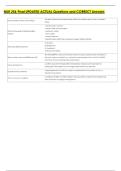
NUR 256 Final UPDATED ACTUAL Questions and CORRECT Answers
Provides evidence and expert based solutions to problem areas in terms of patient
National Patient Safety Goals (NPSGs)
safety
~Identify patient correctly
~Improve Staff communication
What are the goals of National Patient ~Medication safety
Safety? ~Alarm safety
~Prevent infection
~Identify patient safety risk and prevent surgery related mistakes
S: Situation
B: Background
What does SBAR stand for?
A: Assessment
R: Recommendation
The TeamSTEPPS curriculum features tools that may be used by team members to
When would a nurse use SBAR and why? enhance a given competency; a commonly used example of such a tool is the SBAR
format for communicating critical information
a written document that specifies if extraordinary measures are to be taken to
Advanced Directive
prolong life if the patient can no longer make his/her own decision
a legal agreement that allows an agent or representative of the patient to act on
Durable Power of Attorney
behalf of the patient
a medical condition or health problem with associated symptoms that requires long-
What is a Chronic condition?
term (3 months or longer) management
, • Effective and safe analgesia
• Optimal relief
• Comfort function goal
Ways to manage pain • Responsibility of all members of the healthcare team
• Pharmacologic: multimodal
• Routes and dosing
• Patient-controlled analgesia (PCA)
abnormally low absolute neutrophil count neutropenia
friction = rug burn
What is the difference between friction and shear = force of gravity as well as tear in skin
shear?
Preventative Health Screening: Primary reducing risk of disease through health promotion and risk reduction strategies
Prevention Ex: Education (wearing sunscreen, bike helmet)
Preventative Health Screening: Secondary Screening and early detection activities
Prevention Ex: Self exams (breast and testicular)
Preventative Health Screening: Tertiary Already have disease and are trying to prevent recurrence or comorbidity
Prevention
Acute pain: short term, self-limiting, dissipates after injury heals, follows a predictable
trajectory
Acute Pain vs. Chronic Pain
Chronic Pain: continues 6 months or longer, types are malignant and nonmalignant,
does not stop when injury heals
Sleeping More
Eating and Drinking Less
Withdrawing From People
Changing Vital Signs
Changing Waste Functions
What are the signs that death is immanent? Dropping Body Temperature
Weakening Muscles
Breathing Trouble
Increasing Confusion
Pain
Hallucinations
period of time from when the decision for surgical intervention is made to when the
Preoperative Phase
patient is transferred to the operating room table
Health history and physical exam
Medications and allergies
Nutritional, fluid status
Preoperative Documentation Dentition
Drug or alcohol use
Respiratory and cardiovascular status
Hepatic, renal function
period of time that begins with transfer of the patient to the operating room area and
Intraoperative Phase
continues until the patient is admitted to the postanesthesia care unit
one goal of preoperative nursing care is to educate the patient how to promote
Perioperative nursing management
optimal lung expansion and resulting blood oxygenation after anethesia
period of time from when patient is admitted to PACU to follow-up evaluation in
Postoperative Phase
clinical setting or at home
Provides evidence and expert based solutions to problem areas in terms of patient
National Patient Safety Goals (NPSGs)
safety
~Identify patient correctly
~Improve Staff communication
What are the goals of National Patient ~Medication safety
Safety? ~Alarm safety
~Prevent infection
~Identify patient safety risk and prevent surgery related mistakes
S: Situation
B: Background
What does SBAR stand for?
A: Assessment
R: Recommendation
The TeamSTEPPS curriculum features tools that may be used by team members to
When would a nurse use SBAR and why? enhance a given competency; a commonly used example of such a tool is the SBAR
format for communicating critical information
a written document that specifies if extraordinary measures are to be taken to
Advanced Directive
prolong life if the patient can no longer make his/her own decision
a legal agreement that allows an agent or representative of the patient to act on
Durable Power of Attorney
behalf of the patient
a medical condition or health problem with associated symptoms that requires long-
What is a Chronic condition?
term (3 months or longer) management
, • Effective and safe analgesia
• Optimal relief
• Comfort function goal
Ways to manage pain • Responsibility of all members of the healthcare team
• Pharmacologic: multimodal
• Routes and dosing
• Patient-controlled analgesia (PCA)
abnormally low absolute neutrophil count neutropenia
friction = rug burn
What is the difference between friction and shear = force of gravity as well as tear in skin
shear?
Preventative Health Screening: Primary reducing risk of disease through health promotion and risk reduction strategies
Prevention Ex: Education (wearing sunscreen, bike helmet)
Preventative Health Screening: Secondary Screening and early detection activities
Prevention Ex: Self exams (breast and testicular)
Preventative Health Screening: Tertiary Already have disease and are trying to prevent recurrence or comorbidity
Prevention
Acute pain: short term, self-limiting, dissipates after injury heals, follows a predictable
trajectory
Acute Pain vs. Chronic Pain
Chronic Pain: continues 6 months or longer, types are malignant and nonmalignant,
does not stop when injury heals
Sleeping More
Eating and Drinking Less
Withdrawing From People
Changing Vital Signs
Changing Waste Functions
What are the signs that death is immanent? Dropping Body Temperature
Weakening Muscles
Breathing Trouble
Increasing Confusion
Pain
Hallucinations
period of time from when the decision for surgical intervention is made to when the
Preoperative Phase
patient is transferred to the operating room table
Health history and physical exam
Medications and allergies
Nutritional, fluid status
Preoperative Documentation Dentition
Drug or alcohol use
Respiratory and cardiovascular status
Hepatic, renal function
period of time that begins with transfer of the patient to the operating room area and
Intraoperative Phase
continues until the patient is admitted to the postanesthesia care unit
one goal of preoperative nursing care is to educate the patient how to promote
Perioperative nursing management
optimal lung expansion and resulting blood oxygenation after anethesia
period of time from when patient is admitted to PACU to follow-up evaluation in
Postoperative Phase
clinical setting or at home