

Earth Systems Science Final Fall 24 Exam Questions with Answers
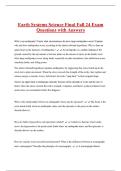
Earth Systems Science Final Fall 24 Exam Questions with Answers What is an earthquake? Under what circumstances do most large earthquakes occur? Explain why and how earthquakes occur, according to the elastic rebound hypothesis. Why is there an upper limit on the intensity of earthquakes? An earthquake is a sudden shaking of the ground, caused by the movement of tectonic plates or the release of stress in the Earth's crust. Most large earthquakes occur along faults, especially at plate boundaries, like subduction zones, transform faults, and rifting zones. The elastic rebound hypothesis explains earthquakes by suggesting that stress builds up in the crust due to plate movement. When the stress exceeds the strength of the rocks, they rupture and release energy as seismic waves. Afterward, the rocks "snap back" to their original shape. There's an upper limit to earthquake intensity because of the strength of rocks and the size of faults. Once the stress exceeds the rock's strength, it ruptures, and there's a physical limit to how much stress can accumulate before this happens.
Información del documento
- Subido en
- 8 de noviembre de 2025
- Número de páginas
- 28
- Escrito en
- 2025/2026
- Tipo
- Examen
- Contiene
- Preguntas y respuestas

