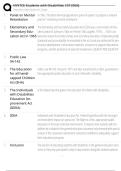
NYSTCE Students with Disabilities CST [060].
Study online at https://quizlet.com/_53spqw
1. Panel on Mental In 1961, President Kennedy appointed a panel of experts to prepare a national
Retardation plan for "combating mental retardation."
2. Elementary and The Elementary and Secondary Education Act (ESEA) was a cornerstone of Pres-
Secondary Edu- ident Lyndon B. Johnson's "War on Poverty" (McLaughlin, 1975). ... ESEA is an
cation Act in 1965 extensive statute that funds primary and secondary education, emphasizing high
standards and accountability. As mandated in the act, funds are authorized for pro-
fessional development, instructional materials, resources to support educational
programs, and the promotion of parental involvement. (QUALITY AND EQUALITY)
3. Public Law
94-143
4. The Education Public Law 94-143. Passed in 1975 and later reauthorized as IDEA. guaranteed a
for all handi- free appropriate public education to each child with a disability.
capped Children
Act (EHA)
5. The Individuals is the federal law that govern the education of children with disabilities.
with Disabilities
Education Im-
provement Act
(IDEIA)
6. IDEA Individuals with Disabilities Education Act. Federal legislation with the strongest
and most direct impact on special ed. The Right to a free, appropriate public
education in the least restrictive environment. It requires that students with dis-
abilities be included in the general education classroom only removed with special
services if the classroom environment cannot be modified to adequately support
their educational progress.
7. Inclusion The practice of educating students with disabilities in the general education class-
room so they may participate in day-to-day routines alongside students without
, NYSTCE Students with Disabilities CST [060].
Study online at https://quizlet.com/_53spqw
disabilities. Inclusion treats the general education classroom as the student's
primary placement. (LRE and FAPE)
8. Mainstreaming students with disabilities were included in the general education classroom only
when their achievement would be near grade level without substantial support.
9. Child find Through IDEA, the federal government provides states with funding for special ed
but in return the states must comply pertain to children from birth to 21. States
must conduct child find activities to identify and evaluate children who may have
disabilities. Students who may have a disability must be evaluated, at no cost to the
parents, for their eligibility for special service. Parents must be in involved in the
evaluation process. Either parents or a school professional (teacher) may request
an evaluation, but parental consent is required before evaluation can take place.
10. Free Appropriate students with disabilities are entitled to the same types of educational experiences
Public Education as their peers without disabilities. Schools must provide each child with a disability
(FAPE) part of an education experience that is appropriate to his or her age and abilities at no
IDEA cost to the parents.
11. LRE Least Restric- Students with disabilities are to be educated in the least restrictive environment,
tive Environment meaning that their educational experiences must be as similar as possible to those
of children who do not have a disability. The goal of LRE is for students with
disabilities to remain in the general education classroom to the greatest extent
possible, with the fewest possible changes to day-to- day routines, and to be
removed from regular classes and provided with special services only when the
severity of their disability requires doing so in order for them to be educated
appropriately.
12. Continuum of allows these students to participate to the greatest extent possible.
service
13. IEP individualized Between the ages of 3 and 21, each student with a disability must have an IEP. It
Education Plan describes the child's present level of progress and learning capacity, the short-
Study online at https://quizlet.com/_53spqw
1. Panel on Mental In 1961, President Kennedy appointed a panel of experts to prepare a national
Retardation plan for "combating mental retardation."
2. Elementary and The Elementary and Secondary Education Act (ESEA) was a cornerstone of Pres-
Secondary Edu- ident Lyndon B. Johnson's "War on Poverty" (McLaughlin, 1975). ... ESEA is an
cation Act in 1965 extensive statute that funds primary and secondary education, emphasizing high
standards and accountability. As mandated in the act, funds are authorized for pro-
fessional development, instructional materials, resources to support educational
programs, and the promotion of parental involvement. (QUALITY AND EQUALITY)
3. Public Law
94-143
4. The Education Public Law 94-143. Passed in 1975 and later reauthorized as IDEA. guaranteed a
for all handi- free appropriate public education to each child with a disability.
capped Children
Act (EHA)
5. The Individuals is the federal law that govern the education of children with disabilities.
with Disabilities
Education Im-
provement Act
(IDEIA)
6. IDEA Individuals with Disabilities Education Act. Federal legislation with the strongest
and most direct impact on special ed. The Right to a free, appropriate public
education in the least restrictive environment. It requires that students with dis-
abilities be included in the general education classroom only removed with special
services if the classroom environment cannot be modified to adequately support
their educational progress.
7. Inclusion The practice of educating students with disabilities in the general education class-
room so they may participate in day-to-day routines alongside students without
, NYSTCE Students with Disabilities CST [060].
Study online at https://quizlet.com/_53spqw
disabilities. Inclusion treats the general education classroom as the student's
primary placement. (LRE and FAPE)
8. Mainstreaming students with disabilities were included in the general education classroom only
when their achievement would be near grade level without substantial support.
9. Child find Through IDEA, the federal government provides states with funding for special ed
but in return the states must comply pertain to children from birth to 21. States
must conduct child find activities to identify and evaluate children who may have
disabilities. Students who may have a disability must be evaluated, at no cost to the
parents, for their eligibility for special service. Parents must be in involved in the
evaluation process. Either parents or a school professional (teacher) may request
an evaluation, but parental consent is required before evaluation can take place.
10. Free Appropriate students with disabilities are entitled to the same types of educational experiences
Public Education as their peers without disabilities. Schools must provide each child with a disability
(FAPE) part of an education experience that is appropriate to his or her age and abilities at no
IDEA cost to the parents.
11. LRE Least Restric- Students with disabilities are to be educated in the least restrictive environment,
tive Environment meaning that their educational experiences must be as similar as possible to those
of children who do not have a disability. The goal of LRE is for students with
disabilities to remain in the general education classroom to the greatest extent
possible, with the fewest possible changes to day-to- day routines, and to be
removed from regular classes and provided with special services only when the
severity of their disability requires doing so in order for them to be educated
appropriately.
12. Continuum of allows these students to participate to the greatest extent possible.
service
13. IEP individualized Between the ages of 3 and 21, each student with a disability must have an IEP. It
Education Plan describes the child's present level of progress and learning capacity, the short-