Yoder-Wise's Leading and Managing in Canadian Nursing 3rd Edition Yoder-
vb vb vb vb vb vb vb vb vb
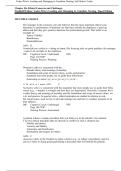
Chapter 06: Ethical Concerns and Challenges
Waddell/Walton: Yoder-Wise’s Leading and Managing in Canadian Nursing, Third Edition
MULTIPLE CHOICE
The manager in the coronary care unit believes that the most important ethical cons
iderations in performance evaluations are that they include the employee‘s good qu
alities and that they give positive direction for professional growth. This belief is an
example of:
Justice. Fidelity.
Beneficence.
Nonmaleficence.
ANS: D
Nonmaleficence refers to ―doing no harm.‖ By focusing only on good qualities, the manager
s eeks to do no harm to the employee.
DIF: Cognitive Level: Understand REF:
Page 110 TOP:
Nursing Process: Planning
Normative ethics is concerned with the:
Broader theory and meaning of morality.
Foundation and scope of moral values, words, and practice.
Standards that most people use to guide their behaviours.
Relationship of ethical NprUinRciSplIesNtGoTreBal.-
l iCfeOmMo r a l issues. ANS: C
Normative ethics is concerned with the standards that most people use to guide their beha
viours (e.g., ―murder is wrong‖) and how they are determined. Metaethics concerns the b
r oader theory and meaning of morality and the foundation and scope of moral values, wo
r ds, and practice. In applied ethics, ethical principles are studied in relation to real-
life moral issues, such as how to provide nursing care and how to conduct research on hu
man subjects.
DIF: Cognitive Level: Understand REF:
Page 104 TOP:
Nursing Process: Assessment
A patient refuses a simple procedure that you believe is in the patient‘s best interest.
T he two ethical principles that are directly in conflict in such a situation are:
Fidelity and justice.
Veracity and fidelity.
Autonomy and beneficence.
Paternalism and respect for others.
ANS: C
Autonomy refers to the freedom to make a choice (e.g., to refuse a procedure), and ben
eficence refers to doing good (performing a procedure that will benefit the patient).
,Yoder-Wise's Leading and Managing in Canadian Nursing 3rd Edition Yoder-
vb vb vb vb vb vb vb vb vb
DIF: Cognitive Level: Analyze REF:
Page 107 TOP:
Nursing Process: Assessment
Three gravely ill patients are candidates for the only available bed in the intensive care u
nit. As the supervisor, you assign the bed to the patient with the best chance of recovery.
This decision reflects which of the following ethical principles?
Beneficence.
Autonomy.
Veracity.
Nonmaleficence.
ANS: A
Beneficence refers to doing what is good for the patient; in this situation, doing what is goo
d means providing care to the patient with the best likelihood of recovery.
DIF: Cognitive Level: Analyze REF:
Page 109 TOP:
Nursing Process: Implementation
Which ethical principle is primarily involved in informed consent?
Veracity.
Autonomy.
Beneficence.
Nonmaleficence.
ANS: B
Autonomy refers to the right to choose freely, which is inherent in informed consent.
DIF:
NURSINGTB.COM
Cognitive Level: Understand REF: Page 107
TOP: Nursing Process: Assessment
Which of the following is a key area of ethical nursing practice?
Nursing process.
Therapeutic relationship.
Decision-making model.
Embodied knowledge.
ANS: B
A key area of ethical nursing practice is the therapeutic relationship between the nurse a
n d the patient.
DIF: Cognitive Level: Understand REF:
Page 104 TOP:
Nursing Process: Assessment
Which question reflects the essence of relational ethics?
―What can I do to maintain my professional practice?‖
―What should I do for others?‖
―What techniques can I use to empower my colleagues?‖
―What ethical decision-
making model will work best for me?‖ ANS: B
, Yoder-Wise's Leading and Managing in Canadian Nursing 3rd Edition Yoder-
vb vb vb vb vb vb vb vb vb
Relational ethics involves asking not only ―What should I do?‖ but also ―What should
I d o for others?”
DIF: Cognitive Level: Apply REF:
Page 104 TOP:
Nursing Process: Planning
The nurse manager organizes interprofessional team meetings on a weekly basis. This act
i on is demonstrating which aspect of relational ethics?
Embodied knowledge.
Interdependent environment.
Engaged interactions.
Mutual respect.
ANS: D
Nurse managers show respect for students, nurses, and the health care team by facilitating
interprofessional team meetings to discuss and plan patient care. Team meetings provide a
n opportunity to value everyone‘s contributions and foster mutual respect, which is a criti
cal aspect of effective teamwork.
DIF: Cognitive Level: Apply REF: Pages 104-
105 TOP:
Nursing Process: Implementation
9.
According to relational ethics, what is critical in the development and maintena
nce of t he roles and actions of the nurse manager?
a. Time management skills.
b. Professional relationships.
c. Understanding of biomNedicRal eIthiHcGs.H HH B.CM
vb v b
UvbSvbNvbT O
d. Comprehension of the Quebec Nurses Association‘s Code of Ethics for nursing.
ANS: B
A relational ethics perspective can help nurse leaders realize that relationships are critical
i n the development and maintenance of the nurse managers‘ and leaders‘ roles and action
s.
DIF: Cognitive Level: Understand REF:
Page 104 TOP:
Nursing Process: Assessment
Which of the following is a criticism of the principle of autonomy?
It is not culturally sensitive.
It can lead to focus on the needs of one person at the expense of the needs
of others.
It is not applicable with entire groups.
It can be viewed as advancing professional directives rather than patient desires.
ANS: B
One criticism of the principle of autonomy is that it can lead to a focus on the rights
or needs of one individual at the expense of the rights or needs of others (including
entire groups).
Nursing Process: Assessment
DIF: Cognitive Level: Understand
Page 108 TOP:
vb vb vb vb vb vb vb vb vb
Chapter 06: Ethical Concerns and Challenges
Waddell/Walton: Yoder-Wise’s Leading and Managing in Canadian Nursing, Third Edition
MULTIPLE CHOICE
The manager in the coronary care unit believes that the most important ethical cons
iderations in performance evaluations are that they include the employee‘s good qu
alities and that they give positive direction for professional growth. This belief is an
example of:
Justice. Fidelity.
Beneficence.
Nonmaleficence.
ANS: D
Nonmaleficence refers to ―doing no harm.‖ By focusing only on good qualities, the manager
s eeks to do no harm to the employee.
DIF: Cognitive Level: Understand REF:
Page 110 TOP:
Nursing Process: Planning
Normative ethics is concerned with the:
Broader theory and meaning of morality.
Foundation and scope of moral values, words, and practice.
Standards that most people use to guide their behaviours.
Relationship of ethical NprUinRciSplIesNtGoTreBal.-
l iCfeOmMo r a l issues. ANS: C
Normative ethics is concerned with the standards that most people use to guide their beha
viours (e.g., ―murder is wrong‖) and how they are determined. Metaethics concerns the b
r oader theory and meaning of morality and the foundation and scope of moral values, wo
r ds, and practice. In applied ethics, ethical principles are studied in relation to real-
life moral issues, such as how to provide nursing care and how to conduct research on hu
man subjects.
DIF: Cognitive Level: Understand REF:
Page 104 TOP:
Nursing Process: Assessment
A patient refuses a simple procedure that you believe is in the patient‘s best interest.
T he two ethical principles that are directly in conflict in such a situation are:
Fidelity and justice.
Veracity and fidelity.
Autonomy and beneficence.
Paternalism and respect for others.
ANS: C
Autonomy refers to the freedom to make a choice (e.g., to refuse a procedure), and ben
eficence refers to doing good (performing a procedure that will benefit the patient).
,Yoder-Wise's Leading and Managing in Canadian Nursing 3rd Edition Yoder-
vb vb vb vb vb vb vb vb vb
DIF: Cognitive Level: Analyze REF:
Page 107 TOP:
Nursing Process: Assessment
Three gravely ill patients are candidates for the only available bed in the intensive care u
nit. As the supervisor, you assign the bed to the patient with the best chance of recovery.
This decision reflects which of the following ethical principles?
Beneficence.
Autonomy.
Veracity.
Nonmaleficence.
ANS: A
Beneficence refers to doing what is good for the patient; in this situation, doing what is goo
d means providing care to the patient with the best likelihood of recovery.
DIF: Cognitive Level: Analyze REF:
Page 109 TOP:
Nursing Process: Implementation
Which ethical principle is primarily involved in informed consent?
Veracity.
Autonomy.
Beneficence.
Nonmaleficence.
ANS: B
Autonomy refers to the right to choose freely, which is inherent in informed consent.
DIF:
NURSINGTB.COM
Cognitive Level: Understand REF: Page 107
TOP: Nursing Process: Assessment
Which of the following is a key area of ethical nursing practice?
Nursing process.
Therapeutic relationship.
Decision-making model.
Embodied knowledge.
ANS: B
A key area of ethical nursing practice is the therapeutic relationship between the nurse a
n d the patient.
DIF: Cognitive Level: Understand REF:
Page 104 TOP:
Nursing Process: Assessment
Which question reflects the essence of relational ethics?
―What can I do to maintain my professional practice?‖
―What should I do for others?‖
―What techniques can I use to empower my colleagues?‖
―What ethical decision-
making model will work best for me?‖ ANS: B
, Yoder-Wise's Leading and Managing in Canadian Nursing 3rd Edition Yoder-
vb vb vb vb vb vb vb vb vb
Relational ethics involves asking not only ―What should I do?‖ but also ―What should
I d o for others?”
DIF: Cognitive Level: Apply REF:
Page 104 TOP:
Nursing Process: Planning
The nurse manager organizes interprofessional team meetings on a weekly basis. This act
i on is demonstrating which aspect of relational ethics?
Embodied knowledge.
Interdependent environment.
Engaged interactions.
Mutual respect.
ANS: D
Nurse managers show respect for students, nurses, and the health care team by facilitating
interprofessional team meetings to discuss and plan patient care. Team meetings provide a
n opportunity to value everyone‘s contributions and foster mutual respect, which is a criti
cal aspect of effective teamwork.
DIF: Cognitive Level: Apply REF: Pages 104-
105 TOP:
Nursing Process: Implementation
9.
According to relational ethics, what is critical in the development and maintena
nce of t he roles and actions of the nurse manager?
a. Time management skills.
b. Professional relationships.
c. Understanding of biomNedicRal eIthiHcGs.H HH B.CM
vb v b
UvbSvbNvbT O
d. Comprehension of the Quebec Nurses Association‘s Code of Ethics for nursing.
ANS: B
A relational ethics perspective can help nurse leaders realize that relationships are critical
i n the development and maintenance of the nurse managers‘ and leaders‘ roles and action
s.
DIF: Cognitive Level: Understand REF:
Page 104 TOP:
Nursing Process: Assessment
Which of the following is a criticism of the principle of autonomy?
It is not culturally sensitive.
It can lead to focus on the needs of one person at the expense of the needs
of others.
It is not applicable with entire groups.
It can be viewed as advancing professional directives rather than patient desires.
ANS: B
One criticism of the principle of autonomy is that it can lead to a focus on the rights
or needs of one individual at the expense of the rights or needs of others (including
entire groups).
Nursing Process: Assessment
DIF: Cognitive Level: Understand
Page 108 TOP: