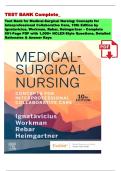
TEST BANK Complete_
Test Bank for Medical-Surgical Nursing: Concepts for
Interprofessional Collaborative Care, 10th Edition by
Ignatavicius, Workman, Rebar, Heimgartner – Complete
591-Page PDF with 1,000+ NCLEX-Style Questions, Detailed
Rationales & Answer Keys
,Chapter 01: Overview of Professional Nursing Concepts for Medical-Surgical Nursing
Ignatavicius: Medical-Surgical Nursing, 10th Edition
MULTIPLE CHOICE
1. A new nurse is working with a preceptor on a medical-surgical unit. The preceptor advises the
new nurse that which is the priority when working as a professional nurse?
a. Attending to holistic client needs
b. Ensuring client safety
c. Not making medication errors
d. Providing client-focused care
ANS: B
All actions are appropriate for the professional nurse. However, ensuring client safety is the
priority. Health care errors have been widely reported for 25 years, many of which result in
client injury, death, and increased health care costs. There are several national and
international organizations that have either recommended or mandated safety initiatives.
Every nurse has the responsibility to guard the client’s safety. The other actions are important
for quality nursing, but they are not as vital as providing safety. Not making medication errors
does provide safety, but is too narrow in scope to be the best answer.
DIF: Understanding TOP: Integrated Process: Nursing Process: Intervention
KEY: Client safety
MSC: Client Needs Category: Safe and Effective Care Environment: Safety and Infection Control
2. A nurse is orienting a new client and family to the medical-surgical unit. What information
does the nurse provide to best help the client promote his or her own safety?
a. Encourage the client and family to be active partners.
b. Have the client monitor hand hygiene in caregivers.
c. Offer the family the opportunity to stay with the client.
d. Tell the client to always wear his or her armband.
ANS: A
Each action could be important for the client or family to perform. However, encouraging the
client to be active in his or her health care as a safety partner is the most critical. The other
actions are very limited in scope and do not provide the broad protection that being active and
involved does.
DIF: Understanding TOP: Integrated Process: Teaching/Learning
KEY: Client safety
MSC: Client Needs Category: Safe and Effective Care Environment: Safety and Infection Control
3. A nurse is caring for a postoperative client on the surgical unit. The client’s blood pressure
was 142/76 mm Hg 30 minutes ago, and now is 88/50 mm Hg. What action would the nurse
take first?
a. Call the Rapid Response Team.
b. Document and continue to monitor.
c. Notify the primary health care provider.
d. Repeat the blood pressure in 15 minutes.
, ANS: A
The purpose of the Rapid Response Team (RRT) is to intervene when clients are deteriorating
before they suffer either respiratory or cardiac arrest. Since the client has manifested a
significant change, the nurse would call the RRT. Changes in blood pressure, mental status,
heart rate, temperature, oxygen saturation, and last 2 hours’ urine output are particularly
significant and are part of the Modified Early Warning System guide. Documentation is vital,
but the nurse must do more than document. The primary health care provider would be
notified, but this is not more important than calling the RRT. The client’s blood pressure
would be reassessed frequently, but the priority is getting the rapid care to the client.
DIF: Applying TOP: Integrated Process: Communication and Documentation
KEY: Rapid Response Team (RRT), Clinical judgment
MSC: Client Needs Category: Physiological Integrity: Physiological Adaptation
4. A nurse wishes to provide client-centered care in all interactions. Which action by the nurse
best demonstrates this concept?
a. Assesses for cultural influences affecting health care.
b. Ensures that all the client’s basic needs are met.
c. Tells the client and family about all upcoming tests.
d. Thoroughly orients the client and family to the room.
ANS: A
Showing respect for the client and family’s preferences and needs is essential to ensure a
holistic or “whole-person” approach to care. By assessing the effect of the client’s culture on
health care, this nurse is practicing client-focused care. Providing for basic needs does not
demonstrate this competence. Simply telling the client about all upcoming tests is not
providing empowering education. Orienting the client and family to the room is an important
safety measure, but not directly related to demonstrating client-centered care.
DIF: Understanding TOP: Integrated Process: Culture and Spirituality
KEY: Client-centered care, Culture MSC: Client Needs Category: Psychosocial Integrity
5. A client is going to be admitted for a scheduled surgical procedure. Which action does the
nurse explain is the most important thing the client can do to protect against errors?
a. Bring a list of all medications and what they are for.
b. Keep the provider’s phone number by the telephone.
c. Make sure that all providers wash hands before entering the room.
d. Write down the name of each caregiver who comes in the room.
ANS: A
Medication reconciliation is a formal process in which the client’s actual current medications
are compared to the prescribed medications at the time of admission, transfer, or discharge.
This National client Safety Goal is important to reduce medication errors. The client would
not have to be responsible for providers washing their hands, and even if the client does so,
this is too narrow to be the most important action to prevent errors. Keeping the provider’s
phone number nearby and documenting everyone who enters the room also do not guarantee
safety.
DIF: Applying TOP: Integrated Process: Teaching/Learning
KEY: Client safety, Informatics
MSC: Client Needs Category: Safe and Effective Care Environment: Safety and Infection Control
, 6. Which action by the nurse working with a client best demonstrates respect for autonomy?
a. Asks if the client has questions before signing a consent.
b. Gives the client accurate information when questioned.
c. Keeps the promises made to the client and family.
d. Treats the client fairly compared to other clients.
ANS: A
Autonomy is self-determination. The client would make decisions regarding care. When the
nurse obtains a signature on the consent form, assessing if the client still has questions is vital,
because without full information the client cannot practice autonomy. Giving accurate
information is practicing with veracity. Keeping promises is upholding fidelity. Treating the
client fairly is providing social justice.
DIF: Applying TOP: Integrated Process: Caring KEY: Ethics, Autonomy
MSC: Client Needs Category: Safe and Effective Care Environment: Management of Care
7. A nurse asks a more seasoned colleague to explain best practices when communicating with a
person from the lesbian, gay, bisexual, transgender, and questioning/queer (LGBTQ)
community. What answer by the faculty is most accurate?
a. Avoid embarrassing the client by asking questions.
b. Don’t make assumptions about his or her health needs.
c. Most LGBTQ people do not want to share information.
d. No differences exist in communicating with this population.
ANS: B
Many members of the LGBTQ community have faced discrimination from health care
providers and may be reluctant to seek health care. The nurse would never make assumptions
about the needs of members of this population. Rather, respectful questions are appropriate. If
approached with sensitivity, the client with any health care need is more likely to answer
honestly.
DIF: Understanding TOP: Integrated Process: Teaching/Learning
KEY: Health care disparities, LGBTQ MSC: Client Needs Category: Psychosocial Integrity
8. A nurse is calling the on-call health care provider about a client who had a hysterectomy 2
days ago and has pain that is unrelieved by the prescribed opioid pain medication. Which
statement comprises the background portion of the SBAR format for communication?
a. “I would like you to order a different pain medication.”
b. “This client has allergies to morphine and codeine.”
c. “Dr. Smith doesn’t like nonsteroidal anti-inflammatory meds.”
d. “This client had a vaginal hysterectomy 2 days ago.”
ANS: B
Test Bank for Medical-Surgical Nursing: Concepts for
Interprofessional Collaborative Care, 10th Edition by
Ignatavicius, Workman, Rebar, Heimgartner – Complete
591-Page PDF with 1,000+ NCLEX-Style Questions, Detailed
Rationales & Answer Keys
,Chapter 01: Overview of Professional Nursing Concepts for Medical-Surgical Nursing
Ignatavicius: Medical-Surgical Nursing, 10th Edition
MULTIPLE CHOICE
1. A new nurse is working with a preceptor on a medical-surgical unit. The preceptor advises the
new nurse that which is the priority when working as a professional nurse?
a. Attending to holistic client needs
b. Ensuring client safety
c. Not making medication errors
d. Providing client-focused care
ANS: B
All actions are appropriate for the professional nurse. However, ensuring client safety is the
priority. Health care errors have been widely reported for 25 years, many of which result in
client injury, death, and increased health care costs. There are several national and
international organizations that have either recommended or mandated safety initiatives.
Every nurse has the responsibility to guard the client’s safety. The other actions are important
for quality nursing, but they are not as vital as providing safety. Not making medication errors
does provide safety, but is too narrow in scope to be the best answer.
DIF: Understanding TOP: Integrated Process: Nursing Process: Intervention
KEY: Client safety
MSC: Client Needs Category: Safe and Effective Care Environment: Safety and Infection Control
2. A nurse is orienting a new client and family to the medical-surgical unit. What information
does the nurse provide to best help the client promote his or her own safety?
a. Encourage the client and family to be active partners.
b. Have the client monitor hand hygiene in caregivers.
c. Offer the family the opportunity to stay with the client.
d. Tell the client to always wear his or her armband.
ANS: A
Each action could be important for the client or family to perform. However, encouraging the
client to be active in his or her health care as a safety partner is the most critical. The other
actions are very limited in scope and do not provide the broad protection that being active and
involved does.
DIF: Understanding TOP: Integrated Process: Teaching/Learning
KEY: Client safety
MSC: Client Needs Category: Safe and Effective Care Environment: Safety and Infection Control
3. A nurse is caring for a postoperative client on the surgical unit. The client’s blood pressure
was 142/76 mm Hg 30 minutes ago, and now is 88/50 mm Hg. What action would the nurse
take first?
a. Call the Rapid Response Team.
b. Document and continue to monitor.
c. Notify the primary health care provider.
d. Repeat the blood pressure in 15 minutes.
, ANS: A
The purpose of the Rapid Response Team (RRT) is to intervene when clients are deteriorating
before they suffer either respiratory or cardiac arrest. Since the client has manifested a
significant change, the nurse would call the RRT. Changes in blood pressure, mental status,
heart rate, temperature, oxygen saturation, and last 2 hours’ urine output are particularly
significant and are part of the Modified Early Warning System guide. Documentation is vital,
but the nurse must do more than document. The primary health care provider would be
notified, but this is not more important than calling the RRT. The client’s blood pressure
would be reassessed frequently, but the priority is getting the rapid care to the client.
DIF: Applying TOP: Integrated Process: Communication and Documentation
KEY: Rapid Response Team (RRT), Clinical judgment
MSC: Client Needs Category: Physiological Integrity: Physiological Adaptation
4. A nurse wishes to provide client-centered care in all interactions. Which action by the nurse
best demonstrates this concept?
a. Assesses for cultural influences affecting health care.
b. Ensures that all the client’s basic needs are met.
c. Tells the client and family about all upcoming tests.
d. Thoroughly orients the client and family to the room.
ANS: A
Showing respect for the client and family’s preferences and needs is essential to ensure a
holistic or “whole-person” approach to care. By assessing the effect of the client’s culture on
health care, this nurse is practicing client-focused care. Providing for basic needs does not
demonstrate this competence. Simply telling the client about all upcoming tests is not
providing empowering education. Orienting the client and family to the room is an important
safety measure, but not directly related to demonstrating client-centered care.
DIF: Understanding TOP: Integrated Process: Culture and Spirituality
KEY: Client-centered care, Culture MSC: Client Needs Category: Psychosocial Integrity
5. A client is going to be admitted for a scheduled surgical procedure. Which action does the
nurse explain is the most important thing the client can do to protect against errors?
a. Bring a list of all medications and what they are for.
b. Keep the provider’s phone number by the telephone.
c. Make sure that all providers wash hands before entering the room.
d. Write down the name of each caregiver who comes in the room.
ANS: A
Medication reconciliation is a formal process in which the client’s actual current medications
are compared to the prescribed medications at the time of admission, transfer, or discharge.
This National client Safety Goal is important to reduce medication errors. The client would
not have to be responsible for providers washing their hands, and even if the client does so,
this is too narrow to be the most important action to prevent errors. Keeping the provider’s
phone number nearby and documenting everyone who enters the room also do not guarantee
safety.
DIF: Applying TOP: Integrated Process: Teaching/Learning
KEY: Client safety, Informatics
MSC: Client Needs Category: Safe and Effective Care Environment: Safety and Infection Control
, 6. Which action by the nurse working with a client best demonstrates respect for autonomy?
a. Asks if the client has questions before signing a consent.
b. Gives the client accurate information when questioned.
c. Keeps the promises made to the client and family.
d. Treats the client fairly compared to other clients.
ANS: A
Autonomy is self-determination. The client would make decisions regarding care. When the
nurse obtains a signature on the consent form, assessing if the client still has questions is vital,
because without full information the client cannot practice autonomy. Giving accurate
information is practicing with veracity. Keeping promises is upholding fidelity. Treating the
client fairly is providing social justice.
DIF: Applying TOP: Integrated Process: Caring KEY: Ethics, Autonomy
MSC: Client Needs Category: Safe and Effective Care Environment: Management of Care
7. A nurse asks a more seasoned colleague to explain best practices when communicating with a
person from the lesbian, gay, bisexual, transgender, and questioning/queer (LGBTQ)
community. What answer by the faculty is most accurate?
a. Avoid embarrassing the client by asking questions.
b. Don’t make assumptions about his or her health needs.
c. Most LGBTQ people do not want to share information.
d. No differences exist in communicating with this population.
ANS: B
Many members of the LGBTQ community have faced discrimination from health care
providers and may be reluctant to seek health care. The nurse would never make assumptions
about the needs of members of this population. Rather, respectful questions are appropriate. If
approached with sensitivity, the client with any health care need is more likely to answer
honestly.
DIF: Understanding TOP: Integrated Process: Teaching/Learning
KEY: Health care disparities, LGBTQ MSC: Client Needs Category: Psychosocial Integrity
8. A nurse is calling the on-call health care provider about a client who had a hysterectomy 2
days ago and has pain that is unrelieved by the prescribed opioid pain medication. Which
statement comprises the background portion of the SBAR format for communication?
a. “I would like you to order a different pain medication.”
b. “This client has allergies to morphine and codeine.”
c. “Dr. Smith doesn’t like nonsteroidal anti-inflammatory meds.”
d. “This client had a vaginal hysterectomy 2 days ago.”
ANS: B