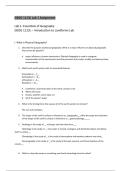
GEOG 1113L Lab 1 Assignment
Lab 1: Essentials of Geography
GEOG 1113L – Introduction to Landforms Lab
I. What is Physical Geography?
1. Describe the purpose of physical geography. What is a major influence on physical geography
that cannot be ignored?
A major influence is human interactions. Physical Geography is used to recognize
characteristics of the environment and the processes that create, modify, and destroy those
environments
2. Match each earth system with its associated features.
Atmosphere = _С__
Hydrosphere = _B__
Lithosphere = _A__
Biosphere = _B__
A Continents, outermost layer of the earth, oceanic crust
B Where life exists
C Clouds, weather, ozone layer, air
D All of the planet’s water
3. What is the driving force that causes all of the earth systems to interact?
The sun and insolation.
4. The shape of the earth’s surface is referred to as _topography__ while the origin and evolution
of the shape of the earth’s surface is referred to as _ geomorphology_____.
5. Pedology is the study of __ soil types and how they form___.
Hydrology is the study of __ how water is moved, managed, and distributed above and below
Earth's surface__.
Climatology is the study of _ is the study of atmosphere and weather patterns over time_.
Oceanography is the study of _ is the study of the past, present, and future features of the
oceans__.
6. What is a key take-away or something you found interesting from the video?
, 7. It's estimated that thousands of cubic kilometers of ocean waters flow through the Great Barrier
Reef
II. Mapping Basics: Scale
Answer the questions that pertain to each map.
Map A
1. What is the relative scale size of Map A?
A. Large scale
B. Medium scale
C. Small scale
2. If each box on the scale bar for Map A represents a centimeter, how many centimeters are equal
to 100 kilometers?
1 centimeter
3. Using the verbal scale you determined in the last question, what is the representative fraction
for Map A?
1:10,000,000
Lab 1: Essentials of Geography
GEOG 1113L – Introduction to Landforms Lab
I. What is Physical Geography?
1. Describe the purpose of physical geography. What is a major influence on physical geography
that cannot be ignored?
A major influence is human interactions. Physical Geography is used to recognize
characteristics of the environment and the processes that create, modify, and destroy those
environments
2. Match each earth system with its associated features.
Atmosphere = _С__
Hydrosphere = _B__
Lithosphere = _A__
Biosphere = _B__
A Continents, outermost layer of the earth, oceanic crust
B Where life exists
C Clouds, weather, ozone layer, air
D All of the planet’s water
3. What is the driving force that causes all of the earth systems to interact?
The sun and insolation.
4. The shape of the earth’s surface is referred to as _topography__ while the origin and evolution
of the shape of the earth’s surface is referred to as _ geomorphology_____.
5. Pedology is the study of __ soil types and how they form___.
Hydrology is the study of __ how water is moved, managed, and distributed above and below
Earth's surface__.
Climatology is the study of _ is the study of atmosphere and weather patterns over time_.
Oceanography is the study of _ is the study of the past, present, and future features of the
oceans__.
6. What is a key take-away or something you found interesting from the video?
, 7. It's estimated that thousands of cubic kilometers of ocean waters flow through the Great Barrier
Reef
II. Mapping Basics: Scale
Answer the questions that pertain to each map.
Map A
1. What is the relative scale size of Map A?
A. Large scale
B. Medium scale
C. Small scale
2. If each box on the scale bar for Map A represents a centimeter, how many centimeters are equal
to 100 kilometers?
1 centimeter
3. Using the verbal scale you determined in the last question, what is the representative fraction
for Map A?
1:10,000,000