This OpenStax ancillary resource is © Rice University under a CC BY 4.0 International license; it may be reproduced or modified but
must be attributed to OpenStax, Rice University and any changes must be noted.
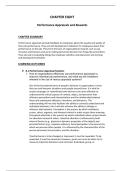
CHAPTER EIGHT
Performance Appraisals and Rewards
CHAPTER SUMMARY
Performance appraisals provide feedback to employees about the quality and quality of
their job performance. They are self-development indicators for employees about their
performance on the job. They form the basis of organizational rewards such as pay
increases and bonuses and aid in making personnel decisions for things like promotions.
They also aid in evaluating things like employee selection and placement and training
and development activities.
LEARNING OUTCOMES
8.1 Performance Appraisal Systems
1. How do organizations effectively use performance appraisals to
improve individual job performance, and what are the limitations
inherent in the use of various appraisal systems?
One of the key determinants of people’s behavior in organizations is how
they see and interpret situations and people around them. It is vital for
anyone (manager or subordinate) who desires to be more effective to
understand the critical aspects of context, object, and perceiver that
influence perceptions and interpretations and the relationship between
these and subsequent attitudes, intentions, and behaviors. This
understanding will not only facilitate the ability to correctly understand and
anticipate behaviors, but it will also enhance the ability to change or
influence that behavior. Perception is the process by which individuals
screen, select, organize, and interpret stimuli in order to give them meaning.
Perceptual selectivity is the process by which individuals select certain stimuli
for attention instead of others. Selective attention is influenced by both
external factors (e.g., physical or dynamic properties of the object) and
personal factors (e.g., response salience). Social perception is the process by
which we perceive other people. It is influenced by the characteristics of the
person perceived, the perceiver, and the situation.
If performance is to be changed or improved, it must be rewarded. To be
rewarded, it must be measured. However, great care must be taken to (1)
measure important behaviors and outcomes (individual, group, or
, Organizational Behavior
organizational) and not just those that are easy to measure, (2) measure
them with the appropriate technique(s), and (3) tie appropriate rewards to
the desired behaviors and outcomes. Organizations use performance
appraisals for several reasons: (1) to provide feedback to employees, (2) to
allow for employee self-development, (3) to allocate rewards, (4) to gather
information for personnel decisions, and (5) to guide them in developing
training and development efforts.
8.2 Techniques of Performance Appraisal
2. What practices are used in the performance appraisal process?
Performance appraisals are subject to several problems, including central
tendency error, strictness or leniency error, halo effect, recency error, and
personal biases.
8.3 Feedback
3. How do managers give effective feedback to subordinates?
Among the most common appraisal systems are graphic rating scales, critical
incident technique, behaviorally anchored rating scales, behavioral
observation scales, management by objectives, and assessment centers.
Assessment centers represent a special case of evaluations in that they focus
on assessing an employee’s long-term potential to an organization.
8.4 Reward Systems in Organizations
4. How do organizations choose the best appraisal system for their
organization?
Rewards serve several functions, including (1) stimulating job effort and
performance, (2) reducing absenteeism and turnover, (3) enhancing
employee commitment, (4) facilitating job satisfaction, and (5) facilitating
occupational and organizational choice. Rewards may be distributed on the
basis of power, equality, need, or distributive justice. Distributive justice rests
on the principle of allocating rewards in proportion to employee
contribution. Intrinsic rewards represent those outcomes that are
administered by the employee (e.g., a sense of task accomplishment),
whereas extrinsic rewards are administered by others (e.g., wages). Gain-
sharing incentive plans base some of the employees’ pay on corporate profits
or productivity. As a result, employees are generally more interested in
facilitating corporate performance.
Skills-based incentives reward employees on the basis of the skills they
possess, not the skills they are allowed to use at work. As a result, employees
are encouraged to continually upgrade their skill levels. A lump-sum salary
May 21, 2019 2
must be attributed to OpenStax, Rice University and any changes must be noted.
CHAPTER EIGHT
Performance Appraisals and Rewards
CHAPTER SUMMARY
Performance appraisals provide feedback to employees about the quality and quality of
their job performance. They are self-development indicators for employees about their
performance on the job. They form the basis of organizational rewards such as pay
increases and bonuses and aid in making personnel decisions for things like promotions.
They also aid in evaluating things like employee selection and placement and training
and development activities.
LEARNING OUTCOMES
8.1 Performance Appraisal Systems
1. How do organizations effectively use performance appraisals to
improve individual job performance, and what are the limitations
inherent in the use of various appraisal systems?
One of the key determinants of people’s behavior in organizations is how
they see and interpret situations and people around them. It is vital for
anyone (manager or subordinate) who desires to be more effective to
understand the critical aspects of context, object, and perceiver that
influence perceptions and interpretations and the relationship between
these and subsequent attitudes, intentions, and behaviors. This
understanding will not only facilitate the ability to correctly understand and
anticipate behaviors, but it will also enhance the ability to change or
influence that behavior. Perception is the process by which individuals
screen, select, organize, and interpret stimuli in order to give them meaning.
Perceptual selectivity is the process by which individuals select certain stimuli
for attention instead of others. Selective attention is influenced by both
external factors (e.g., physical or dynamic properties of the object) and
personal factors (e.g., response salience). Social perception is the process by
which we perceive other people. It is influenced by the characteristics of the
person perceived, the perceiver, and the situation.
If performance is to be changed or improved, it must be rewarded. To be
rewarded, it must be measured. However, great care must be taken to (1)
measure important behaviors and outcomes (individual, group, or
, Organizational Behavior
organizational) and not just those that are easy to measure, (2) measure
them with the appropriate technique(s), and (3) tie appropriate rewards to
the desired behaviors and outcomes. Organizations use performance
appraisals for several reasons: (1) to provide feedback to employees, (2) to
allow for employee self-development, (3) to allocate rewards, (4) to gather
information for personnel decisions, and (5) to guide them in developing
training and development efforts.
8.2 Techniques of Performance Appraisal
2. What practices are used in the performance appraisal process?
Performance appraisals are subject to several problems, including central
tendency error, strictness or leniency error, halo effect, recency error, and
personal biases.
8.3 Feedback
3. How do managers give effective feedback to subordinates?
Among the most common appraisal systems are graphic rating scales, critical
incident technique, behaviorally anchored rating scales, behavioral
observation scales, management by objectives, and assessment centers.
Assessment centers represent a special case of evaluations in that they focus
on assessing an employee’s long-term potential to an organization.
8.4 Reward Systems in Organizations
4. How do organizations choose the best appraisal system for their
organization?
Rewards serve several functions, including (1) stimulating job effort and
performance, (2) reducing absenteeism and turnover, (3) enhancing
employee commitment, (4) facilitating job satisfaction, and (5) facilitating
occupational and organizational choice. Rewards may be distributed on the
basis of power, equality, need, or distributive justice. Distributive justice rests
on the principle of allocating rewards in proportion to employee
contribution. Intrinsic rewards represent those outcomes that are
administered by the employee (e.g., a sense of task accomplishment),
whereas extrinsic rewards are administered by others (e.g., wages). Gain-
sharing incentive plans base some of the employees’ pay on corporate profits
or productivity. As a result, employees are generally more interested in
facilitating corporate performance.
Skills-based incentives reward employees on the basis of the skills they
possess, not the skills they are allowed to use at work. As a result, employees
are encouraged to continually upgrade their skill levels. A lump-sum salary
May 21, 2019 2