

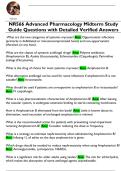
NR566 Advanced Pharmacology Midterm Study
Guide Questions with Detailed Verified Answers
What are the two categories of systemic mycoses? Ans: Opportunistic infections
(primarily in debilitated or immunocompromised hosts) and non-opportunistic
infections (in any host).
What are the classes of systemic antifungal drugs? Ans: Polyene antibiotics
(Amphotericin B), Azoles (Itraconazole), Echinocandins (Caspofungin), Pyrimidine
analogs (Flucytosine).
What is the drug of choice for most systemic mycoses? Ans: Amphotericin B.
What alternative antifungal can be used for some infections if amphotericin B is not
suitable? Ans: Itraconazole.
What should be used if patients are unresponsive to amphotericin B or itraconazole?
Ans: IV caspofungin.
What is a key pharmacokinetic characteristic of Amphotericin B? Ans: After leaving
the vascular system, it undergoes extensive binding to sterol-containing membranes.
How is Amphotericin B eliminated from the body? Ans: Little is known about its
elimination; renal excretion of unchanged amphotericin is minimal.
What is the recommended action for patients with preexisting renal impairment
receiving Amphotericin B? Ans: Consider reducing the dose or frequency.
What is a strategy to minimize nephrotoxicity when administering Amphotericin B?
Ans: Infusing 1L of saline on the days amphotericin is given.
Which drugs should be avoided to reduce nephrotoxicity when using Amphotericin B?
Ans: Aminoglycosides, cyclosporine, NSAIDs.
What is a significant risk for older adults using azoles? Ans: The risk for achlorhydria,
which makes the absorption of some antifungal agents unpredictable.
,What is the effect of azoles on CYP450 enzymes? Ans: They inhibit CYP450,
increasing the levels of many drugs such as warfarin and phenytoin.
What are the important drug interactions associated with Itraconazole? Ans: Increases
levels of cisapride, pimozide, dofetilide, and quinidine, leading to fatal ventricular
dysrhythmias.
What should be monitored when using Itraconazole with warfarin? Ans: Monitor PT
(Prothrombin Time).
How should antacids, H2RA, or PPI be administered in relation to Itraconazole? Ans:
They should be given at least 1 hour before or 2 hours after Itraconazole to avoid
reducing its absorption.
What is the therapeutic use of Caspofungin? Ans: IV therapy for invasive aspergillosis
in patients unresponsive to or intolerant of amphotericin B or itraconazole, and
systemic Candida infections.
What is a notable characteristic of the adverse effects of Caspofungin? Ans: Generally
well tolerated.
What is the elimination time for Amphotericin B after discontinuation of treatment?
Ans: Complete elimination takes over a year.
What should be monitored in patients receiving Amphotericin B? Ans: Kidney function
tests every 3-4 days and I&O (intake and output).
What is the risk associated with a total dose of Amphotericin B greater than 4g? Ans:
Residual impairment of kidney function is likely.
What is the primary mechanism of action for Caspofungin? Ans: Disrupts the fungal
cell wall.
What types of infections can Caspofungin treat? Ans: Candidemia, Candida-related
esophagitis, peritonitis, pleural space infections, and intra-abdominal abscesses.
© Get it right 2025 Getaway - Stuvia US All rights reserved
,What are the most common adverse effects of Caspofungin? Ans: Fever and phlebitis
at the injection site.
What less common adverse effects can occur with Caspofungin? Ans: Headache, rash,
nausea/vomiting.
What effects of Caspofungin are mediated by histamine release? Ans: Rash, facial
flushing, pruritus, sense of warmth.
What is the primary indication for Griseofulvin? Ans: Oral treatment of
dermatophytic infections of the skin, hair, and nails.
How long does it typically take for skin infections to respond to Griseofulvin
treatment? Ans: 3-8 weeks; infections of palms may require 2-3 months, toenails a
year or more.
Is Griseofulvin effective against Candida species or systemic mycoses? Ans: No, it is
not active against Candida species or systemic mycoses.
What is the primary use of oral terbinafine? Ans: Treatment of ringworm and
onychomycosis (nails).
What is a notable side effect of oral terbinafine? Ans: Weird taste.
What should be monitored during treatment with oral terbinafine? Ans: Liver function
tests (LFT).
What are the recommended topical treatments for Tinea Pedis? Ans: Terbinafine,
butenafine, undecylenic acid, ciclopirox.
What lifestyle recommendations should patients follow for Tinea Pedis? Ans: Wear
absorbent cotton socks, change shoes often, and dry feet after bathing.
What is the mechanism of action of Acyclovir? Ans: Inhibits viral replication by
suppressing the synthesis of viral DNA.
© Get it right 2025 Getaway - Stuvia US All rights reserved
, What types of infections is Acyclovir indicated for? Ans: Mucocutaneous herpes
simplex infections and varicella zoster infections.
What is the preferred route of administration for Acyclovir in immunocompromised
patients? Ans: IV administration.
What is the mechanism of action of Oseltamivir (Tamiflu)? Ans: Inhibits
neuraminidase, a viral enzyme required for replication.
What are the indications for Oseltamivir (Tamiflu)? Ans: Prevent and treat influenza in
patients over 1 year old.
When should Oseltamivir be administered for it to be effective? Ans: Within 48 hours
of symptom onset.
What is the purpose of the annual flu vaccine? Ans: To provide the best protection
against influenza.
What are the contraindications for the flu vaccine? Ans: Acute febrile illness, severe
allergic reaction to the vaccine, and live vaccine for high-risk individuals.
What is Palivizumab indicated for? Ans: Preventing RSV infection in premature infants
and young children with chronic lung disease.
When should Palivizumab dosing begin? Ans: Before the RSV season (December
through March) and continue until the season ends.
What should be done before receiving the flu vaccine if a person has an acute febrile
illness? Ans: They should wait until symptoms abate.
Is an allergy to egg a contraindication for the flu vaccine? Ans: No, it is not a
contraindication.
What is the mechanism of action (MOA) of NRTIs in HIV treatment? Ans: NRTIs
inhibit HIV replication by suppressing the synthesis of viral DNA, incorporating into
the growing DNA strand, and blocking further growth.
© Get it right 2025 Getaway - Stuvia US All rights reserved
Guide Questions with Detailed Verified Answers
What are the two categories of systemic mycoses? Ans: Opportunistic infections
(primarily in debilitated or immunocompromised hosts) and non-opportunistic
infections (in any host).
What are the classes of systemic antifungal drugs? Ans: Polyene antibiotics
(Amphotericin B), Azoles (Itraconazole), Echinocandins (Caspofungin), Pyrimidine
analogs (Flucytosine).
What is the drug of choice for most systemic mycoses? Ans: Amphotericin B.
What alternative antifungal can be used for some infections if amphotericin B is not
suitable? Ans: Itraconazole.
What should be used if patients are unresponsive to amphotericin B or itraconazole?
Ans: IV caspofungin.
What is a key pharmacokinetic characteristic of Amphotericin B? Ans: After leaving
the vascular system, it undergoes extensive binding to sterol-containing membranes.
How is Amphotericin B eliminated from the body? Ans: Little is known about its
elimination; renal excretion of unchanged amphotericin is minimal.
What is the recommended action for patients with preexisting renal impairment
receiving Amphotericin B? Ans: Consider reducing the dose or frequency.
What is a strategy to minimize nephrotoxicity when administering Amphotericin B?
Ans: Infusing 1L of saline on the days amphotericin is given.
Which drugs should be avoided to reduce nephrotoxicity when using Amphotericin B?
Ans: Aminoglycosides, cyclosporine, NSAIDs.
What is a significant risk for older adults using azoles? Ans: The risk for achlorhydria,
which makes the absorption of some antifungal agents unpredictable.
,What is the effect of azoles on CYP450 enzymes? Ans: They inhibit CYP450,
increasing the levels of many drugs such as warfarin and phenytoin.
What are the important drug interactions associated with Itraconazole? Ans: Increases
levels of cisapride, pimozide, dofetilide, and quinidine, leading to fatal ventricular
dysrhythmias.
What should be monitored when using Itraconazole with warfarin? Ans: Monitor PT
(Prothrombin Time).
How should antacids, H2RA, or PPI be administered in relation to Itraconazole? Ans:
They should be given at least 1 hour before or 2 hours after Itraconazole to avoid
reducing its absorption.
What is the therapeutic use of Caspofungin? Ans: IV therapy for invasive aspergillosis
in patients unresponsive to or intolerant of amphotericin B or itraconazole, and
systemic Candida infections.
What is a notable characteristic of the adverse effects of Caspofungin? Ans: Generally
well tolerated.
What is the elimination time for Amphotericin B after discontinuation of treatment?
Ans: Complete elimination takes over a year.
What should be monitored in patients receiving Amphotericin B? Ans: Kidney function
tests every 3-4 days and I&O (intake and output).
What is the risk associated with a total dose of Amphotericin B greater than 4g? Ans:
Residual impairment of kidney function is likely.
What is the primary mechanism of action for Caspofungin? Ans: Disrupts the fungal
cell wall.
What types of infections can Caspofungin treat? Ans: Candidemia, Candida-related
esophagitis, peritonitis, pleural space infections, and intra-abdominal abscesses.
© Get it right 2025 Getaway - Stuvia US All rights reserved
,What are the most common adverse effects of Caspofungin? Ans: Fever and phlebitis
at the injection site.
What less common adverse effects can occur with Caspofungin? Ans: Headache, rash,
nausea/vomiting.
What effects of Caspofungin are mediated by histamine release? Ans: Rash, facial
flushing, pruritus, sense of warmth.
What is the primary indication for Griseofulvin? Ans: Oral treatment of
dermatophytic infections of the skin, hair, and nails.
How long does it typically take for skin infections to respond to Griseofulvin
treatment? Ans: 3-8 weeks; infections of palms may require 2-3 months, toenails a
year or more.
Is Griseofulvin effective against Candida species or systemic mycoses? Ans: No, it is
not active against Candida species or systemic mycoses.
What is the primary use of oral terbinafine? Ans: Treatment of ringworm and
onychomycosis (nails).
What is a notable side effect of oral terbinafine? Ans: Weird taste.
What should be monitored during treatment with oral terbinafine? Ans: Liver function
tests (LFT).
What are the recommended topical treatments for Tinea Pedis? Ans: Terbinafine,
butenafine, undecylenic acid, ciclopirox.
What lifestyle recommendations should patients follow for Tinea Pedis? Ans: Wear
absorbent cotton socks, change shoes often, and dry feet after bathing.
What is the mechanism of action of Acyclovir? Ans: Inhibits viral replication by
suppressing the synthesis of viral DNA.
© Get it right 2025 Getaway - Stuvia US All rights reserved
, What types of infections is Acyclovir indicated for? Ans: Mucocutaneous herpes
simplex infections and varicella zoster infections.
What is the preferred route of administration for Acyclovir in immunocompromised
patients? Ans: IV administration.
What is the mechanism of action of Oseltamivir (Tamiflu)? Ans: Inhibits
neuraminidase, a viral enzyme required for replication.
What are the indications for Oseltamivir (Tamiflu)? Ans: Prevent and treat influenza in
patients over 1 year old.
When should Oseltamivir be administered for it to be effective? Ans: Within 48 hours
of symptom onset.
What is the purpose of the annual flu vaccine? Ans: To provide the best protection
against influenza.
What are the contraindications for the flu vaccine? Ans: Acute febrile illness, severe
allergic reaction to the vaccine, and live vaccine for high-risk individuals.
What is Palivizumab indicated for? Ans: Preventing RSV infection in premature infants
and young children with chronic lung disease.
When should Palivizumab dosing begin? Ans: Before the RSV season (December
through March) and continue until the season ends.
What should be done before receiving the flu vaccine if a person has an acute febrile
illness? Ans: They should wait until symptoms abate.
Is an allergy to egg a contraindication for the flu vaccine? Ans: No, it is not a
contraindication.
What is the mechanism of action (MOA) of NRTIs in HIV treatment? Ans: NRTIs
inhibit HIV replication by suppressing the synthesis of viral DNA, incorporating into
the growing DNA strand, and blocking further growth.
© Get it right 2025 Getaway - Stuvia US All rights reserved

