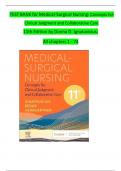
Medical-Surgical Nursing: Concepts for Interprofessional
Collaborative Care (11th Ed.) — Unit I (Ch. 1–9).
Medical-Surgical Nursing
11th Edition
• Author(s)Donna D. Ignatavicius; Cherie R. Rebar; Nicole M.
Heimgartner
1.
Reference: Ch. 1 — Nursing Roles & Accountability (Overview of
Professional Nursing Concepts for Medical-Surgical Nursing)
Question Stem: A staff RN is caring for four medical-surgical
patients and plans the day’s assignments. Which task is most
appropriate to delegate to a licensed practical nurse (LPN)?
A. Teach a newly admitted patient how to manage warfarin at
home.
B. Perform admission history and comprehensive assessment
for a complex multisystem patient.
C. Administer routine scheduled subcutaneous insulin and
document blood glucose values.
D. Develop and modify the plan of care for a patient showing
rapid clinical decline.
Correct Answer: C
Rationales — Correct: The LPN may safely administer routine
medications and document glucose values under RN
,supervision, consistent with scope-of-practice delegation. The
RN retains responsibility for initial, complex assessments and
care planning.
Rationales — A: Teaching about warfarin involves complex
education, dosage adjustment, and safety counseling; RN
should perform.
Rationales — B: Comprehensive admission assessments for
complex patients are RN responsibilities requiring critical
judgment.
Rationales — D: Rapid clinical changes require RN assessment
and care-plan modifications and may require provider
notification.
Teaching Point: Delegate stable, routine tasks (e.g., medication
administration) to appropriate licensed staff.
Citation: Ignatavicius et al., 2024, Ch. 1: Nursing roles &
accountability
2.
Reference: Ch. 1 — Delegation and Interprofessional
Collaboration (Overview of Professional Nursing Concepts)
Question Stem: The RN assigns a CNA to help with morning
hygiene for a patient with neutropenia. Which instruction is
essential before the CNA begins care?
A. “Use chlorhexidine wipes instead of soap and water for
bathing.”
B. “Wear sterile gloves for all contact with the patient.”
,C. “Notify me immediately if you observe skin breakdown or
drainage.”
D. “You may use the same basin for two patients if you change
the water.”
Correct Answer: C
Rationales — Correct: Timely reporting of skin breakdown or
drainage is vital for early infection identification in
immunocompromised patients; reporting is a key delegated
responsibility.
Rationales — A: Chlorhexidine may be used per protocol, but
the primary safety need is observation and reporting; use
depends on unit policy.
Rationales — B: Sterile gloves are not required for routine
hygiene; standard precautions apply.
Rationales — D: Sharing basins risks cross-contamination and is
unsafe for neutropenic patients.
Teaching Point: Delegate observation and reporting tasks;
ensure clear instructions for infection surveillance.
Citation: Ignatavicius et al., 2024, Ch. 1: Delegation &
collaboration
3.
Reference: Ch. 2 — Clinical Judgment: Recognizing Cues and
Prioritization (Clinical Judgment and Systems Thinking)
Question Stem: A post-op abdominal surgery patient is
nauseated, has a soft distended abdomen, decreased bowel
, sounds, and a Foley with 20 mL output in the past 4 hours.
Which action should the RN perform first?
A. Administer the prescribed antiemetic immediately.
B. Assess the abdomen for bowel sounds in all quadrants and
check for bladder distention.
C. Increase the IV maintenance fluid rate to promote perfusion.
D. Notify the surgeon of suspected paralytic ileus.
Correct Answer: B
Rationales — Correct: First perform focused assessment to
gather more data (bowel sounds, bladder distention) before
interventions or notification—accurate cue recognition guides
next steps.
Rationales — A: Antiemetic may relieve nausea but should
follow assessment to determine cause and safety.
Rationales — C: Increasing IV fluids is a treatment decision
requiring assessment of volume status and orders.
Rationales — D: Notification may be necessary later, but
immediate comprehensive assessment is the priority.
Teaching Point: Always assess and gather key clinical cues
before implementing treatments or escalating.
Citation: Ignatavicius et al., 2024, Ch. 2: Clinical judgment—cue
recognition
4.
Reference: Ch. 2 — Systems Thinking and Error Reduction
(Clinical Judgment and Systems Thinking)
Collaborative Care (11th Ed.) — Unit I (Ch. 1–9).
Medical-Surgical Nursing
11th Edition
• Author(s)Donna D. Ignatavicius; Cherie R. Rebar; Nicole M.
Heimgartner
1.
Reference: Ch. 1 — Nursing Roles & Accountability (Overview of
Professional Nursing Concepts for Medical-Surgical Nursing)
Question Stem: A staff RN is caring for four medical-surgical
patients and plans the day’s assignments. Which task is most
appropriate to delegate to a licensed practical nurse (LPN)?
A. Teach a newly admitted patient how to manage warfarin at
home.
B. Perform admission history and comprehensive assessment
for a complex multisystem patient.
C. Administer routine scheduled subcutaneous insulin and
document blood glucose values.
D. Develop and modify the plan of care for a patient showing
rapid clinical decline.
Correct Answer: C
Rationales — Correct: The LPN may safely administer routine
medications and document glucose values under RN
,supervision, consistent with scope-of-practice delegation. The
RN retains responsibility for initial, complex assessments and
care planning.
Rationales — A: Teaching about warfarin involves complex
education, dosage adjustment, and safety counseling; RN
should perform.
Rationales — B: Comprehensive admission assessments for
complex patients are RN responsibilities requiring critical
judgment.
Rationales — D: Rapid clinical changes require RN assessment
and care-plan modifications and may require provider
notification.
Teaching Point: Delegate stable, routine tasks (e.g., medication
administration) to appropriate licensed staff.
Citation: Ignatavicius et al., 2024, Ch. 1: Nursing roles &
accountability
2.
Reference: Ch. 1 — Delegation and Interprofessional
Collaboration (Overview of Professional Nursing Concepts)
Question Stem: The RN assigns a CNA to help with morning
hygiene for a patient with neutropenia. Which instruction is
essential before the CNA begins care?
A. “Use chlorhexidine wipes instead of soap and water for
bathing.”
B. “Wear sterile gloves for all contact with the patient.”
,C. “Notify me immediately if you observe skin breakdown or
drainage.”
D. “You may use the same basin for two patients if you change
the water.”
Correct Answer: C
Rationales — Correct: Timely reporting of skin breakdown or
drainage is vital for early infection identification in
immunocompromised patients; reporting is a key delegated
responsibility.
Rationales — A: Chlorhexidine may be used per protocol, but
the primary safety need is observation and reporting; use
depends on unit policy.
Rationales — B: Sterile gloves are not required for routine
hygiene; standard precautions apply.
Rationales — D: Sharing basins risks cross-contamination and is
unsafe for neutropenic patients.
Teaching Point: Delegate observation and reporting tasks;
ensure clear instructions for infection surveillance.
Citation: Ignatavicius et al., 2024, Ch. 1: Delegation &
collaboration
3.
Reference: Ch. 2 — Clinical Judgment: Recognizing Cues and
Prioritization (Clinical Judgment and Systems Thinking)
Question Stem: A post-op abdominal surgery patient is
nauseated, has a soft distended abdomen, decreased bowel
, sounds, and a Foley with 20 mL output in the past 4 hours.
Which action should the RN perform first?
A. Administer the prescribed antiemetic immediately.
B. Assess the abdomen for bowel sounds in all quadrants and
check for bladder distention.
C. Increase the IV maintenance fluid rate to promote perfusion.
D. Notify the surgeon of suspected paralytic ileus.
Correct Answer: B
Rationales — Correct: First perform focused assessment to
gather more data (bowel sounds, bladder distention) before
interventions or notification—accurate cue recognition guides
next steps.
Rationales — A: Antiemetic may relieve nausea but should
follow assessment to determine cause and safety.
Rationales — C: Increasing IV fluids is a treatment decision
requiring assessment of volume status and orders.
Rationales — D: Notification may be necessary later, but
immediate comprehensive assessment is the priority.
Teaching Point: Always assess and gather key clinical cues
before implementing treatments or escalating.
Citation: Ignatavicius et al., 2024, Ch. 2: Clinical judgment—cue
recognition
4.
Reference: Ch. 2 — Systems Thinking and Error Reduction
(Clinical Judgment and Systems Thinking)