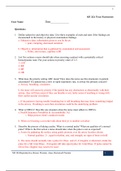
NR 304 week 7 ATI worksheet; Candice Hamby (latest update)
Questions: 1. Define subjective and objective data. Give three examples of each and state if the findings are documented in the history or physical examination findings. a. Subjective data: information given to you by the pt. i. pain, cramping, decreased sensation b. Objective: information that is gathered by examination and assessment i. Pallor, skin texture, capillary refill 2. List five actions a nurse should take when assessing a patient with a potentially critical hemodynamic state. Put your actions in priority order of 1-5. 1. LOC 2. RR 3. BP 4. HR 3. What does the priority setting ABC mean? How does the nurse use this mnemonic in patient assessment? If a patient has a slow or rapid respiratory rate, is airway the primary concern? a. Airway, breathing, circulation b. the nurse will assess by priority if the patient has any obstruction or abnormality with their airway, they will then assess if they can breathe or not, lastly assess if anything is wrong with their cardiovascular circulation. c. If the patient is having trouble breathing but is still breathing that may show something lodged in the airway. If nothing is seen then circulation could be the underlying problem. 4. What is HIPAA? Describe one situation when the nurse must adhere to HIPAA. a. Health Insurance Portability & Accountability Act i. Helps protect client’s medical records b. When over hearing a coworker talk about their pt. to another coworker 5. Describe the process of taking a pulse. What is a normal pulse? What are qualities of a normal pulse? What is the first action a nurse should take when the pulse is not as expected? a. Assess by palpating the surface using gentle pressure over the artery location chosen i. Normal qualities: 2+, equal in rhythm, rate, and strength, no signs of bruit or thrill b. The nurse should normally take a pulse for 30sec. and x2, if irregular or abnormal, retake the pulse for a full 1min/60sec., if irregular still take apical pulse for 1min/60sec. If pulse cannot be felt at first, Doppler may need to be used 6. What is dehydration? List three subjective and three objective findings of dehydration. List the expected vital signs of a patient who is dehydrated. a. Lack of fluid volume in your blood b. Sub: drowsiness, lightheadedness, increase thirst c. Obj: dry tongue/mucosa, sunken eyes, decreased skin turgor d. Decreased BP, increased RR/temp/HR (will be weak and thread) 7. How is fluid volume deficit related to dehydration? How would concentrations of some solutes (solids) change with dehydration? Why? a. Fluid volume deficiency involves the decrease of intravascular, interstitial, and/or intracellular fluid-which leads to dehydration: water loss without change in sodium 8. What is an undesirable response of the body to a fever? High fever Why is this undesirable? What effect does it have? Blood levels to go up 9. What is the most serious skin cancer? What is one risk factor for this cancer and one teaching item to address with your patient? Describe this most serious skin cancer below. a. Melanoma: uneven smudgy outline, may be blotchy and more than one color-brown, black, blue, red, or grey, could be raised b. Over exposure to the sun: be sure to limit your time in the sun and use sunscreen and/or clothes that cover your body well 10. In dark skinned client, where is the best area to assess for jaundice (not skin or sclera)? Best place to assess for pallor? Best place to assess for cyanosis? a. Palms of hands, oral mucosa b. Oral mucosa, lips, nailbeds, c. Oral mucosa 11. To document pitting edema, the nurse measures the following depths of pitting. What is the corresponding scale (1+, 2+, 3+, 4+ )2mm deep = ___+, 4mm deep =____+, 6 mm deep =___+, 8 mm deep = ____+ a. What is the corresponding scale (1+, 2+, 3+, 4+ )2mm deep = _1_+, 4mm deep =_2_+, 6 mm deep =_3_+, 8 mm deep = _4_+ 12. What is a body system complication for the client who is a chronic heavy drinker? Name 3 possible associated findings associated with this complication. a. Liver disease b. Jaundice, confusion, ascites 13. It is important to encourage the elderly client to continue to be as active as possible. List five complications associated with the inability to move independently. a. Bone breakdown (loss of bone density), weak bones, muscle atrophy, increase fat content, deterioration of articulating cartilage 14. Describe fluid volume overload. List a possible cause of FVO. List three signs/symptoms of FVO. a. Increase in extracellular body water b. Heart failure, cirrhosis, kidney failure c. Weight gain, pitting edema, increase BP 15. Describe fluid volume deficit. List a possible cause of FVD. List three signs/symptoms of FVD. a. Decrease of intravascular, intracellular, and interstitial fluid: dehydration b. Vomiting, diarrhea, sweating, not drinking enough water c. Decreased skin turgor, dry mucous membrane, weak, rapid pulse 16. Differentiate between oral candidiasis and leukoplakia. List one possible cause of each. a. oral candidiasis: also known as oral thrush occurs when infection develops on the inside of the mouth and on the tongue. This condition is also known as oropharyngeal candidiasis albicans fungus causes oral thrush b. leukoplakia: is a white or grey patch that develops on the tongue, the inside of the cheek, or on the floor of the mouth, it is the mouth’s reaction to chronic irritation of the mucous membranes of the mouth. Leukoplakia patches can also develop on the female genital area, however the cause is unknown. 17. What is a common manifestation that an elderly client has an acute problem such as infection or stroke a. confusion / altered level of consciousness 18. What are crackles? a. crackles are abnormal lung sounds characterized by discontinuous clicking or rattling How would you describe the sound crackles? a. Loud, low – pitch bubbling and gurgling sounds that start in early inspiration and may be present in expiration; may decrease somewhat by suctioning or coughing but reappear shortly – sounds like opening of Velcro fastener Describe two pathological conditions when the nurse would expect crackles on auscultation. a. pneumonia b. CHF 19. What are wheezes? a. A wheeze (formally called “sibilant rhonchi”) is continuous, coarse, whistling sound produced in the respiratory airways during breathing. For wheezes to occur, some part of the respiratory tree must be narrowed or obstructed, or airflow velocity within the respiratory tree must be heightened. How would you describe the sound of wheezes? a. High pitched, musical squeaking sound that sounds polyphonic (multiple notes as in a musical cord) predominate in expiration but may occur in both expiration and inspiration Describe two pathological conditions when the nurse would expect wheezes on auscultation. a. acute asthma b. Chronic emphysema 20. What is the significance of a syncopal episode in the elderly client? a. normally a cardiac issue/ stimulation of the vasovagal response when medication is inserted rectally / when an elderly client bares down too hard to have a bowel movement 21. Describe the subjective and objective findings of a client with a pneumothorax. -Trapped air in the pleural space -A large part of the lung or com
Escuela, estudio y materia
Información del documento
- Subido en
- 13 de enero de 2021
- Número de páginas
- 12
- Escrito en
- 2020/2021
- Tipo
- Examen
- Contiene
- Preguntas y respuestas
Temas
- nr 304
- ati worksheet
- week 7
- worksheet
-
nr 304 week 7 ati worksheet candice hamby latest update

Documento también disponible en un lote