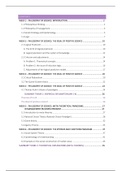
CONTENTS
WEEK 1 – PHILOSOPHY OF SCIENCE: INTRODUCTION ............................................................. 2
1.1 Philosophical thinking ....................................................................................................... 2
1.2 Philosophy of management.............................................................................................. 3
1.3 Social Ontology and Epistemology ................................................................................... 5
1.4 Logic ................................................................................................................................. 7
WEEK 2 – PHILOSOPHY OF SCIENCE: THE IDEAL OF POSITIVE SCIENCE ................................. 10
2.1 Logical Positivism............................................................................................................ 10
A. The birth of logical positivism ...................................................................................... 10
B. Logical positivism and the system of knowledge ......................................................... 12
2.2 Criticism and adjustments .............................................................................................. 14
A. Problem 1: Theoretical concepts ................................................................................. 14
B. Problem 2: the issue of Induction logic ........................................................................ 16
C. Adjustments of the logical positivism model................................................................ 17
WEEK 3 – PHILOSOPHY OF SCIENCE: THE IDEAL OF POSITIVE SCIENCE ................................. 20
3.1 Critical Rationalism ......................................................................................................... 20
3.2 The Quine–Duhem thesis ............................................................................................... 22
WEEK 4 – PHILOSOPHY OF SCIENCE: THE IDEAL OF POSITIVE SCIENCE ................................. 24
4.1 Thomas Kuhn’s theory of paradigms .............................................................................. 24
SUMMARY THEME 1: EMPIRICAL EXPLANATION (WK 1-4) ........................................... 26
Theories of truth .................................................................................................................. 26
The ideal of positive science? ............................................................................................... 26
WEEK 5 – PHILOSOPHY OF SCIENCE: META-THEORETICAL PARADIGMS ................................ 27
IN MANAGEMENT/BUSINESS RESEARCH ..................................................................... 27
5.1 Introduction to meta-theories........................................................................................ 27
5.2 Rational Choice Theory (Rational Choice Paradigm) ...................................................... 28
5.3 Game theory................................................................................................................... 32
5.4 Agency Theory ................................................................................................................ 35
WEEK 6 – PHILOSOPHY OF SCIENCE: THE SYSTEMS AND FUNCTIONS PARADIGM ................. 37
6.1 Social System Theory ...................................................................................................... 37
6.2 Epistemology of Understanding ..................................................................................... 41
6.3 Example on the social construction of market value ..................................................... 43
SUMMARY THEME 2: THEORETICAL EXPLANATIONS (META-THEORIES) ............................... 45
, Philosophy of Science 2020-2021 RSM
Meta-theories perspectives (takewaway) ............................................................................ 45
Implications .......................................................................................................................... 45
WEEK 7 – PHILOSOPHY OF SCIENCE: RESEARCH STRATEGY .................................................. 47
7.1 Quantitative Research .................................................................................................... 47
7.2 Qualitative Research ...................................................................................................... 47
7.3 Quantitative versus Qualitative ...................................................................................... 48
1
, Philosophy of Science 2020-2021 RSM
THEME 1: EMPIRICAL EXPLANATION
WEEK 1 – PHILOSOPHY OF SCIENCE: INTRODUCTION
1.1 PHILOSOPHICAL THINKING
What is philosophical thinking and how different it is from the way we think on our daily lives?
Test of “If a machine makes five products in five minutes, how long does it take ten machines
to make ten products?” as an example of intuition vs rational thinking.
This is because of our fallible thinking, in which we have the intuitive thinking (system 1) which
is fast but unreliable, and the rational thinking (system 2) which is slow but reliable.
What is philosophy thinking? Philosophy is thinking slowly, thinking deeply about apparent
simple questions. It takes cognitive effort.
Two basic concepts, ontology, and epistemology
Ontology comes from the Greek word for “being”, and it is the study of being or existence, and
its basic categories and relationships. It seeks to determine what entities can be said to exist,
or whether we can group these entities on similarities or differences. It’s the theory of reality,
of what is there and what we can accept as reality. Theory being a “rational and abstract
thinking about a certain type of phenomenon”. Example of our ontology is accepting bitcoin as
a currency, because it takes all of us to agree on it being a currency, it would not work if only
two people think is a currency. This also works for the euro.
Epistemology is a philosophical theory about knowledge. It is one of the four main branches of
philosophy along with logics, axiology and metaphysics. This theory asks what knowledge is,
what scientific knowledge is, and how is this obtained. Epistemology questions can be “what
do we know?” or “what do we not know?”. “do we really know what we think we know?”.
While ontology is about the theory of being, existence, epistemology is about how can we
acquire knowledge about the being, about the reality out there. An example to illustrate the
difference between these two is for example, an ontology question is “does god exist?” and in
an epistemology manner it would be “how can we know if god exists?”.
Ontology How we view the world
Epistemology How we should investigate the world
Methodology How we should best collect data
2
, Philosophy of Science 2020-2021 RSM
1.2 PHILOSOPHY OF MANAGEMENT
Why do we study philosophy of science? What is philosophy of science?
Philosophy of science is a field that deals with a) what science is, b) how it works, and c) the
logic through which we build scientific knowledge. It deals with how much or what kind of
evidence we need before me accept hypothesis, which kind of data do we need and etc.
The first question philosophy of science focuses on is what science is. Fundamentally science
is both a body of knowledge and a process. In the beginning human beings explained natural
phenomenon through religion and mythology, whilst now these phenomena are explained
through systematically observing them and testing ideas. So how can be separate science from
not science?
Scientific knowledge shall be generalizable because it wants to explain and understand
phenomena, not a single event.
Scientific knowledge shall be clear and simple because parsimony enhances the
explanatory power of a theory.
Scientific knowledge shall be based upon research methods that are valid among the
scientific community.
Knowing that scientific knowledge is different to general knowledge, what differentiates them?
To test what is scientific we would have to prove causality, we would have to test it with
randomization.
However, causality is not a simple idea.
Explaining an outcome Y in terms of the necessary and/or sufficient conditions (X) for Y to take
place.
Causality has a strong connection with determinism.
Determinism being the ontology that if we would know all applicable laws of nature as
well as the initial conditions, we can perfectly predict what will happen in the future.
Determinism is sort of the “house ontology” of natural science.
However, the methods to establish causality are sometimes not feasible in management
science (e.g. if you want to test the effect of a diverse employment in small start-ups you
cannot force a start-up to hire a more diverse team).
Alternatively, the way is used now in management (and social) science is called a
counterfactual understanding of causation.
An outcome Y is caused by cause X, if and only if when X had occurred Y would also
have occurred, AND, if X had not occurred, Y would also not have happened.
3
WEEK 1 – PHILOSOPHY OF SCIENCE: INTRODUCTION ............................................................. 2
1.1 Philosophical thinking ....................................................................................................... 2
1.2 Philosophy of management.............................................................................................. 3
1.3 Social Ontology and Epistemology ................................................................................... 5
1.4 Logic ................................................................................................................................. 7
WEEK 2 – PHILOSOPHY OF SCIENCE: THE IDEAL OF POSITIVE SCIENCE ................................. 10
2.1 Logical Positivism............................................................................................................ 10
A. The birth of logical positivism ...................................................................................... 10
B. Logical positivism and the system of knowledge ......................................................... 12
2.2 Criticism and adjustments .............................................................................................. 14
A. Problem 1: Theoretical concepts ................................................................................. 14
B. Problem 2: the issue of Induction logic ........................................................................ 16
C. Adjustments of the logical positivism model................................................................ 17
WEEK 3 – PHILOSOPHY OF SCIENCE: THE IDEAL OF POSITIVE SCIENCE ................................. 20
3.1 Critical Rationalism ......................................................................................................... 20
3.2 The Quine–Duhem thesis ............................................................................................... 22
WEEK 4 – PHILOSOPHY OF SCIENCE: THE IDEAL OF POSITIVE SCIENCE ................................. 24
4.1 Thomas Kuhn’s theory of paradigms .............................................................................. 24
SUMMARY THEME 1: EMPIRICAL EXPLANATION (WK 1-4) ........................................... 26
Theories of truth .................................................................................................................. 26
The ideal of positive science? ............................................................................................... 26
WEEK 5 – PHILOSOPHY OF SCIENCE: META-THEORETICAL PARADIGMS ................................ 27
IN MANAGEMENT/BUSINESS RESEARCH ..................................................................... 27
5.1 Introduction to meta-theories........................................................................................ 27
5.2 Rational Choice Theory (Rational Choice Paradigm) ...................................................... 28
5.3 Game theory................................................................................................................... 32
5.4 Agency Theory ................................................................................................................ 35
WEEK 6 – PHILOSOPHY OF SCIENCE: THE SYSTEMS AND FUNCTIONS PARADIGM ................. 37
6.1 Social System Theory ...................................................................................................... 37
6.2 Epistemology of Understanding ..................................................................................... 41
6.3 Example on the social construction of market value ..................................................... 43
SUMMARY THEME 2: THEORETICAL EXPLANATIONS (META-THEORIES) ............................... 45
, Philosophy of Science 2020-2021 RSM
Meta-theories perspectives (takewaway) ............................................................................ 45
Implications .......................................................................................................................... 45
WEEK 7 – PHILOSOPHY OF SCIENCE: RESEARCH STRATEGY .................................................. 47
7.1 Quantitative Research .................................................................................................... 47
7.2 Qualitative Research ...................................................................................................... 47
7.3 Quantitative versus Qualitative ...................................................................................... 48
1
, Philosophy of Science 2020-2021 RSM
THEME 1: EMPIRICAL EXPLANATION
WEEK 1 – PHILOSOPHY OF SCIENCE: INTRODUCTION
1.1 PHILOSOPHICAL THINKING
What is philosophical thinking and how different it is from the way we think on our daily lives?
Test of “If a machine makes five products in five minutes, how long does it take ten machines
to make ten products?” as an example of intuition vs rational thinking.
This is because of our fallible thinking, in which we have the intuitive thinking (system 1) which
is fast but unreliable, and the rational thinking (system 2) which is slow but reliable.
What is philosophy thinking? Philosophy is thinking slowly, thinking deeply about apparent
simple questions. It takes cognitive effort.
Two basic concepts, ontology, and epistemology
Ontology comes from the Greek word for “being”, and it is the study of being or existence, and
its basic categories and relationships. It seeks to determine what entities can be said to exist,
or whether we can group these entities on similarities or differences. It’s the theory of reality,
of what is there and what we can accept as reality. Theory being a “rational and abstract
thinking about a certain type of phenomenon”. Example of our ontology is accepting bitcoin as
a currency, because it takes all of us to agree on it being a currency, it would not work if only
two people think is a currency. This also works for the euro.
Epistemology is a philosophical theory about knowledge. It is one of the four main branches of
philosophy along with logics, axiology and metaphysics. This theory asks what knowledge is,
what scientific knowledge is, and how is this obtained. Epistemology questions can be “what
do we know?” or “what do we not know?”. “do we really know what we think we know?”.
While ontology is about the theory of being, existence, epistemology is about how can we
acquire knowledge about the being, about the reality out there. An example to illustrate the
difference between these two is for example, an ontology question is “does god exist?” and in
an epistemology manner it would be “how can we know if god exists?”.
Ontology How we view the world
Epistemology How we should investigate the world
Methodology How we should best collect data
2
, Philosophy of Science 2020-2021 RSM
1.2 PHILOSOPHY OF MANAGEMENT
Why do we study philosophy of science? What is philosophy of science?
Philosophy of science is a field that deals with a) what science is, b) how it works, and c) the
logic through which we build scientific knowledge. It deals with how much or what kind of
evidence we need before me accept hypothesis, which kind of data do we need and etc.
The first question philosophy of science focuses on is what science is. Fundamentally science
is both a body of knowledge and a process. In the beginning human beings explained natural
phenomenon through religion and mythology, whilst now these phenomena are explained
through systematically observing them and testing ideas. So how can be separate science from
not science?
Scientific knowledge shall be generalizable because it wants to explain and understand
phenomena, not a single event.
Scientific knowledge shall be clear and simple because parsimony enhances the
explanatory power of a theory.
Scientific knowledge shall be based upon research methods that are valid among the
scientific community.
Knowing that scientific knowledge is different to general knowledge, what differentiates them?
To test what is scientific we would have to prove causality, we would have to test it with
randomization.
However, causality is not a simple idea.
Explaining an outcome Y in terms of the necessary and/or sufficient conditions (X) for Y to take
place.
Causality has a strong connection with determinism.
Determinism being the ontology that if we would know all applicable laws of nature as
well as the initial conditions, we can perfectly predict what will happen in the future.
Determinism is sort of the “house ontology” of natural science.
However, the methods to establish causality are sometimes not feasible in management
science (e.g. if you want to test the effect of a diverse employment in small start-ups you
cannot force a start-up to hire a more diverse team).
Alternatively, the way is used now in management (and social) science is called a
counterfactual understanding of causation.
An outcome Y is caused by cause X, if and only if when X had occurred Y would also
have occurred, AND, if X had not occurred, Y would also not have happened.
3