

03 Enzymes
#21 Enzymes and reactions
Many chemical reactions can be speeded up by substances called catalysts. Within
living organisms, these reactions (metabolic reactions) are controlled by catalysts
called enzymes. Enzyme molecules are proteins.
Enzymes and reactions
Most enzyme names end in –ase, e.g. lipase, protease.
,Temperature, pH and enzymes
The activity of enzymes is affected by temperature and pH.
Effect of temperature on enzymes
The optimum (best) temperature for enzyme-controlled reactions is 370C (body
temperature).
As the temperature increases, the rate of reaction increases. But
very high temperatures denature enzymes.
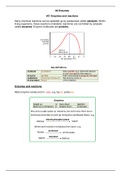
The graph shows the typical change in an enzyme's activity with increasing
temperature.
The enzyme activity gradually increases with temperature up to around 37ºC, or body
temperature. Then, as the temperature continues to rise, the rate of reaction falls
rapidly as heat energy denatures the enzyme. Most enzymes are denatured above
500C.
Effect of pH on enzymes
The pH of a solution is how acidic or alkaline it is.
Different enzymes work best at different pH values.
The optimum pH for an enzyme depends on where it normally works.
It is around neutral (pH= 7) for most enzymes but there are some exceptions.
, Changes in pH also alter an enzyme’s shape and slow down its activity, but this can
usually be reversed if the optimum pH is restored.
An extreme pH can denature enzymes – the active site is deformed permanently.
#21 Enzymes and reactions
Many chemical reactions can be speeded up by substances called catalysts. Within
living organisms, these reactions (metabolic reactions) are controlled by catalysts
called enzymes. Enzyme molecules are proteins.
Enzymes and reactions
Most enzyme names end in –ase, e.g. lipase, protease.
,Temperature, pH and enzymes
The activity of enzymes is affected by temperature and pH.
Effect of temperature on enzymes
The optimum (best) temperature for enzyme-controlled reactions is 370C (body
temperature).
As the temperature increases, the rate of reaction increases. But
very high temperatures denature enzymes.
The graph shows the typical change in an enzyme's activity with increasing
temperature.
The enzyme activity gradually increases with temperature up to around 37ºC, or body
temperature. Then, as the temperature continues to rise, the rate of reaction falls
rapidly as heat energy denatures the enzyme. Most enzymes are denatured above
500C.
Effect of pH on enzymes
The pH of a solution is how acidic or alkaline it is.
Different enzymes work best at different pH values.
The optimum pH for an enzyme depends on where it normally works.
It is around neutral (pH= 7) for most enzymes but there are some exceptions.
, Changes in pH also alter an enzyme’s shape and slow down its activity, but this can
usually be reversed if the optimum pH is restored.
An extreme pH can denature enzymes – the active site is deformed permanently.

