

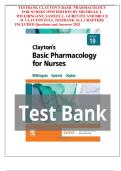
TESTBANK CLAYTON’S BASIC PHARMACOLOGY
FOR NURSES 19TH EDITION BY MICHELLE J.
WILLIHNGANZ, SAMUEL L. GUREVITZ AND BRUCE
D. CLAYTON FULL TESTBANK ALL CHAPTERS
INCLUDED Questions and Answers 2025
,2|P age
TESTBANK CLAYTON’S BASIC PHARMACOLOGY FOR
NURSES 19TH EDITION BY MICHELLE J. WILLIHNGANZ,
SAMUEL L. GUREVITZ AND BRUCE D. CLAYTON FULL
TESTBANK ALL CHAPTERS INCLUDED|| LATEST AND
COMPLETE UPDATE WITH VERIFIED SOLUTIONS
Chapter 01: Drug Definitions, Standards, and Information Sources
Willihnganz: Clayton’s Basic Pharmacology for Nurses, 19th Edition
MULTIPLE CHOICE
1. An older adult experiencing shortness of breath is brought to the hospital by her daughter.
While obtaining the medication history from the patient and her daughter, the nurse discovers
that neither has a list of the patient‘s current medications or prescriptions. The patient has is a
weekly pill dispenser that contains four different pills. The prescriptions are filled through the
local pharmacy. Which resource would be appropriate to use in determining the medication
names and doses?
a. Martindale—The Complete Drug Reference
b. Drugs and Facts Comparisons
c. Senior citizens‘ center
d. Patient‘s home pharmacy
ANSWER: D
The patient‘s pharmacy would have an accurate account of all the medications the client is
currently taking. Martindale—The Complete Drug Reference has written information on
medications and would not be an appropriate resource. Drugs and Facts Comparisons contains
drug monographs that describe all drugs in a therapeutic class but would not help identify
medications by photograph. The senior citizens‘ center is not likely to have specific patient
medication information.
DIF: Cognitive Level: Application REF: p. 2 OBJ: 3 NAT: NCLEX Client Needs
Category: Physiological Integrity
TOP: Nursing Process Step: Assessment
CON: Care Coordination | Safety | Patient Education | Clinical Judgment
2. Which classification does meperidine (Demerol) fall under?
a. I
b. II
c. III
,3|P age
d. IV
ANSWER: B
Meperidine (Demerol) is a Schedule II drug; it has a high potential for abuse and may lead to
severe psychological and physical dependence. Schedule I drugs have high potential for abuse
and no recognized medical use. Schedule III drugs have some potential for abuse. Use may lead
to low to moderate physical dependence or high psychological dependence. Schedule IV drugs
have low potential for abuse. Use may lead to limited physical or psychological dependence.
DIF: Cognitive Level: Knowledge REF: p. 10 OBJ: 2 NAT: NCLEX Client Needs
Category: Safe, Effective Care Environment
TOP: Nursing Process Step: Assessment CON: Patient Education | Addiction | Pain
3. Which statement is true about over-the-counter (OTC) drugs?
a. They are not listed in the USP NF.
b. A prescription from a healthcare provider is needed.
c. They are sold without a prescription.
d. They are known only by their brand names.
ANSWER: C
OTC medications do not require a prescription. A variety of names, both generic and trade, can
be used for individual drugs sold OTC. OTC drugs are listed in the USP NF. Prescription drugs
require an order by a health professional who is licensed to prescribe, such as a physician, nurse
practitioner, physician assistant, or dentist.
DIF: Cognitive Level: Comprehension REF: p. 2 OBJ: 2 NAT: NCLEX Client Needs
Category: Physiological Integrity
TOP: Nursing Process Step: Planning CON: Patient Education
4. Which is the most authoritative reference for medications that are injected?
a. Martindale: The Complete
b. Handbook on Injectable Drugs
c. DailyMed
, 4|P age
d. Handbook of Nonprescription Drugs
ANSWER: B
The Handbook on Injectable Drugs is the most comprehensive reference available on the topic of
compatibility of injectable drugs. It is a collection of monographs for more than 300 injectable
drugs that are listed alphabetically by generic name.
DIF: Cognitive Level: Knowledge REF: p. 4 OBJ: 3 NAT: NCLEX Client Needs
Category: Physiological Integrity
TOP: Nursing Process Step: Assessment CON: Clinical Judgment | Safety
5. Which statement is true about Lomotil?
a. Abuse potential for this drug is low.
b. Psychological dependency is likely.
c. There is a high potential for abuse.
d. This drug is not a controlled substance.
ANSWER: A
Lomotil, a Schedule V drug, has an abuse potential of limited physical or psychological
dependence liability compared with drugs in Schedule IV. Because abuse potential is low with a
Schedule V drug, a prescription may not be required. Psychological dependency is not likely
with a Schedule V drug. Schedule V drugs are classified as controlled substances.
DIF: Cognitive Level: Knowledge REF: p. 5 Box 1.1 OBJ: 2 NAT: NCLEX Client Needs
Category: Physiological Integrity
TOP: Nursing Process Step: Assessment CON: Clinical Judgment | Safety | Patient Education
6. Which medication ordered for a patient with a substance abuse history has the greatest
risk for abuse?
a. Lomotil
b. Diazepam
c. Phenobarbital
d. Lortab
ANSWER: D
Lortab is a Schedule III drug with a high potential for abuse but less so than drugs in Schedules I
and II. Lomotil is a Schedule V drug with a low potential for abuse compared with those in
Schedule V. Diazepam is a Schedule IV drug with a low potential for abuse compared with those
FOR NURSES 19TH EDITION BY MICHELLE J.
WILLIHNGANZ, SAMUEL L. GUREVITZ AND BRUCE
D. CLAYTON FULL TESTBANK ALL CHAPTERS
INCLUDED Questions and Answers 2025
,2|P age
TESTBANK CLAYTON’S BASIC PHARMACOLOGY FOR
NURSES 19TH EDITION BY MICHELLE J. WILLIHNGANZ,
SAMUEL L. GUREVITZ AND BRUCE D. CLAYTON FULL
TESTBANK ALL CHAPTERS INCLUDED|| LATEST AND
COMPLETE UPDATE WITH VERIFIED SOLUTIONS
Chapter 01: Drug Definitions, Standards, and Information Sources
Willihnganz: Clayton’s Basic Pharmacology for Nurses, 19th Edition
MULTIPLE CHOICE
1. An older adult experiencing shortness of breath is brought to the hospital by her daughter.
While obtaining the medication history from the patient and her daughter, the nurse discovers
that neither has a list of the patient‘s current medications or prescriptions. The patient has is a
weekly pill dispenser that contains four different pills. The prescriptions are filled through the
local pharmacy. Which resource would be appropriate to use in determining the medication
names and doses?
a. Martindale—The Complete Drug Reference
b. Drugs and Facts Comparisons
c. Senior citizens‘ center
d. Patient‘s home pharmacy
ANSWER: D
The patient‘s pharmacy would have an accurate account of all the medications the client is
currently taking. Martindale—The Complete Drug Reference has written information on
medications and would not be an appropriate resource. Drugs and Facts Comparisons contains
drug monographs that describe all drugs in a therapeutic class but would not help identify
medications by photograph. The senior citizens‘ center is not likely to have specific patient
medication information.
DIF: Cognitive Level: Application REF: p. 2 OBJ: 3 NAT: NCLEX Client Needs
Category: Physiological Integrity
TOP: Nursing Process Step: Assessment
CON: Care Coordination | Safety | Patient Education | Clinical Judgment
2. Which classification does meperidine (Demerol) fall under?
a. I
b. II
c. III
,3|P age
d. IV
ANSWER: B
Meperidine (Demerol) is a Schedule II drug; it has a high potential for abuse and may lead to
severe psychological and physical dependence. Schedule I drugs have high potential for abuse
and no recognized medical use. Schedule III drugs have some potential for abuse. Use may lead
to low to moderate physical dependence or high psychological dependence. Schedule IV drugs
have low potential for abuse. Use may lead to limited physical or psychological dependence.
DIF: Cognitive Level: Knowledge REF: p. 10 OBJ: 2 NAT: NCLEX Client Needs
Category: Safe, Effective Care Environment
TOP: Nursing Process Step: Assessment CON: Patient Education | Addiction | Pain
3. Which statement is true about over-the-counter (OTC) drugs?
a. They are not listed in the USP NF.
b. A prescription from a healthcare provider is needed.
c. They are sold without a prescription.
d. They are known only by their brand names.
ANSWER: C
OTC medications do not require a prescription. A variety of names, both generic and trade, can
be used for individual drugs sold OTC. OTC drugs are listed in the USP NF. Prescription drugs
require an order by a health professional who is licensed to prescribe, such as a physician, nurse
practitioner, physician assistant, or dentist.
DIF: Cognitive Level: Comprehension REF: p. 2 OBJ: 2 NAT: NCLEX Client Needs
Category: Physiological Integrity
TOP: Nursing Process Step: Planning CON: Patient Education
4. Which is the most authoritative reference for medications that are injected?
a. Martindale: The Complete
b. Handbook on Injectable Drugs
c. DailyMed
, 4|P age
d. Handbook of Nonprescription Drugs
ANSWER: B
The Handbook on Injectable Drugs is the most comprehensive reference available on the topic of
compatibility of injectable drugs. It is a collection of monographs for more than 300 injectable
drugs that are listed alphabetically by generic name.
DIF: Cognitive Level: Knowledge REF: p. 4 OBJ: 3 NAT: NCLEX Client Needs
Category: Physiological Integrity
TOP: Nursing Process Step: Assessment CON: Clinical Judgment | Safety
5. Which statement is true about Lomotil?
a. Abuse potential for this drug is low.
b. Psychological dependency is likely.
c. There is a high potential for abuse.
d. This drug is not a controlled substance.
ANSWER: A
Lomotil, a Schedule V drug, has an abuse potential of limited physical or psychological
dependence liability compared with drugs in Schedule IV. Because abuse potential is low with a
Schedule V drug, a prescription may not be required. Psychological dependency is not likely
with a Schedule V drug. Schedule V drugs are classified as controlled substances.
DIF: Cognitive Level: Knowledge REF: p. 5 Box 1.1 OBJ: 2 NAT: NCLEX Client Needs
Category: Physiological Integrity
TOP: Nursing Process Step: Assessment CON: Clinical Judgment | Safety | Patient Education
6. Which medication ordered for a patient with a substance abuse history has the greatest
risk for abuse?
a. Lomotil
b. Diazepam
c. Phenobarbital
d. Lortab
ANSWER: D
Lortab is a Schedule III drug with a high potential for abuse but less so than drugs in Schedules I
and II. Lomotil is a Schedule V drug with a low potential for abuse compared with those in
Schedule V. Diazepam is a Schedule IV drug with a low potential for abuse compared with those

