EJPME-US002-16
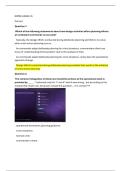
Pre test
Question 1.
Which of the following statements about how design activities effect planning efforts
at combatant commands is accurate?
Typically, the design efforts conducted during deliberate planning add little to no value
when crisis action planning occurs.
As commands adapt deliberate planning for crisis situations, commanders often lose
focus of 'understanding of the problem' due to the analysis of risks.
As commands adapt deliberate planning for crisis situations, rarely does the operational
approach change.
Design efforts conducted during deliberate planning manifest their worth at the initiation
of crisis action planning.
Question 2.
The coherent integration of lethal and nonlethal actions at the operational level is
provided by _____. *I selected only the 1st and 4th which was wrong…but according to the
module that I had to do, because I missed the question….it is correct???
operational framework; planning guidance
crisis situations
tactical units
commander's intent
, Question 3.
Which statement best describes how the battle rhythm assists the command and
staff in achieving efficiency and effectiveness?
It allows JTFs to revisit design activities often to develop their own individualized
operational approach
It prevents dialogue/translation with other agencies, battlefield circulation, and
interaction with peers/staff
It provides broad approaches, timely guidance to planners, and clear and succinct intent
to subordinates
It ensures there is enough interaction between the commander and planning teams to
keep an open flow of guidance and direction in maintaining the planning momentum
Question 4.
What has given commanders the ability to leverage many joint capabilities at the
lowest levels?
The "co-creation of context" principle has given commanders unique viewpoints to
leverage joint capabilities.
Advances in information technology have enabled collaborative and decentralized
approaches to better understand the operational environment.
Recent changes in joint command hierarchical structures have enabled commanders to
delegate authority more efficiently across all echelons.
Question 5.
Which of the following provides the foundation for "living plans" designed and
resourced to achieve national defense and military strategic objectives in a manner
that is both militarily and politically acceptable?
deliberate planning process
tactical planning process
adaptive planning process
operational planning process
Question 6.
Pre test
Question 1.
Which of the following statements about how design activities effect planning efforts
at combatant commands is accurate?
Typically, the design efforts conducted during deliberate planning add little to no value
when crisis action planning occurs.
As commands adapt deliberate planning for crisis situations, commanders often lose
focus of 'understanding of the problem' due to the analysis of risks.
As commands adapt deliberate planning for crisis situations, rarely does the operational
approach change.
Design efforts conducted during deliberate planning manifest their worth at the initiation
of crisis action planning.
Question 2.
The coherent integration of lethal and nonlethal actions at the operational level is
provided by _____. *I selected only the 1st and 4th which was wrong…but according to the
module that I had to do, because I missed the question….it is correct???
operational framework; planning guidance
crisis situations
tactical units
commander's intent
, Question 3.
Which statement best describes how the battle rhythm assists the command and
staff in achieving efficiency and effectiveness?
It allows JTFs to revisit design activities often to develop their own individualized
operational approach
It prevents dialogue/translation with other agencies, battlefield circulation, and
interaction with peers/staff
It provides broad approaches, timely guidance to planners, and clear and succinct intent
to subordinates
It ensures there is enough interaction between the commander and planning teams to
keep an open flow of guidance and direction in maintaining the planning momentum
Question 4.
What has given commanders the ability to leverage many joint capabilities at the
lowest levels?
The "co-creation of context" principle has given commanders unique viewpoints to
leverage joint capabilities.
Advances in information technology have enabled collaborative and decentralized
approaches to better understand the operational environment.
Recent changes in joint command hierarchical structures have enabled commanders to
delegate authority more efficiently across all echelons.
Question 5.
Which of the following provides the foundation for "living plans" designed and
resourced to achieve national defense and military strategic objectives in a manner
that is both militarily and politically acceptable?
deliberate planning process
tactical planning process
adaptive planning process
operational planning process
Question 6.