
Natural sciences term 2 grade 8
Study online at https://quizlet.com/_6p49kg
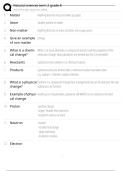
1. Matter Anything that has mass and takes up space
2. Atom Smaller particle of matter
3. Non-matter Anything that has no mass and does not occupy space
4. Give an example Energy
of non matter
5. What is a chemi- When 2 or more elements or compounds interact and the properties of the
cal change? molecules change. New substances are formed but this is irreversible!
6. Reactants Substances that combine in a chemical reaction
7. Products Substances that are formed after a chemical reaction has taken place
E.g. sodium + chlorine= sodium chloride
8. What is a physical Particles in a compound change their arrangement but can be reversed. No new
change? substances are formed
9. Example of physi- Heating ice to liquid water, substance still WATER so no substances formed
cal change
10. Proton -positive charge
-larger/ heavier than electrons
-located in nucleus of atom
11. Neutron -neutral
- no electrical charge
- large and heavy
- located in nucleus
12. Electron
1/2
Study online at https://quizlet.com/_6p49kg
1. Matter Anything that has mass and takes up space
2. Atom Smaller particle of matter
3. Non-matter Anything that has no mass and does not occupy space
4. Give an example Energy
of non matter
5. What is a chemi- When 2 or more elements or compounds interact and the properties of the
cal change? molecules change. New substances are formed but this is irreversible!
6. Reactants Substances that combine in a chemical reaction
7. Products Substances that are formed after a chemical reaction has taken place
E.g. sodium + chlorine= sodium chloride
8. What is a physical Particles in a compound change their arrangement but can be reversed. No new
change? substances are formed
9. Example of physi- Heating ice to liquid water, substance still WATER so no substances formed
cal change
10. Proton -positive charge
-larger/ heavier than electrons
-located in nucleus of atom
11. Neutron -neutral
- no electrical charge
- large and heavy
- located in nucleus
12. Electron
1/2

