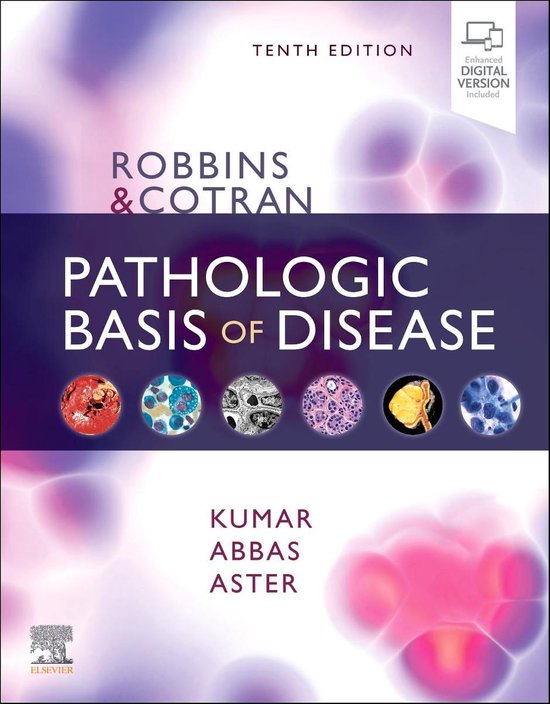
Robbins & Cotran 10th Ed. Pathology Test Bank | Chapter-
by-Chapter Questions & Verified Solutions
Robbins & Cotran Pathologic Basis of Disease
10th Edition
• Author(s)Vinay Kumar; Abul K. Abbas; Jon C. Aster
Chapter 1 — The Genome
1. Question: A 62-year-old smoker presents with chronic
bronchitis and areas of ciliated columnar epithelium
replaced by stratified squamous epithelium in bronchial
biopsies. Which cellular process best explains this
epithelial change?
A. Dysplasia
B. Metaplasia
C. Anaplasia
D. Hyperplasia
Correct Answer: B. Metaplasia
Rationales:
• B (Correct): Metaplasia refers to reversible replacement of
one differentiated cell type by another better suited to
, chronic stress (e.g., columnar → squamous in smokers).
Robbins describes metaplasia as an adaptive
reprogramming of stem cells or progenitors.
• A: Dysplasia is disordered growth with atypia; it involves
cellular atypia and is a precancerous change, not a direct,
ordered replacement like metaplasia.
• C: Anaplasia implies loss of differentiation typical of
malignant transformation; not the organized replacement
seen here.
• D: Hyperplasia is increased cell number of the same cell
type in response to stimulus, not a change in cell type.
Teaching Point: Metaplasia is an adaptive, reversible
replacement of one differentiated cell type by another.
Citation: Robbins & Cotran, Ch. 1 — The Cell as a Unit of Health
and Disease (adaptive responses: metaplasia).
2. Chapter 1 — The Genome
Question: A newborn is diagnosed with a defect in a DNA
mismatch repair protein. Which cellular consequence most
directly increases the risk of cancer in this child?
A. Decreased homologous recombination
B. Increased point mutation rate during DNA replication
C. Impaired base excision repair of oxidative lesions
D. Failure of nucleotide excision repair of UV lesions
,Correct Answer: B. Increased point mutation rate during DNA
replication
Rationales:
• B (Correct): Mismatch repair corrects replication errors
(base–base mismatches, small insertions/deletions); loss
leads to microsatellite instability and increased point
mutation rate, raising cancer risk.
• A: Homologous recombination repairs double-strand
breaks; mismatch repair defects don’t directly cause HR
defects.
• C: Base excision repair handles small base modifications;
mismatch repair is distinct from BER.
• D: Nucleotide excision repair removes bulky adducts (e.g.,
UV dimers); mismatch repair is not the primary pathway
for UV lesions.
Teaching Point: Mismatch repair defects raise mutation rates
by failing to correct replication errors.
Citation: Robbins & Cotran, Ch. 1 — The Genome (DNA repair
and mutation).
3. Chapter 1 — Cellular Housekeeping
Question: A 55-year-old with chronic alcohol use develops
macrovesicular fatty change in hepatocytes. Which
organelle dysfunction most directly produces this
, intracellular lipid accumulation?
A. Lysosomal hydrolase deficiency
B. Mitochondrial β-oxidation impairment
C. Golgi trafficking defect
D. Nucleus DNA repair failure
Correct Answer: B. Mitochondrial β-oxidation impairment
Rationales:
• B (Correct): Hepatic fatty change often results from
impaired mitochondrial fatty acid β-oxidation and altered
lipid handling, causing triglyceride accumulation in
cytoplasm.
• A: Lysosomal hydrolase deficiency causes storage
disorders with specific accumulated substrates, not typical
alcoholic fatty change.
• C: Golgi defects affect secretion/processing, less directly
linked to intracellular triglyceride accumulation.
• D: Nuclear DNA repair failure does not directly cause
hepatocellular steatosis.
Teaching Point: Hepatic fatty change reflects disrupted fatty
acid oxidation and lipid export.
Citation: Robbins & Cotran, Ch. 1 — Cellular Housekeeping
(intracellular accumulations; fatty change).
by-Chapter Questions & Verified Solutions
Robbins & Cotran Pathologic Basis of Disease
10th Edition
• Author(s)Vinay Kumar; Abul K. Abbas; Jon C. Aster
Chapter 1 — The Genome
1. Question: A 62-year-old smoker presents with chronic
bronchitis and areas of ciliated columnar epithelium
replaced by stratified squamous epithelium in bronchial
biopsies. Which cellular process best explains this
epithelial change?
A. Dysplasia
B. Metaplasia
C. Anaplasia
D. Hyperplasia
Correct Answer: B. Metaplasia
Rationales:
• B (Correct): Metaplasia refers to reversible replacement of
one differentiated cell type by another better suited to
, chronic stress (e.g., columnar → squamous in smokers).
Robbins describes metaplasia as an adaptive
reprogramming of stem cells or progenitors.
• A: Dysplasia is disordered growth with atypia; it involves
cellular atypia and is a precancerous change, not a direct,
ordered replacement like metaplasia.
• C: Anaplasia implies loss of differentiation typical of
malignant transformation; not the organized replacement
seen here.
• D: Hyperplasia is increased cell number of the same cell
type in response to stimulus, not a change in cell type.
Teaching Point: Metaplasia is an adaptive, reversible
replacement of one differentiated cell type by another.
Citation: Robbins & Cotran, Ch. 1 — The Cell as a Unit of Health
and Disease (adaptive responses: metaplasia).
2. Chapter 1 — The Genome
Question: A newborn is diagnosed with a defect in a DNA
mismatch repair protein. Which cellular consequence most
directly increases the risk of cancer in this child?
A. Decreased homologous recombination
B. Increased point mutation rate during DNA replication
C. Impaired base excision repair of oxidative lesions
D. Failure of nucleotide excision repair of UV lesions
,Correct Answer: B. Increased point mutation rate during DNA
replication
Rationales:
• B (Correct): Mismatch repair corrects replication errors
(base–base mismatches, small insertions/deletions); loss
leads to microsatellite instability and increased point
mutation rate, raising cancer risk.
• A: Homologous recombination repairs double-strand
breaks; mismatch repair defects don’t directly cause HR
defects.
• C: Base excision repair handles small base modifications;
mismatch repair is distinct from BER.
• D: Nucleotide excision repair removes bulky adducts (e.g.,
UV dimers); mismatch repair is not the primary pathway
for UV lesions.
Teaching Point: Mismatch repair defects raise mutation rates
by failing to correct replication errors.
Citation: Robbins & Cotran, Ch. 1 — The Genome (DNA repair
and mutation).
3. Chapter 1 — Cellular Housekeeping
Question: A 55-year-old with chronic alcohol use develops
macrovesicular fatty change in hepatocytes. Which
organelle dysfunction most directly produces this
, intracellular lipid accumulation?
A. Lysosomal hydrolase deficiency
B. Mitochondrial β-oxidation impairment
C. Golgi trafficking defect
D. Nucleus DNA repair failure
Correct Answer: B. Mitochondrial β-oxidation impairment
Rationales:
• B (Correct): Hepatic fatty change often results from
impaired mitochondrial fatty acid β-oxidation and altered
lipid handling, causing triglyceride accumulation in
cytoplasm.
• A: Lysosomal hydrolase deficiency causes storage
disorders with specific accumulated substrates, not typical
alcoholic fatty change.
• C: Golgi defects affect secretion/processing, less directly
linked to intracellular triglyceride accumulation.
• D: Nuclear DNA repair failure does not directly cause
hepatocellular steatosis.
Teaching Point: Hepatic fatty change reflects disrupted fatty
acid oxidation and lipid export.
Citation: Robbins & Cotran, Ch. 1 — Cellular Housekeeping
(intracellular accumulations; fatty change).