SEP2606
Assignment 2 Semester 2 2025
Unique number:
Due Date: 2 October 2025
QUESTION 1
After risks are identified and vulnerabilities assessed, management must decide how to
respond in order to safeguard organisational assets. According to Rogers, Van Schalkwyk,
and Ngoveni (2017), there are four cost-effective decisions available to management,
commonly referred to as the “four Ts” of risk management: terminate, tolerate, transfer, and
treat.
The first option, terminate, involves stopping the risky activity altogether. This is chosen
when the potential consequences are too severe to justify continuation. For example, if
delivery trucks are repeatedly hijacked in a high-crime zone, a company may decide to
terminate deliveries to that area and instead require customers to collect goods at a safer
location (Rogers et al., 2017).
The second option, tolerate, is selected when the risk is minor and not worth the cost of
implementing controls. For instance, the occasional loss of office stationery may be tolerated
as the cost of control would outweigh the benefit. However, tolerance must be balanced, as
Terms of use
small losses can escalate if not monitored (Rogers et al., 2017).
By making use of this document you agree to:
Use this document as a guide for learning, comparison and reference purpose,
Terms of use
Not to duplicate, reproduce and/or misrepresent the contents of this document as your own work,
By making use of this document you agree to:
Use this document
Fully accept the consequences
solely as a guide forshould you plagiarise
learning, reference,or and
misuse this document.
comparison purposes,
Ensure originality of your own work, and fully accept the consequences should you plagiarise or misuse this document.
Comply with all relevant standards, guidelines, regulations, and legislation governing academic and written work.
Disclaimer
Great care has been taken in the preparation of this document; however, the contents are provided "as is" without any express or
implied representations or warranties. The author accepts no responsibility or liability for any actions taken based on the
information contained within this document. This document is intended solely for comparison, research, and reference purposes.
Reproduction, resale, or transmission of any part of this document, in any form or by any means, is strictly prohibited.
, +27 67 171 1739
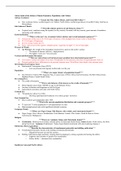
QUESTION 1
After risks are identified and vulnerabilities assessed, management must decide how
to respond in order to safeguard organisational assets. According to Rogers, Van
Schalkwyk, and Ngoveni (2017), there are four cost-effective decisions available to
management, commonly referred to as the “four Ts” of risk management: terminate,
tolerate, transfer, and treat.
The first option, terminate, involves stopping the risky activity altogether. This is
chosen when the potential consequences are too severe to justify continuation. For
example, if delivery trucks are repeatedly hijacked in a high-crime zone, a company
may decide to terminate deliveries to that area and instead require customers to
collect goods at a safer location (Rogers et al., 2017).
The second option, tolerate, is selected when the risk is minor and not worth the
cost of implementing controls. For instance, the occasional loss of office stationery
may be tolerated as the cost of control would outweigh the benefit. However,
tolerance must be balanced, as small losses can escalate if not monitored (Rogers
et al., 2017).
The third option, transfer, occurs when responsibility for the risk is shifted to a third
party. This is commonly done through insurance or outsourcing. For example,
contracting a cash-in-transit company to transport money reduces the organisation’s
direct exposure (Rogers et al., 2017).
Finally, treat involves implementing control measures to minimise risk. Examples
include installing CCTV, access control systems, and alarm-linked tagging devices in
retail environments. This option is often the most practical and ensures that threats
are managed at their root cause (Rogers et al., 2017).
QUESTION 2
Security Measures Costs
Disclaimer
Great care has been taken in the preparation of this document; however, the contents are provided "as is"
without any express or implied representations or warranties. The author accepts no responsibility or
liability for any actions taken based on the information contained within this document. This document is
intended solely for comparison, research, and reference purposes. Reproduction, resale, or transmission
of any part of this document, in any form or by any means, is strictly prohibited.
Assignment 2 Semester 2 2025
Unique number:
Due Date: 2 October 2025
QUESTION 1
After risks are identified and vulnerabilities assessed, management must decide how to
respond in order to safeguard organisational assets. According to Rogers, Van Schalkwyk,
and Ngoveni (2017), there are four cost-effective decisions available to management,
commonly referred to as the “four Ts” of risk management: terminate, tolerate, transfer, and
treat.
The first option, terminate, involves stopping the risky activity altogether. This is chosen
when the potential consequences are too severe to justify continuation. For example, if
delivery trucks are repeatedly hijacked in a high-crime zone, a company may decide to
terminate deliveries to that area and instead require customers to collect goods at a safer
location (Rogers et al., 2017).
The second option, tolerate, is selected when the risk is minor and not worth the cost of
implementing controls. For instance, the occasional loss of office stationery may be tolerated
as the cost of control would outweigh the benefit. However, tolerance must be balanced, as
Terms of use
small losses can escalate if not monitored (Rogers et al., 2017).
By making use of this document you agree to:
Use this document as a guide for learning, comparison and reference purpose,
Terms of use
Not to duplicate, reproduce and/or misrepresent the contents of this document as your own work,
By making use of this document you agree to:
Use this document
Fully accept the consequences
solely as a guide forshould you plagiarise
learning, reference,or and
misuse this document.
comparison purposes,
Ensure originality of your own work, and fully accept the consequences should you plagiarise or misuse this document.
Comply with all relevant standards, guidelines, regulations, and legislation governing academic and written work.
Disclaimer
Great care has been taken in the preparation of this document; however, the contents are provided "as is" without any express or
implied representations or warranties. The author accepts no responsibility or liability for any actions taken based on the
information contained within this document. This document is intended solely for comparison, research, and reference purposes.
Reproduction, resale, or transmission of any part of this document, in any form or by any means, is strictly prohibited.
, +27 67 171 1739
QUESTION 1
After risks are identified and vulnerabilities assessed, management must decide how
to respond in order to safeguard organisational assets. According to Rogers, Van
Schalkwyk, and Ngoveni (2017), there are four cost-effective decisions available to
management, commonly referred to as the “four Ts” of risk management: terminate,
tolerate, transfer, and treat.
The first option, terminate, involves stopping the risky activity altogether. This is
chosen when the potential consequences are too severe to justify continuation. For
example, if delivery trucks are repeatedly hijacked in a high-crime zone, a company
may decide to terminate deliveries to that area and instead require customers to
collect goods at a safer location (Rogers et al., 2017).
The second option, tolerate, is selected when the risk is minor and not worth the
cost of implementing controls. For instance, the occasional loss of office stationery
may be tolerated as the cost of control would outweigh the benefit. However,
tolerance must be balanced, as small losses can escalate if not monitored (Rogers
et al., 2017).
The third option, transfer, occurs when responsibility for the risk is shifted to a third
party. This is commonly done through insurance or outsourcing. For example,
contracting a cash-in-transit company to transport money reduces the organisation’s
direct exposure (Rogers et al., 2017).
Finally, treat involves implementing control measures to minimise risk. Examples
include installing CCTV, access control systems, and alarm-linked tagging devices in
retail environments. This option is often the most practical and ensures that threats
are managed at their root cause (Rogers et al., 2017).
QUESTION 2
Security Measures Costs
Disclaimer
Great care has been taken in the preparation of this document; however, the contents are provided "as is"
without any express or implied representations or warranties. The author accepts no responsibility or
liability for any actions taken based on the information contained within this document. This document is
intended solely for comparison, research, and reference purposes. Reproduction, resale, or transmission
of any part of this document, in any form or by any means, is strictly prohibited.