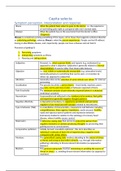
Capita selecta
Symptom perception, interpretation and response
Illness What the patient feels when he goes to the doctor, i.e. the experience
of not feeling quite right as compared with one’s normal state.
Disease What the patient has on the way home from the doctor’s office.
(Diagnosis)
Disease is considered as being something of the organ, cell or tissue that suggests a physical disorder
or underlying pathology, whereas illness is what the person experiences. People can feel ill without
having an identifiable disease, and, importantly, people can have a disease and not feel ill.
Processes of getting ill:
1. Perceiving symptoms
2. Interpreting symptoms as illness
3. Planning and taking actions
Subjective Personal, i.e. what a person thinks and reports (e.g. excitement) as
opposed to what is objective. Subjective is generally related to internal
interpretations of events rather than observable features.
Objective I.e. real, visible or systematically measurable (e.g. adrenaline levels).
Generally pertains to something that can be seen, or recorded, by
others (as opposed to subjective).
Attention Generally refers to the selection of some stimuli over others for internal
processing.
Socialization The process by which a person learns – from family, teachers, peers –
the rules, norms and moral codes of behavior expected of them.
Pain thresholds The minimum amount of pain intensity required before it is detected
(individual variation).
Neuroticism A personality trait reflected in the tendency to be anxious, feel guilty
and experience generally negative thought patterns.
Negative affectivity A dispositional tendency to experience persistent and pervasive
negative or low mood and self-concept (related to neuroticism).
Type A behavior (TAB) A constellation of characteristics, mannerisms and behavior including
competitiveness, time urgency, impatience, easily aroused, hostility,
rapid and vigorous speech patterns and expressive behavior.
Extensively studied in relation to the aetiology of coronary heart
disease, where hostility seems central.
Repression A defensive coping style that serves to protect the person from
negative memories or anxiety-producing thoughts by preventing their
gaining access to consciousness.
Comparative optimism Initially termed ‘unrealistic optimism’, this term describes an
individual’s estimate of their risk of experiencing a negative event
compared with similar others.
Monitors This generalized coping style involves attending to the source of stress
or threat and trying to deal with it directly, e.g. through information-
gathering/ attending to threat-relevant information (as opposed to
blunters).
Blunters This general coping style involves minimizing or avoiding the source of
threat or stress, i.e. avoiding threat-relevant information (as opposed to
monitors).
, (1)Symptom perception:
There are several models of symptom perception:
- The attentional model of Pennebaker (1982)
describes how competition for attention
between multiple internal or external cues or
stimuli leads to the same physical sign or
physiological change going unnoticed in some
contexts but not in others.
- The cognitive–perceptual model of Cioffi
(1991) focuses more on the processes of
interpretation of physical signs and influences upon their attribution as symptoms while also
acknowledging the role of selective attention.
Symptoms generally result from physiological changes with physical (somatic) properties, but the fact
that only some will be detected by the individual highlights that biological explanations of symptom
perception are insufficient. Those receiving attention and interpretation as a symptom are likely to
be:
- Painful or disruptive: if a bodily sign has consequences for the person, they are more likely to
perceive the symptoms
- Novel; when a symptom is perceived as novel, is likely to be considered indicative of
something rare and serious. If a symptom is thought to be common, this leads to
assumptions of lower severity and a reduced likelihood to seek out health information or
care.
- Persistent: a bodily sign is more likely to be perceived as a symptom if it persists for longer
than is considered usual
- Pre-existing chronic disease: past or current illness experience has a strong influence upon
somatization and increases the number of other symptoms perceived and reported. Previous
experience with an illness can increase a person’s attentional bias.
Pennebaker discovered that somatic sensations are less likely to be noticed when a person’s
attention is engaged externally than when they are not otherwise distracted.
- Competition of cues theory Individuals are limited in their attentional capacity, so internal
and external stimuli have to compete for attention. Therefore, some people notice
symptoms earlier on, and some people don’t notice symptoms at all. A high degree of
attention increases a person’s sensitivity to new, or different, bodily signs.
‘Medical student’s disease’ the increased knowledge about disease-specific symptoms obtained
during medical lectures increased the self-reported experience of exactly these symptoms among
medical students
Two attentional systems which are proposed to influence how symptom information is processed:
1. Primary attentional system (PAS): proposed to operate below the level of consciousness and
acts on stored representations, such as illness schema which it automatically selects from
when a person for whatever reasons, over-attends to somatic (bodily) experiences. This can
lead to wrong matched pre-existing schemas this might happen in cases of medical
student disease.
, 2. Secondary attentional system (SAS): is considered more amenable to executive control, i.e.
attention here can be manipulated by conscious thoughts and cognitive processes, such as
rational weighing up of likelihood. This process is hampered if the PAS has already decided
where the person’s attention is focused on, and this can be difficult to change.
Social influences on symptom perception:
- Our motivation to attend to and detect signs or symptoms of illness will depend on the
context at the time the symptom presents itself.
- Amongst children and adolescents there is evidence that peer presence can influence the
willingness to express symptoms, referred to as ‘social display rules’.
Individual differences affecting symptom perception:
- Gender; It is often proposed that gender socialization provides women with a greater
readiness to attend to and perceive bodily signs and symptoms. However, in a study among
men with prostate disease, they found that men learn to ignore symptoms out of a need to
be seen to be strong and masculine, point to a lack of understanding about prostate
problems being symptoms of illness as opposed to part of ageing, and highlight men’s
unwillingness or anxiety about taking ‘embarrassing’ symptoms to a health-care professional.
It may also be that physiological differences arising from puberty and menstruation influence
pain thresholds in the first place, or perhaps the evidence that women talk about symptoms
more and attend health care more does not reflect so much a gender difference in symptom
perception as one in reporting behavior.
- Life stage; With age comes experience and typically an increasing awareness of one’s internal
organs, their functions and sensations. Increasing age tends to be associated with increased
symptom self-report. The child’s own symptom perception is influenced by similar
attentional, contextual, individual and emotional influences as seen in adults.
- Emotional state; People who are in a positive mood tend to rate themselves as more healthy
and indicate fewer symptoms, whereas people in negative moods report more symptoms,
are more pessimistic about their ability to act to relieve their symptoms and believe
themselves to be more susceptible to illness. Negative emotional states, particularly anxiety
or depression, may increase symptom perception by means of its effect on attention, as well
as by increasing rumination and recall of prior negative health events, which increases the
likelihood of new bodily signs being viewed as symptoms of further illness.
- Personality traits; Neuroticism (N) is described as a trait-like tendency to experience negative
emotional states and is related to the broader construct ‘negative affectivity’ (NA). NA can
manifest itself either as a state (situation-specific) or a trait (generalized). State NA can
incorporate a range of emotions, including anger, sadness and fear. In terms of perceptual
style, neurotics and those high in trait NA are more introspective and attend more negatively
to somatic information and thus they perceive more frequent symptoms and are more likely
to misattribute them to under-lying disease.
Coping styles:
- There is some evidence that individuals characterized by time urgency, impatience, hostility
and (i.e. type A behavior) are less likely to perceive symptoms, perhaps because they are
highly task-focused or because they avoid paying attention to signs of self-weakness.
- There is also evidence that people who cope with aversive events by using the cognitive
defense mechanism of repression are less likely to experience symptoms than non-
Symptom perception, interpretation and response
Illness What the patient feels when he goes to the doctor, i.e. the experience
of not feeling quite right as compared with one’s normal state.
Disease What the patient has on the way home from the doctor’s office.
(Diagnosis)
Disease is considered as being something of the organ, cell or tissue that suggests a physical disorder
or underlying pathology, whereas illness is what the person experiences. People can feel ill without
having an identifiable disease, and, importantly, people can have a disease and not feel ill.
Processes of getting ill:
1. Perceiving symptoms
2. Interpreting symptoms as illness
3. Planning and taking actions
Subjective Personal, i.e. what a person thinks and reports (e.g. excitement) as
opposed to what is objective. Subjective is generally related to internal
interpretations of events rather than observable features.
Objective I.e. real, visible or systematically measurable (e.g. adrenaline levels).
Generally pertains to something that can be seen, or recorded, by
others (as opposed to subjective).
Attention Generally refers to the selection of some stimuli over others for internal
processing.
Socialization The process by which a person learns – from family, teachers, peers –
the rules, norms and moral codes of behavior expected of them.
Pain thresholds The minimum amount of pain intensity required before it is detected
(individual variation).
Neuroticism A personality trait reflected in the tendency to be anxious, feel guilty
and experience generally negative thought patterns.
Negative affectivity A dispositional tendency to experience persistent and pervasive
negative or low mood and self-concept (related to neuroticism).
Type A behavior (TAB) A constellation of characteristics, mannerisms and behavior including
competitiveness, time urgency, impatience, easily aroused, hostility,
rapid and vigorous speech patterns and expressive behavior.
Extensively studied in relation to the aetiology of coronary heart
disease, where hostility seems central.
Repression A defensive coping style that serves to protect the person from
negative memories or anxiety-producing thoughts by preventing their
gaining access to consciousness.
Comparative optimism Initially termed ‘unrealistic optimism’, this term describes an
individual’s estimate of their risk of experiencing a negative event
compared with similar others.
Monitors This generalized coping style involves attending to the source of stress
or threat and trying to deal with it directly, e.g. through information-
gathering/ attending to threat-relevant information (as opposed to
blunters).
Blunters This general coping style involves minimizing or avoiding the source of
threat or stress, i.e. avoiding threat-relevant information (as opposed to
monitors).
, (1)Symptom perception:
There are several models of symptom perception:
- The attentional model of Pennebaker (1982)
describes how competition for attention
between multiple internal or external cues or
stimuli leads to the same physical sign or
physiological change going unnoticed in some
contexts but not in others.
- The cognitive–perceptual model of Cioffi
(1991) focuses more on the processes of
interpretation of physical signs and influences upon their attribution as symptoms while also
acknowledging the role of selective attention.
Symptoms generally result from physiological changes with physical (somatic) properties, but the fact
that only some will be detected by the individual highlights that biological explanations of symptom
perception are insufficient. Those receiving attention and interpretation as a symptom are likely to
be:
- Painful or disruptive: if a bodily sign has consequences for the person, they are more likely to
perceive the symptoms
- Novel; when a symptom is perceived as novel, is likely to be considered indicative of
something rare and serious. If a symptom is thought to be common, this leads to
assumptions of lower severity and a reduced likelihood to seek out health information or
care.
- Persistent: a bodily sign is more likely to be perceived as a symptom if it persists for longer
than is considered usual
- Pre-existing chronic disease: past or current illness experience has a strong influence upon
somatization and increases the number of other symptoms perceived and reported. Previous
experience with an illness can increase a person’s attentional bias.
Pennebaker discovered that somatic sensations are less likely to be noticed when a person’s
attention is engaged externally than when they are not otherwise distracted.
- Competition of cues theory Individuals are limited in their attentional capacity, so internal
and external stimuli have to compete for attention. Therefore, some people notice
symptoms earlier on, and some people don’t notice symptoms at all. A high degree of
attention increases a person’s sensitivity to new, or different, bodily signs.
‘Medical student’s disease’ the increased knowledge about disease-specific symptoms obtained
during medical lectures increased the self-reported experience of exactly these symptoms among
medical students
Two attentional systems which are proposed to influence how symptom information is processed:
1. Primary attentional system (PAS): proposed to operate below the level of consciousness and
acts on stored representations, such as illness schema which it automatically selects from
when a person for whatever reasons, over-attends to somatic (bodily) experiences. This can
lead to wrong matched pre-existing schemas this might happen in cases of medical
student disease.
, 2. Secondary attentional system (SAS): is considered more amenable to executive control, i.e.
attention here can be manipulated by conscious thoughts and cognitive processes, such as
rational weighing up of likelihood. This process is hampered if the PAS has already decided
where the person’s attention is focused on, and this can be difficult to change.
Social influences on symptom perception:
- Our motivation to attend to and detect signs or symptoms of illness will depend on the
context at the time the symptom presents itself.
- Amongst children and adolescents there is evidence that peer presence can influence the
willingness to express symptoms, referred to as ‘social display rules’.
Individual differences affecting symptom perception:
- Gender; It is often proposed that gender socialization provides women with a greater
readiness to attend to and perceive bodily signs and symptoms. However, in a study among
men with prostate disease, they found that men learn to ignore symptoms out of a need to
be seen to be strong and masculine, point to a lack of understanding about prostate
problems being symptoms of illness as opposed to part of ageing, and highlight men’s
unwillingness or anxiety about taking ‘embarrassing’ symptoms to a health-care professional.
It may also be that physiological differences arising from puberty and menstruation influence
pain thresholds in the first place, or perhaps the evidence that women talk about symptoms
more and attend health care more does not reflect so much a gender difference in symptom
perception as one in reporting behavior.
- Life stage; With age comes experience and typically an increasing awareness of one’s internal
organs, their functions and sensations. Increasing age tends to be associated with increased
symptom self-report. The child’s own symptom perception is influenced by similar
attentional, contextual, individual and emotional influences as seen in adults.
- Emotional state; People who are in a positive mood tend to rate themselves as more healthy
and indicate fewer symptoms, whereas people in negative moods report more symptoms,
are more pessimistic about their ability to act to relieve their symptoms and believe
themselves to be more susceptible to illness. Negative emotional states, particularly anxiety
or depression, may increase symptom perception by means of its effect on attention, as well
as by increasing rumination and recall of prior negative health events, which increases the
likelihood of new bodily signs being viewed as symptoms of further illness.
- Personality traits; Neuroticism (N) is described as a trait-like tendency to experience negative
emotional states and is related to the broader construct ‘negative affectivity’ (NA). NA can
manifest itself either as a state (situation-specific) or a trait (generalized). State NA can
incorporate a range of emotions, including anger, sadness and fear. In terms of perceptual
style, neurotics and those high in trait NA are more introspective and attend more negatively
to somatic information and thus they perceive more frequent symptoms and are more likely
to misattribute them to under-lying disease.
Coping styles:
- There is some evidence that individuals characterized by time urgency, impatience, hostility
and (i.e. type A behavior) are less likely to perceive symptoms, perhaps because they are
highly task-focused or because they avoid paying attention to signs of self-weakness.
- There is also evidence that people who cope with aversive events by using the cognitive
defense mechanism of repression are less likely to experience symptoms than non-