

Rates of Reactions
Collisions:
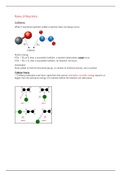
When 2 reactance particles collide a reaction does not always occur
Ek1 Ek2
Collision
Kinetic energy:
If Ek1 + Ek2 ≥ Ea than a successful collision, a reaction takes place, could occur.
If Ek1 + Ek2 < Ea than a successful collision, no reaction, will occur.
Orientation:
Must collide so that the functional group, or centres of chemical activity, are in contact.
Collision theory
= Colliding molecules must have, apart from the correct orientation, a kinetic energy equal to or
bigger than the activation energy of a reaction before the reaction can take place.
,Rate of reaction
The change in concentration per unit time of either a reactant or a product.
𝐶ℎ𝑎𝑛𝑔𝑒 𝑖𝑛 𝑐𝑜𝑛𝑐𝑒𝑛𝑡𝑟𝑎𝑡𝑖𝑜𝑛 ∆𝑐
Rate = 𝑇𝑜𝑡𝑎𝑙 𝑡𝑖𝑚𝑒 𝑡𝑎𝑘𝑒𝑛
= ∆𝑡
Factors that affect reaction rate:
Nature of the reacting substances, but we cannot alter this, so rarely asked.
To increase reaction rate:
1. Increase the temperature
2. Add a catalyst at the start
3. Gas: Increase the pressure
4. Liquid or solution: Increase the concentration
5. Solid: Increase the surface area, by breaking into smaller pieces
, Measuring rates and graphs
The gradient of the tangent to the curve is used to determine rate.
∆𝑉 𝑜𝑟 ∆𝑐 𝑜𝑟 ∆𝑚
Gradient = ∆𝑡
= rate of reaction
Graphs:
Graph 1: Using products
e.g. Volume of gas formed (ml)
Time (s)
Graph 2: Using reactants
e.g. Mass of flask (g)
Time (s)
Collisions:
When 2 reactance particles collide a reaction does not always occur
Ek1 Ek2
Collision
Kinetic energy:
If Ek1 + Ek2 ≥ Ea than a successful collision, a reaction takes place, could occur.
If Ek1 + Ek2 < Ea than a successful collision, no reaction, will occur.
Orientation:
Must collide so that the functional group, or centres of chemical activity, are in contact.
Collision theory
= Colliding molecules must have, apart from the correct orientation, a kinetic energy equal to or
bigger than the activation energy of a reaction before the reaction can take place.
,Rate of reaction
The change in concentration per unit time of either a reactant or a product.
𝐶ℎ𝑎𝑛𝑔𝑒 𝑖𝑛 𝑐𝑜𝑛𝑐𝑒𝑛𝑡𝑟𝑎𝑡𝑖𝑜𝑛 ∆𝑐
Rate = 𝑇𝑜𝑡𝑎𝑙 𝑡𝑖𝑚𝑒 𝑡𝑎𝑘𝑒𝑛
= ∆𝑡
Factors that affect reaction rate:
Nature of the reacting substances, but we cannot alter this, so rarely asked.
To increase reaction rate:
1. Increase the temperature
2. Add a catalyst at the start
3. Gas: Increase the pressure
4. Liquid or solution: Increase the concentration
5. Solid: Increase the surface area, by breaking into smaller pieces
, Measuring rates and graphs
The gradient of the tangent to the curve is used to determine rate.
∆𝑉 𝑜𝑟 ∆𝑐 𝑜𝑟 ∆𝑚
Gradient = ∆𝑡
= rate of reaction
Graphs:
Graph 1: Using products
e.g. Volume of gas formed (ml)
Time (s)
Graph 2: Using reactants
e.g. Mass of flask (g)
Time (s)

