Social Science Psychology Clinical Psychology
Pearson RBT Exam
Save
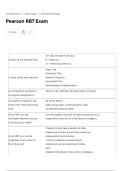
Sd- discriminative stimulus
3 parts of the discrete trial R- response
Sr- reinforcing stimulus.
Mass Trial
Distracter Trial
5 steps of the discrete trial Random Rotation
Expanded Trial
Generalization/Maintenance
An Acquisition program is Teach a new skill the individual does not have.
a program designed to...
Acquisition programs can all of the above
teach with of the following (daily living skills, communication skills,
skills recreational/leisure skills)
As an RBT you are You are legally required to report instances of, or
mandated reporter by law, suspected instances of, child abuse or neglect.
what does this mean?
Prepare to and take a variety of data,
implement continuous and discontinuous
As an RBT you will be measurement procedures,
expected to do which of conduct preference assessments,
the following? implement various teaching formats,
and
implement behavior intervention strategies.
, Automatic Negative Something taken away without need for another
Reinforcement person
Automatic Positive something added without the need of another person
Reinforcement
reinforcement not requiring mediation from another
Automatic Reinforcement
person
providing a client with automatic reinforcement or
Automatic Reinforcement teaching a client to provide him/herself with
Interventions: automatic reinforcement appropriately by providing
breaks or a time to engage in these activities.
interrupting maladaptive, or stereotypic behaviors
Behavior interrupting
with appropriate and incompatible behavior.
Antecedent Based and Consequence Based
Behavior Reduction
Interventions designed to reduce
Interventions
maladaptive/problem behaviors.
calculate frequency/rate 60 per hour, 1 per minute
per hour and minute for a
behavior that occurred 120
times over a 2 hour
observation
Any instance of the client crying and hitting himself in
Choose the best the head with a closed fist which makes a sound that
operational definition for a can be heard within five feet. Instance must last
tantrum longer than 30 seconds and are separated by 30
seconds of non-occurrence.
Pearson RBT Exam
Save
Sd- discriminative stimulus
3 parts of the discrete trial R- response
Sr- reinforcing stimulus.
Mass Trial
Distracter Trial
5 steps of the discrete trial Random Rotation
Expanded Trial
Generalization/Maintenance
An Acquisition program is Teach a new skill the individual does not have.
a program designed to...
Acquisition programs can all of the above
teach with of the following (daily living skills, communication skills,
skills recreational/leisure skills)
As an RBT you are You are legally required to report instances of, or
mandated reporter by law, suspected instances of, child abuse or neglect.
what does this mean?
Prepare to and take a variety of data,
implement continuous and discontinuous
As an RBT you will be measurement procedures,
expected to do which of conduct preference assessments,
the following? implement various teaching formats,
and
implement behavior intervention strategies.
, Automatic Negative Something taken away without need for another
Reinforcement person
Automatic Positive something added without the need of another person
Reinforcement
reinforcement not requiring mediation from another
Automatic Reinforcement
person
providing a client with automatic reinforcement or
Automatic Reinforcement teaching a client to provide him/herself with
Interventions: automatic reinforcement appropriately by providing
breaks or a time to engage in these activities.
interrupting maladaptive, or stereotypic behaviors
Behavior interrupting
with appropriate and incompatible behavior.
Antecedent Based and Consequence Based
Behavior Reduction
Interventions designed to reduce
Interventions
maladaptive/problem behaviors.
calculate frequency/rate 60 per hour, 1 per minute
per hour and minute for a
behavior that occurred 120
times over a 2 hour
observation
Any instance of the client crying and hitting himself in
Choose the best the head with a closed fist which makes a sound that
operational definition for a can be heard within five feet. Instance must last
tantrum longer than 30 seconds and are separated by 30
seconds of non-occurrence.