

Escrito por estudiantes que aprobaron Inmediatamente disponible después del pago Leer en línea o como PDF ¿Documento equivocado? Cámbialo gratis 4,6 TrustPilot
logo-home
Document preview thumbnail
Vista previa 2 fuera de 6 páginas
Examen

BUSML 3250 Exam 2025

Document preview thumbnail
Vista previa 2 fuera de 6 páginas

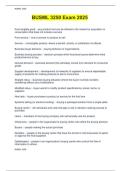
BUSML 3250 Exam 2025 Pure tangible good - -any product that can be offered to the market for acquisition or consumption that does not include a service Pure service - -only a service no product to sell Service - -nontangible product, where a benefit, activity, or safisfaction is offered Business buyer behavior - -buying behavior of organizations Business buying process - -decision process which business buyers determine what product/service to buy Derived demand - -business demand that ultimately comes from demand for consumer goods Supplier development - -development of networks of suppliers to ensure dependable supply of products for making products to sell to consumers Straight rebuy - -business buying stituation where the buyer routinely reorders something without any modifications Modified rebuy - -buyer wants to modify product specifications, prices, terms, or suppliers New task - -buyer purchases a product or service for the first time Systems selling (or solutions selling) - -buying a packaged solution from a single seller Buying center - -all individuals and units that play a role in decision making process of purchase Users - -members of the buying company who will actually use the product Influencers - -people in the organization's buying center who affect the buying decision Buyers - -people making the actual purchase Deciders - -people in the buying center that have the formal or informal power to select or approve the final suppliers Gatekeepers - -people in an organization's buying center who control the flow of information to others BUSML 3250 BUSML 3250 Problem recognition - -stage in business buying process which a company recognizes a problem that needs to be met by acquiring a good or service General need description - -stage is BBP which a buyer describes the characteristics and quantity of what is needed Product specification - -stage of BBP which buying organization decides on and specifies the best technical product characteristic for a needed item Supplier search - -stage of BBP which the buyer tries to find the best vendors Proposal solicitation - -stage of BBP which buyer invites qualified suppliers to submit proposals Supplier selection - -Stage of business buying process which the buyer reviews proposals and selects a supplier Order-routine specification - -stage of BBP which buyer writes final order to supplier Performance review - -stage of BBP which buyer assess the performance of the supplier and decides to continue, modify, or drop the arrangement E-procurement - -purchasing through electronic connections, gives buyers access to new suppliers, lower costs, and sped up processing and delivering Institutional market - -schools, hospitals, nursing homes, prison, and other institutions, provide services to people in their care Government market - -government units that purchase/rent goods or services for carrying out main functions of government Market segmentation - -dividing a marketing into smaller segments of buyers with distinct needs, characteristics, or behaviors Market targeting - -evaluating each market segment's attractiveness and selecting one or more segment to enter Differentiation - -differentiating the market offering to create superior customer value Positioning - -arranging for a market offering to occupy a clear, distinctive, and desirable place relative to competing products in the minds of target consumers Geographic segmentation - -dividing the market into different geographical units BUSML 3250 BUSML 3250 Demographic segmentation - -dividing market into segments based on variables such as age, life-cycle stage, gender, income, occupation, education, religion, etc. Age and life-cycle segmentation - -dividing a market into different age and life-cycle groups Gender segmentation - -different segments based on gender Income segmentation - -market into different income segments Psychographic segmentation - -dividing a market into different segments based on social class, lifestyle, or personally characteristics Behavioral segmentation - -market into segments based on consumer knowledge, attitudes, uses, or responses to a product Occasion segmentation - -dividing the market into segments according to occasions when buyers get the idea to buy, actually make their purchase or use the purchased item Benefit segmentation - -dividing market into segments according to the different benefits that consumers seek from the product Intermarket segmentation - -forming segments of consumers who have similar needs and buying behaviors even though they are located in different countries Target market - -set of buyers sharing common meeds that company decides to serve Undifferentiated (mass) marketing - -a market coverage strategy in which a firm decides to ignore market segment difference and go after whole market with one offer Differentiated (segmented) marketing - -marketing coverage strategy in which a firm decides to target several market segments and designs separate offers for each Concentrated (niche) marketing - -marketing-coverage strategy in which a firm goes a large share of one or a few segments or niches Micromarketing - -tailoring products and marketing programs to the needs and wants of specific individuals and local customer segments; includes lock and individual marketing Local marketing - -marketing to the needs and wants of local customer segments Individual marketing - -marketing programs to the needs and preferences of individual customers BUSML 3250 BUSML 3250 Product position - -how a product is defined by consumers on important attributes- the place the product occupies in consumers' minds relatives to competing products Competitive advantage - -advantage over competitors gained by offering greater customer value Value proposition - -the full mix of benefits on which it is positioned Positioning statement - -summarizes company or brand positioning using this form: to (target segment and need) our (brand) is (concept) that (point of difference) Consumer product - -product bought by final consumers for personal consumption Convenience product - -consumer product that customers usually buy frequently, immediately, and with minimal comparison and buying effort; generally the lowest price Shopping product - -consumer product that the customer usually compares on such attributes such as sustainability, quality, price, style Specialty product - -consumer product with unique characteristics or brand identification for which a significant group of buyers is willing to make a special purchase effort Unsought product - -consumer product that the consumer either does not know about or knows about but does not normally consider buying Industrial product - -product bought by individuals and organizations for further processing or for use in conducting a business Social marketing - -use of commercial marketing concepts and tools in programs designed to influence individuals' behavior to improve their well-being and that of society Product quality - -characteristics of a product or service that bear on its ability to satsfy stated or implied customer needs Product line - -group of products that are closely related because they function in a similar manner, are sold to the same customer groups, are marketed through the same types of outlets or fall within given price ranges Product Mix - -set of all product lines and items that a particular seller offers for sale Service intangibility - -service cannot be seen, tasted, felt, heard, or smelled before they are bought Service inseparability - -services are produced and consumed at the same time and cannot be separated from their providers BUSML 3250 BUSML 3250 Service variability - -quality of services may vary greatly depending on who provides them and when. Where, and how they are provided Service perishability - -services cannot be stored for later sale or use Service profit chain - -chain that links service firm profits with employee and customer satisfaction Internal marketing - -orienting and motivating customer - contact employees and supporting service employees to work as a team to provide customer satisfaction Interactive marketing - -training service employees in the fine art of interacting with customers to satisfy their needs Brand equity - -differential effect that knowing the brand name has on customer response to the product or its marketing Line extensions - -extending an existing brand name to new forms, colors, sizes, ingredients, or flavors of an existing product category Brand extension - -extending an existing brand name to new product categories Consumer buyer behavior - -buying behavior of final consumers - individuals and households that buy goods and services for personal consumption Consumer market - -all the individuals and households that buy or acquire goods and services for personal consumptions Culture - -set of basic, values, perceptions, wants, and behaviors learned by a member of society from family and other important institutions Subculture - -group of people with shared value systems based on common life experiences and situations Social class - -relatively permanent and ordered division in a society whose members share similar values and behaviors Group - -two or more people who interact to accomplish individual and mutual goals Word-of-mouth influence - -impact of personal words and recommendations of trusted friends, associates and other consumers on buying behavior Opinion leader - -person within reference group who, because of special skills, knowledge, personality, or other characteristics,

Vista previa del contenido

BUSML 3250


BUSML 3250 Exam 2025

Pure tangible good - -any product that can be offered to the market for acquisition or
consumption that does not include a service

Pure service - -only a service no product to sell

Service - -nontangible product, where a benefit, activity, or safisfaction is offered

Business buyer behavior - -buying behavior of organizations

Business buying process - -decision process which business buyers determine what
product/service to buy

Derived demand - -business demand that ultimately comes from demand for consumer
goods

Supplier development - -development of networks of suppliers to ensure dependable
supply of products for making products to sell to consumers

Straight rebuy - -business buying stituation where the buyer routinely reorders
something without any modifications

Modified rebuy - -buyer wants to modify product specifications, prices, terms, or
suppliers

New task - -buyer purchases a product or service for the first time

Systems selling (or solutions selling) - -buying a packaged solution from a single seller

Buying center - -all individuals and units that play a role in decision making process of
purchase

Users - -members of the buying company who will actually use the product

Influencers - -people in the organization's buying center who affect the buying decision

Buyers - -people making the actual purchase

Deciders - -people in the buying center that have the formal or informal power to select
or approve the final suppliers

Gatekeepers - -people in an organization's buying center who control the flow of
information to others

BUSML 3250

, BUSML 3250


Problem recognition - -stage in business buying process which a company recognizes a
problem that needs to be met by acquiring a good or service

General need description - -stage is BBP which a buyer describes the characteristics
and quantity of what is needed

Product specification - -stage of BBP which buying organization decides on and
specifies the best technical product characteristic for a needed item

Supplier search - -stage of BBP which the buyer tries to find the best vendors

Proposal solicitation - -stage of BBP which buyer invites qualified suppliers to submit
proposals

Supplier selection - -Stage of business buying process which the buyer reviews
proposals and selects a supplier

Order-routine specification - -stage of BBP which buyer writes final order to supplier

Performance review - -stage of BBP which buyer assess the performance of the
supplier and decides to continue, modify, or drop the arrangement

E-procurement - -purchasing through electronic connections, gives buyers access to
new suppliers, lower costs, and sped up processing and delivering

Institutional market - -schools, hospitals, nursing homes, prison, and other institutions,
provide services to people in their care

Government market - -government units that purchase/rent goods or services for
carrying out main functions of government

Market segmentation - -dividing a marketing into smaller segments of buyers with
distinct needs, characteristics, or behaviors

Market targeting - -evaluating each market segment's attractiveness and selecting one
or more segment to enter

Differentiation - -differentiating the market offering to create superior customer value

Positioning - -arranging for a market offering to occupy a clear, distinctive, and desirable
place relative to competing products in the minds of target consumers

Geographic segmentation - -dividing the market into different geographical units


BUSML 3250

Información del documento

Subido en
20 de septiembre de 2025
Número de páginas
6
Escrito en
2025/2026
Tipo
Examen
Contiene
Preguntas y respuestas
$11.99

¿Documento equivocado? Cámbialo gratis Dentro de los 14 días posteriores a la compra y antes de descargarlo, puedes elegir otro documento. Puedes gastar el importe de nuevo.
Escrito por estudiantes que aprobaron
Inmediatamente disponible después del pago
Leer en línea o como PDF

Seller avatar
Los indicadores de reputación están sujetos a la cantidad de artículos vendidos por una tarifa y las reseñas que ha recibido por esos documentos. Hay tres niveles: Bronce, Plata y Oro. Cuanto mayor reputación, más podrás confiar en la calidad del trabajo del vendedor.
AlexScorer
2.5
(2)
Vendido
11
Seguidores
0
Artículos
1800
Última venta
2 semanas hace


Por qué los estudiantes eligen Stuvia

Creado por compañeros estudiantes, verificado por reseñas

Calidad en la que puedes confiar: escrito por estudiantes que aprobaron y evaluado por otros que han usado estos resúmenes.

¿No estás satisfecho? Elige otro documento

¡No te preocupes! Puedes elegir directamente otro documento que se ajuste mejor a lo que buscas.

Paga como quieras, empieza a estudiar al instante

Sin suscripción, sin compromisos. Paga como estés acostumbrado con tarjeta de crédito y descarga tu documento PDF inmediatamente.

Student with book image

“Comprado, descargado y aprobado. Así de fácil puede ser.”

Alisha Student

Preguntas frecuentes