
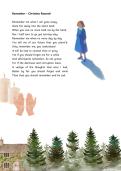
Remember – Christina Rossetti
Remember me when I am gone away,
Gone far away into the silent land;
When you can no more hold me by the hand,
Nor I half turn to go yet turning stay.
Remember me when no more day by day
You tell me of our future that you plann'd:
Only remember me; you understand
It will be late to counsel then or pray.
Yet if you should forget me for a while
And afterwards remember, do not grieve:
For if the darkness and corruption leave
A vestige of the thoughts that once I had,
Better by far you should forget and smile
Than that you should remember and be sad.
, - The title Remember is a direct, urgent plea that highlights the
poem’s focus on memory, loss, and emotional connection.
Remember
- Its simplicity and command-like tone immediately draw attention
to the speaker’s concern for how they will be remembered,
setting the reflective and intimate mood of the poem.
- Rossetti opens with a direct plea that immediately sets the tone
of intimacy and mortality, addressing the beloved with urgency
and tenderness.
- The word “remember” carries both a command and a hope,
showing the speaker’s desire for continuity of love even in
Remember me when I am absence.
gone away, - The phrase “gone away” is a gentle euphemism for death,
softening its harsh reality and presenting it as a departure
rather than an end, which reflects Victorian sensibilities about
speaking of mortality indirectly.
- By framing death as absence rather than annihilation, Rossetti
creates space for love and memory to survive, transforming grief
into an enduring emotional bond.
- Rossetti compresses both distance and finality into this image,
presenting death as a departure into an unfamiliar, unreachable
place.
The phrase “gone far away” evokes physical separation,
-
emphasizing the pain of absence, while “silent land” transforms
Gone far away into the death into a realm defined not by violence but by stillness and
muteness.
silent land;
The choice of “land” suggests permanence and territory, a
-
destination rather than a mere state, yet the silence attached to
it underscores the absence of communication, love, and vitality.
The line balances comfort and unease: death is not fiery or
-
chaotic, but its quietness carries an unsettling, eternal emptiness.
This line captures the intimacy of physical touch as a symbol of
-
love, presence, and human connection.
The “hand” represents not only comfort and affection but also
-
the everyday gestures that anchor relationships in tangible
When you can no more reality.
By imagining the moment when such touch is no longer possible,
hold me by the hand, -
the speaker gently introduces the inevitability of separation
through death.
The phrasing emphasizes loss by contrasting the ordinary, simple
-
act of holding hands with its future absence, turning a
commonplace action into something precious.
It conveys both tenderness and sorrow, underscoring how
-
mortality interrupts even the smallest, most loving rituals of
closeness.
Remember me when I am gone away,
Gone far away into the silent land;
When you can no more hold me by the hand,
Nor I half turn to go yet turning stay.
Remember me when no more day by day
You tell me of our future that you plann'd:
Only remember me; you understand
It will be late to counsel then or pray.
Yet if you should forget me for a while
And afterwards remember, do not grieve:
For if the darkness and corruption leave
A vestige of the thoughts that once I had,
Better by far you should forget and smile
Than that you should remember and be sad.
, - The title Remember is a direct, urgent plea that highlights the
poem’s focus on memory, loss, and emotional connection.
Remember
- Its simplicity and command-like tone immediately draw attention
to the speaker’s concern for how they will be remembered,
setting the reflective and intimate mood of the poem.
- Rossetti opens with a direct plea that immediately sets the tone
of intimacy and mortality, addressing the beloved with urgency
and tenderness.
- The word “remember” carries both a command and a hope,
showing the speaker’s desire for continuity of love even in
Remember me when I am absence.
gone away, - The phrase “gone away” is a gentle euphemism for death,
softening its harsh reality and presenting it as a departure
rather than an end, which reflects Victorian sensibilities about
speaking of mortality indirectly.
- By framing death as absence rather than annihilation, Rossetti
creates space for love and memory to survive, transforming grief
into an enduring emotional bond.
- Rossetti compresses both distance and finality into this image,
presenting death as a departure into an unfamiliar, unreachable
place.
The phrase “gone far away” evokes physical separation,
-
emphasizing the pain of absence, while “silent land” transforms
Gone far away into the death into a realm defined not by violence but by stillness and
muteness.
silent land;
The choice of “land” suggests permanence and territory, a
-
destination rather than a mere state, yet the silence attached to
it underscores the absence of communication, love, and vitality.
The line balances comfort and unease: death is not fiery or
-
chaotic, but its quietness carries an unsettling, eternal emptiness.
This line captures the intimacy of physical touch as a symbol of
-
love, presence, and human connection.
The “hand” represents not only comfort and affection but also
-
the everyday gestures that anchor relationships in tangible
When you can no more reality.
By imagining the moment when such touch is no longer possible,
hold me by the hand, -
the speaker gently introduces the inevitability of separation
through death.
The phrasing emphasizes loss by contrasting the ordinary, simple
-
act of holding hands with its future absence, turning a
commonplace action into something precious.
It conveys both tenderness and sorrow, underscoring how
-
mortality interrupts even the smallest, most loving rituals of
closeness.



