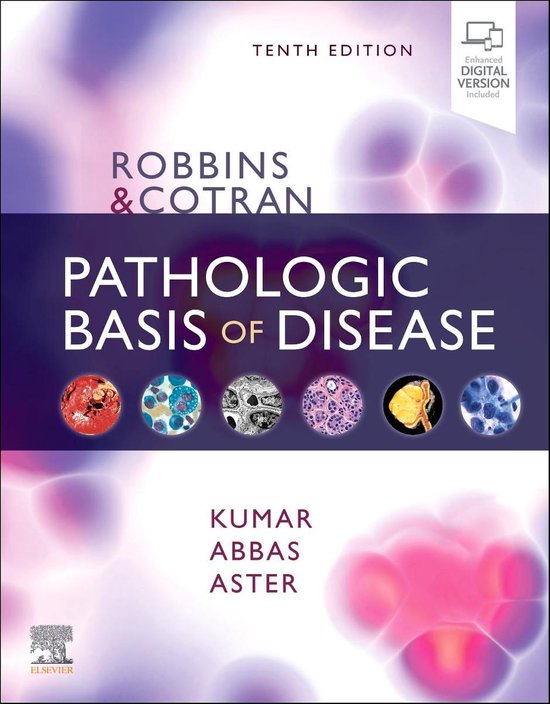
Robbins & Cotran 10th Ed. Pathology Test Bank | Chapter-
by-Chapter Questions & Verified Solutions
Robbins & Cotran Pathologic Basis of Disease
10th Edition
• Author(s)Vinay Kumar; Abul K. Abbas; Jon C. Aster
Chapter Reference – Chapter 1: The Cell as a Unit of Health
and Disease — The Genome
Stem: A 6-month-old infant presents with hypotonia and
developmental regression. Enzyme assay shows absent
hexosaminidase A activity; genetic testing reveals an insertion
causing a frameshift in the HEXA gene. Which mutation
consequence best explains the absent enzyme?
A. A silent mutation that reduces transcription.
B. A frameshift causing a premature stop codon and truncated
protein.
C. A missense mutation that increases enzymatic activity.
D. A promoter duplication increasing expression of an inhibitory
RNA.
Correct Answer: B
Rationale (correct): Frameshift insertions typically change the
reading frame, producing aberrant amino acids and frequently
,introducing premature stop codons that yield truncated,
nonfunctional proteins — explaining absent hexosaminidase A.
Incorrect A: Silent mutations do not change amino acids and
rarely reduce transcription; they would not explain complete
enzyme absence.
Incorrect C: Missense mutations alter a single amino acid and
may reduce activity, but they do not inherently increase activity
and are less likely to abolish protein entirely.
Incorrect D: Promoter duplications usually affect transcription
levels; producing an inhibitory RNA is unlikely and does not
match the frameshift finding.
Teaching Point: Frameshift mutations often create premature
stop codons that produce nonfunctional proteins.
2
Chapter Reference – Chapter 1: The Cell as a Unit of Health
and Disease — The Genome
Stem: A patient’s tumor shows microsatellite instability on
testing. Which DNA repair pathway defect is most likely
responsible?
A. Base excision repair.
B. Nucleotide excision repair.
C. Mismatch repair.
D. Homologous recombination.
Correct Answer: C
Rationale (correct): Microsatellite instability arises from
defects in mismatch repair proteins (e.g., MLH1, MSH2) that
,normally correct replication slippage and base–base mismatches.
Incorrect A: Base excision repair corrects small base lesions
(e.g., deaminations), not replication-associated microsatellite
errors.
Incorrect B: Nucleotide excision repair removes bulky helix-
distorting lesions (e.g., UV dimers), not microsatellite repeats.
Incorrect D: Homologous recombination repairs double-strand
breaks, not replication slippage at microsatellites.
Teaching Point: Mismatch repair defects cause microsatellite
instability and predispose to certain cancers.
3
Chapter Reference – Chapter 1: The Cell as a Unit of Health
and Disease — The Genome
Stem: A newborn screening reveals markedly elevated
phenylalanine. The likely mutation impairs which enzymatic
cofactor pathway?
A. Tetrahydrobiopterin (BH4) regeneration.
B. NADPH production in the pentose phosphate pathway.
C. Vitamin B12–dependent methylation.
D. Folate-mediated one-carbon metabolism.
Correct Answer: A
Rationale (correct): Classic phenylketonuria results from
phenylalanine hydroxylase deficiency or defects in BH4
synthesis/regeneration; BH4 is the required cofactor for
phenylalanine hydroxylase.
Incorrect B: NADPH is important for reductive biosynthesis
, and for glutathione reduction, not directly for phenylalanine
hydroxylation.
Incorrect C: Vitamin B12 pathways affect
homocysteine/methionine metabolism, not phenylalanine
hydroxylase activity.
Incorrect D: Folate pathways are involved in one-carbon
transfers; they don’t supply BH4 for phenylalanine
hydroxylation.
Teaching Point: BH4 is an essential cofactor for phenylalanine
hydroxylase; its deficiency mimics PKU.
4
Chapter Reference – Chapter 1: The Cell as a Unit of Health
and Disease — Cellular Housekeeping
Stem: A 45-year-old receives a drug that inhibits proteasome
activity. Which intracellular process will be most directly
impaired?
A. Lysosomal degradation of extracellular proteins.
B. Ubiquitin-mediated degradation of misfolded cytosolic
proteins.
C. Autophagy of large organelles like mitochondria.
D. Exocytosis of secretory granules.
Correct Answer: B
Rationale (correct): The proteasome degrades ubiquitinated
cytosolic and nuclear proteins; proteasome inhibition prevents
ubiquitin-mediated protein turnover, causing accumulation of
misfolded proteins.
by-Chapter Questions & Verified Solutions
Robbins & Cotran Pathologic Basis of Disease
10th Edition
• Author(s)Vinay Kumar; Abul K. Abbas; Jon C. Aster
Chapter Reference – Chapter 1: The Cell as a Unit of Health
and Disease — The Genome
Stem: A 6-month-old infant presents with hypotonia and
developmental regression. Enzyme assay shows absent
hexosaminidase A activity; genetic testing reveals an insertion
causing a frameshift in the HEXA gene. Which mutation
consequence best explains the absent enzyme?
A. A silent mutation that reduces transcription.
B. A frameshift causing a premature stop codon and truncated
protein.
C. A missense mutation that increases enzymatic activity.
D. A promoter duplication increasing expression of an inhibitory
RNA.
Correct Answer: B
Rationale (correct): Frameshift insertions typically change the
reading frame, producing aberrant amino acids and frequently
,introducing premature stop codons that yield truncated,
nonfunctional proteins — explaining absent hexosaminidase A.
Incorrect A: Silent mutations do not change amino acids and
rarely reduce transcription; they would not explain complete
enzyme absence.
Incorrect C: Missense mutations alter a single amino acid and
may reduce activity, but they do not inherently increase activity
and are less likely to abolish protein entirely.
Incorrect D: Promoter duplications usually affect transcription
levels; producing an inhibitory RNA is unlikely and does not
match the frameshift finding.
Teaching Point: Frameshift mutations often create premature
stop codons that produce nonfunctional proteins.
2
Chapter Reference – Chapter 1: The Cell as a Unit of Health
and Disease — The Genome
Stem: A patient’s tumor shows microsatellite instability on
testing. Which DNA repair pathway defect is most likely
responsible?
A. Base excision repair.
B. Nucleotide excision repair.
C. Mismatch repair.
D. Homologous recombination.
Correct Answer: C
Rationale (correct): Microsatellite instability arises from
defects in mismatch repair proteins (e.g., MLH1, MSH2) that
,normally correct replication slippage and base–base mismatches.
Incorrect A: Base excision repair corrects small base lesions
(e.g., deaminations), not replication-associated microsatellite
errors.
Incorrect B: Nucleotide excision repair removes bulky helix-
distorting lesions (e.g., UV dimers), not microsatellite repeats.
Incorrect D: Homologous recombination repairs double-strand
breaks, not replication slippage at microsatellites.
Teaching Point: Mismatch repair defects cause microsatellite
instability and predispose to certain cancers.
3
Chapter Reference – Chapter 1: The Cell as a Unit of Health
and Disease — The Genome
Stem: A newborn screening reveals markedly elevated
phenylalanine. The likely mutation impairs which enzymatic
cofactor pathway?
A. Tetrahydrobiopterin (BH4) regeneration.
B. NADPH production in the pentose phosphate pathway.
C. Vitamin B12–dependent methylation.
D. Folate-mediated one-carbon metabolism.
Correct Answer: A
Rationale (correct): Classic phenylketonuria results from
phenylalanine hydroxylase deficiency or defects in BH4
synthesis/regeneration; BH4 is the required cofactor for
phenylalanine hydroxylase.
Incorrect B: NADPH is important for reductive biosynthesis
, and for glutathione reduction, not directly for phenylalanine
hydroxylation.
Incorrect C: Vitamin B12 pathways affect
homocysteine/methionine metabolism, not phenylalanine
hydroxylase activity.
Incorrect D: Folate pathways are involved in one-carbon
transfers; they don’t supply BH4 for phenylalanine
hydroxylation.
Teaching Point: BH4 is an essential cofactor for phenylalanine
hydroxylase; its deficiency mimics PKU.
4
Chapter Reference – Chapter 1: The Cell as a Unit of Health
and Disease — Cellular Housekeeping
Stem: A 45-year-old receives a drug that inhibits proteasome
activity. Which intracellular process will be most directly
impaired?
A. Lysosomal degradation of extracellular proteins.
B. Ubiquitin-mediated degradation of misfolded cytosolic
proteins.
C. Autophagy of large organelles like mitochondria.
D. Exocytosis of secretory granules.
Correct Answer: B
Rationale (correct): The proteasome degrades ubiquitinated
cytosolic and nuclear proteins; proteasome inhibition prevents
ubiquitin-mediated protein turnover, causing accumulation of
misfolded proteins.