
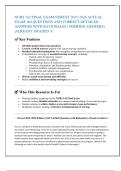
NURS 142 FINAL EXAM NEWEST 2025-2026 ACTUAL
EXAM 160 QUESTIONS AND CORRECT DETAILED
ANSWERS WITH RATIONALES (VERIFIED ANSWERS)
|ALREADY GRADED A
✅ Key Features
160 high-quality final exam questions
Correct, verified answers aligned with current nursing standards
Detailed rationales/explanations that strengthen comprehension and clinical reasoning
Comprehensive coverage of essential nursing concepts, including:
o Patient safety & infection control
o Health promotion & wellness
o Pharmacology basics & medication administration
o Nutrition, elimination, and fluid/electrolyte balance
o Comfort, mobility, and pain management
o Psychosocial and cultural care considerations
o End-of-life care and ethical principles
Mirrors actual exam format and difficulty
Builds confidence and test-taking strategies for success
🎯 Who This Resource Is For
Nursing students preparing for the NURS 142 Final Exam
Learners seeking detailed rationales for a deeper understanding of core nursing topics
Students aiming to achieve higher scores and stronger exam performance
Healthcare learners needing a refresher in fundamentals of nursing
🩺 Newest 2025–2026 Edition | 160 Verified Questions with Rationales | Already Graded A
You are caring for a family that consists of a father and 3-year-old boy who has well-managed asthma
but misses care infrequently. They live in state-supported housing. The father is in school studying to be
an information technology professional. His income and time are limited, and he admits to going to
fastfood restaurants frequently for dinner. However, he and his son spend a lot of time together. The
family receives state-supported health care for his son, but he does not have health insurance or a
personal physician. He has his son enrolled in a government-assisted day care program. Which of the
following are risks to this family's level of health? (Select all that apply.)
,1. Economic status
2. Chronic illness
3. Underinsured
4. Government-assisted day care
5. Frequency of fast-food dinners
6. State-supported housing - answer-1,3,5
Which of the following are possible outcomes with clear family communication? (Select all that apply.)
1. Family goals
2. Increased socialization
3. Decision making
4. Methods of discipline
5. Improved education
6. Impaired coping - answer-3,4,5
Which of the following are possible outcomes with clear family communication? (Select all that apply.)
1. Family goals
2. Increased socialization
3. Decision making
4. Methods of discipline
5. Improved education
6. Impaired coping - answer-1,3,4
A family has decided to care for a grandparent with terminal cancer in the daughter's home. Family
caregiving is new to the family. When helping this family as they begin to plan for their caregiving roles,
what are the two top priority assessments to best learn about family functioning? (Select all that apply.)
1. Communication
2. Decision making 3.
Development
4. Economic status
, 5. Family structure - answer-1,2
A family is facing job loss of the father, who is the major wage earner, and relocation to a new city
where there is a new job. The children will have to switch schools, and his wife will have to resign from
the job she likes. Which of the following contribute to this family's hardiness? (Select all that apply.) 1.
Family meetings
2. Established family roles
3. New neighborhood
4. Willingness to change in time of stress
5. Passive orientation to life - answer-1,2,4
A family is undergoing a major change. Just as twins graduate from college and leave home to begin
their careers, the husband loses his executive well-paying job. Because the family had two children in
college at the same time, they did not save for retirement. They planned to save aggressively after the
children left college. In this situation, which of the following demonstrate family resiliency? (Select all
that apply.)
1. Resuming full-time work when spouse loses job
2. Increasing problems among siblings
3. Developing hobbies when children leave home
4. Placing blame on family members
5. Expecting children to help financially
6. Consulting a financial planner - answer-1,3,6
In viewing the family as context, what is the primary focus?
1. Family members within a system
2. Family process and relationships
3. Family relational and transactional concepts
4. Health needs of an individual member - answer-4
A hospice nurse is caring for a family that is providing end-of-life care for their grandmother, who has
terminal breast cancer. When the nurse visits, the focus is on symptom management for the
EXAM 160 QUESTIONS AND CORRECT DETAILED
ANSWERS WITH RATIONALES (VERIFIED ANSWERS)
|ALREADY GRADED A
✅ Key Features
160 high-quality final exam questions
Correct, verified answers aligned with current nursing standards
Detailed rationales/explanations that strengthen comprehension and clinical reasoning
Comprehensive coverage of essential nursing concepts, including:
o Patient safety & infection control
o Health promotion & wellness
o Pharmacology basics & medication administration
o Nutrition, elimination, and fluid/electrolyte balance
o Comfort, mobility, and pain management
o Psychosocial and cultural care considerations
o End-of-life care and ethical principles
Mirrors actual exam format and difficulty
Builds confidence and test-taking strategies for success
🎯 Who This Resource Is For
Nursing students preparing for the NURS 142 Final Exam
Learners seeking detailed rationales for a deeper understanding of core nursing topics
Students aiming to achieve higher scores and stronger exam performance
Healthcare learners needing a refresher in fundamentals of nursing
🩺 Newest 2025–2026 Edition | 160 Verified Questions with Rationales | Already Graded A
You are caring for a family that consists of a father and 3-year-old boy who has well-managed asthma
but misses care infrequently. They live in state-supported housing. The father is in school studying to be
an information technology professional. His income and time are limited, and he admits to going to
fastfood restaurants frequently for dinner. However, he and his son spend a lot of time together. The
family receives state-supported health care for his son, but he does not have health insurance or a
personal physician. He has his son enrolled in a government-assisted day care program. Which of the
following are risks to this family's level of health? (Select all that apply.)
,1. Economic status
2. Chronic illness
3. Underinsured
4. Government-assisted day care
5. Frequency of fast-food dinners
6. State-supported housing - answer-1,3,5
Which of the following are possible outcomes with clear family communication? (Select all that apply.)
1. Family goals
2. Increased socialization
3. Decision making
4. Methods of discipline
5. Improved education
6. Impaired coping - answer-3,4,5
Which of the following are possible outcomes with clear family communication? (Select all that apply.)
1. Family goals
2. Increased socialization
3. Decision making
4. Methods of discipline
5. Improved education
6. Impaired coping - answer-1,3,4
A family has decided to care for a grandparent with terminal cancer in the daughter's home. Family
caregiving is new to the family. When helping this family as they begin to plan for their caregiving roles,
what are the two top priority assessments to best learn about family functioning? (Select all that apply.)
1. Communication
2. Decision making 3.
Development
4. Economic status
, 5. Family structure - answer-1,2
A family is facing job loss of the father, who is the major wage earner, and relocation to a new city
where there is a new job. The children will have to switch schools, and his wife will have to resign from
the job she likes. Which of the following contribute to this family's hardiness? (Select all that apply.) 1.
Family meetings
2. Established family roles
3. New neighborhood
4. Willingness to change in time of stress
5. Passive orientation to life - answer-1,2,4
A family is undergoing a major change. Just as twins graduate from college and leave home to begin
their careers, the husband loses his executive well-paying job. Because the family had two children in
college at the same time, they did not save for retirement. They planned to save aggressively after the
children left college. In this situation, which of the following demonstrate family resiliency? (Select all
that apply.)
1. Resuming full-time work when spouse loses job
2. Increasing problems among siblings
3. Developing hobbies when children leave home
4. Placing blame on family members
5. Expecting children to help financially
6. Consulting a financial planner - answer-1,3,6
In viewing the family as context, what is the primary focus?
1. Family members within a system
2. Family process and relationships
3. Family relational and transactional concepts
4. Health needs of an individual member - answer-4
A hospice nurse is caring for a family that is providing end-of-life care for their grandmother, who has
terminal breast cancer. When the nurse visits, the focus is on symptom management for the

