
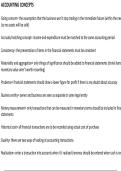
ACCOUNTING CONCEPTS
Going concern= the assumption that the business won’t stop trading in the immediate future (within the nex
(so no assets will be sold)
Accruals/matching concept= income and expenditure must be matched to the same accounting period
Consistency= the presentation of items in the financial statements must be consistent
Materiality and aggregation= only things of significance should be added to financial statements (trivial items
monetary value aren’t worth recording)
Prudence= financial statements should show a lower figure for profit if there is any doubt about accuracy
Business entity= owner and business are seen as separate or same legal entity
Money measurement= only transactions that can be measured in monetary terms should be included in finan
statements
Historical cost= all financial transactions are to be recorded using actual cost of purchase
Duality= there are two ways of looking at accounting transactions
Realisation= enter a transaction into accounts when it’s realised (revenue should be entered when cash is rec
, FINANCIAL AND MANAGEMENT ACCOUNTING
Financial Accounting:
Looks at the past, has external stakeholders
Aims to keep a fair and true record of transactions
Record financial information in documents (double entry bookkeeping)
Prepare financial statements (income statement, SOFP)
Management Accounting:
Looks to the future, has internal stakeholders
Uses financial data to predict future by producing budgets (income statement, SOFP)
Work out cost of a product or service
Provide information to owners for decision making (in any format)
Purpose of financial accounting
Assess the performance of a business
Reduce the chance of error or fraud
Assist in getting a loan
Reasons for keeping records
Purpose of management accounting To assess the profitability and liquidity
Helps in decision making Aid in decision making
Helps in future planning Monitor and control
Going concern= the assumption that the business won’t stop trading in the immediate future (within the nex
(so no assets will be sold)
Accruals/matching concept= income and expenditure must be matched to the same accounting period
Consistency= the presentation of items in the financial statements must be consistent
Materiality and aggregation= only things of significance should be added to financial statements (trivial items
monetary value aren’t worth recording)
Prudence= financial statements should show a lower figure for profit if there is any doubt about accuracy
Business entity= owner and business are seen as separate or same legal entity
Money measurement= only transactions that can be measured in monetary terms should be included in finan
statements
Historical cost= all financial transactions are to be recorded using actual cost of purchase
Duality= there are two ways of looking at accounting transactions
Realisation= enter a transaction into accounts when it’s realised (revenue should be entered when cash is rec
, FINANCIAL AND MANAGEMENT ACCOUNTING
Financial Accounting:
Looks at the past, has external stakeholders
Aims to keep a fair and true record of transactions
Record financial information in documents (double entry bookkeeping)
Prepare financial statements (income statement, SOFP)
Management Accounting:
Looks to the future, has internal stakeholders
Uses financial data to predict future by producing budgets (income statement, SOFP)
Work out cost of a product or service
Provide information to owners for decision making (in any format)
Purpose of financial accounting
Assess the performance of a business
Reduce the chance of error or fraud
Assist in getting a loan
Reasons for keeping records
Purpose of management accounting To assess the profitability and liquidity
Helps in decision making Aid in decision making
Helps in future planning Monitor and control


