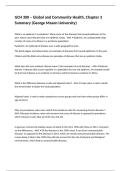
GCH 300 – Global and Community Health, Chapter 3
Summary (George Mason University)
What is an epidemic? A pandemic? Name some of the diseases that caused epidemics in the
past. Name some diseases that are epidemic today. - ANS ✔Epidemic: An unexpectedly large
number of cases of an illness in a particular population
Pandemic: An outbreak of disease over a wide geographical area.
The black plague and tuberculosis are examples of diseases that caused epidemics in the past.
Cholera and the Ebola virus disease are examples of diseases that are an epidemic today.
What does the term endemic disease mean? Give examples of such diseases. - ANS ✔Endemic
disease: A disease that occurs regularly in a population but are not epidemic. An example would
be that heart disease is an endemic in America and that malaria is endemic in Africa.
What is the difference between crude and adjusted rates? - ANS ✔Crude rates: A rate in which
the denominator includes the total population
Adjusted rates: A rate to make comparisons across groups and over time when groups differ in
age structure
Why are prevalence rates more useful than incidence rates for measuring chronic diseases? -
ANS ✔Because incidence rates only measure new cases of disease as opposed to prevalence
which measures cases that are both new and old.
In general, contrast the leading causes of death in the US in 1900 with those in 2013. Comment
on the differences. - ANS ✔Of the diseases in the 1900, most, if not all are communicable
diseases. As opposed to the diseases in 2013, which are mostly noncommunicable diseases. The
reason being is that in the 1900s they did not account for the role of physical and biological
environments, which lead to communicable diseases.
Summary (George Mason University)
What is an epidemic? A pandemic? Name some of the diseases that caused epidemics in the
past. Name some diseases that are epidemic today. - ANS ✔Epidemic: An unexpectedly large
number of cases of an illness in a particular population
Pandemic: An outbreak of disease over a wide geographical area.
The black plague and tuberculosis are examples of diseases that caused epidemics in the past.
Cholera and the Ebola virus disease are examples of diseases that are an epidemic today.
What does the term endemic disease mean? Give examples of such diseases. - ANS ✔Endemic
disease: A disease that occurs regularly in a population but are not epidemic. An example would
be that heart disease is an endemic in America and that malaria is endemic in Africa.
What is the difference between crude and adjusted rates? - ANS ✔Crude rates: A rate in which
the denominator includes the total population
Adjusted rates: A rate to make comparisons across groups and over time when groups differ in
age structure
Why are prevalence rates more useful than incidence rates for measuring chronic diseases? -
ANS ✔Because incidence rates only measure new cases of disease as opposed to prevalence
which measures cases that are both new and old.
In general, contrast the leading causes of death in the US in 1900 with those in 2013. Comment
on the differences. - ANS ✔Of the diseases in the 1900, most, if not all are communicable
diseases. As opposed to the diseases in 2013, which are mostly noncommunicable diseases. The
reason being is that in the 1900s they did not account for the role of physical and biological
environments, which lead to communicable diseases.