

Neuroticism en NEO-PI-R
Neuroticism
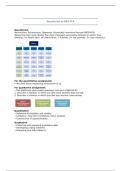
Neuroticism, Extraversion, Openness, Personality Inventory Revised (NEO-PI-R).
Measuring Five Factor Model; five most important personality domains in adults. Five
domains, six facets each. 48 Likert-items; 1–5 points (1= not neurotic, 5= very neurotic).
For the quantitative assignment:
• 48 Likert-items measuring neuroticism (1-5)
For qualitative assignment:
• Two additional open-ended questions (not part of NEO-PI-R):
1. Describe a situation in which you feel more neurotic than normal.
2. Describe a situation in which you feel less neurotic than normal.
Quantitative
• Definition of reliability and validity
• Lambda-2, inter-item correlation, factor analysis
• Construction of questionnaires
Qualitative
• Collecting and analysing qualitative data
• Developing coding schemes
• Analysing your data (Atlas.ti)
, General – APA rules
1. The use of passive sentences is not more academic
The passive voice is often taught as formal writing, but it inhibits clarity and makes the
text (unnecessarily) longer. The passive voice can appropriately place emphasis on the
thing that is being done rather than the performer on the action.
According to APA, you should use the active voice as much as possible to create
direct clear and concise sentences.
Also, try to avoid (too many) long sentences.
e.g.
“The questionnaire was then completed by participants.” (7 words)
Versus
“Participants then completed the questionnaire” (5 words)
“The research was undertaken by the authors in Spring 2022” (10 words)
Versus
“We performed the research in Spring 2022” (7 words)
2. You can sometimes use the first person in science writing
Avoiding first person thought to make text appear more objective. According to APA,
you should use the first person when you're describing the work you did as part of your
research and when you are expressing your own views.
However, the first person is not always appropriate and can make your writing look
like an opinionated rant. Even if it is your subjective position, you need to substantiate
this with evidence (your data or relevant literature).
A very rough rule of thumb, the use of first person is okay in the methods and when
you’re drawing conclusions in the discussion.
3. Complexity does not always show that an authority is writing
If you want to look clever, make your writing easy to read.
According to APA, a paper with excessive jargon, contractions, unnecessary acronyms, or
terminology familiar to only a few specialists does not sufficiently contribute to the
literature because its meaning is obfuscated.
APA warns against
• Ambiguity
Precision in language is hard to achieve and takes practice but is totally necessary. Avoid
overusing “it”, “that”, and “they” and instead specifically name what you refer to.
• Wordiness
Use simple words where possible; “At the present time” versus “Now”
• Redundancy (overbodige of dubbele formuleringen)
“Four different groups”, “it was previously shown” and “The reason is because”.
The tone in your writing should be professional, persuasive, and accessible to non-
experts. Maintain professional distance: academics don’t want your (non-evidence) based
opinions.
Clarity is primary, demonstrate that you understand what you have written.
,Three aspects why you should credit sources
1. Acknowledge earlier work (you build on others)
2. Allow readers to retrace your steps (check reliability)
3. Give credit where credit is due; avoid accusations and guide readers who want
to know more.
Reminders
• Headers should be in the same font, and same font size as the rest of the text
• All paragraphs should be indented in APA, except the first paragraph in an abstract
• Line spacing in APA is 2-point
• APA is the baseline – deviations are common
• Write out full words (e.g., “it is” instead of “it’s”)
Example of quoting and paraphrasing
A. Others have contradicted this view: Co-presence does not ensure intimate interaction
among all group members. (Purcell, 1997). (paraphrase)
B. Others have contradicted this view: “Co-presence does not ensure intimate interaction
among allgroup members” (Purcell, 1997, p. 111). (quote)
Note
• Quotation marks
• Page number
• Be mindful of full stops
• Avoid using too many quotes – show your own understanding
Examples of in-text references
A. Kessler and John (2003) found no differences among epidemiological samples.
B. Kessler and John found no differences among epidemiological samples (2003).
Notes:
• Year always in connection with author (B, date is not in connection)
• Consider whether date supports your argument:
“This scale is the most widely used measure of self-esteem (Rosenthal, 1963)”
(outdated)
A. In a study of epidemiological samples, no differences were found (Ward, Zuik, Hutton,
Hoffman, Conway, Alison, & Halway, 1995).
B. In a study of epidemiological samples, no differences were found (Ward et al., 1995).
• More than two authors are summarized differently in brackets
• In APA 7th this is done from very first reference
In summary
1. Use active voice as much as possible to create direct, clear, and concise
sentences.
2. (sometimes) Use the first person when describing the work, you did as part of
your research and when expressing your own views. However, first person is not
always appropriate and can make your writing look like an opinionated rant.
3. If you want to look clever, make your writing easy to read. APA warns
against: jargon, contractions, unnecessary acronyms, ambiguity, wordiness,
redundancy, tone (professional, persuasive, and accessible to non-experts).
Clarity is primary (demonstrate that you understand), maintain professional
distance, use simple words where possible, avoid (too many) long sentences, write
, out full words. Be a guide for your reader. Argument should be understandable
from your document alone.
Structure of a scientific report
Section Description
1. Title Title of the report, clear and informative
2. Introduction Introduces the topic (current situation), explains the niche
(problem), goal (research question)
3. Methods Describes participants, materials, procedure, and data analysis
4. Results Presents the findings without interpretation
5. Discussion & Interprets the results, reflects on the research
Conclusion question/hypotheses, and concludes
The introduction, results, discussion & conclusion will be written in present tense.
The methods, participants, materials, procedures, and data-analysis will be written in
past tense.
Fundamentals of the paper
Clarity and concision over (needless) complexity
Write in an engaging, but not hyperbolic way
Write a thesis: a statement or theory that is put forward as a premise to be
maintained or proved
Write a single coherent argument
Write only what needs to be written, otherwise: cut it! -
Outline the introduction before writing it: heading,
subheading
One topic per paragraph (Check the first and last
sentences of paragraphs for a clear narrative)
You will need multiple drafts to write a good report
A scientific report is structured like an hourglass
Introduction
This section conducts all three steps; the current situation, the niche and the goal.
1. The current situation
Introduce the topic, describe what has been done and detail the research. What makes
your research relevant in society or practice? What is already known?
2. The niche
Demonstrate the relevance for new knowledge by showing gaps or inconsistencies in
current literature. Based on what we already know; how might the situation be improved?
How will your specific study remedy the situation?
3. The goal
Neuroticism
Neuroticism, Extraversion, Openness, Personality Inventory Revised (NEO-PI-R).
Measuring Five Factor Model; five most important personality domains in adults. Five
domains, six facets each. 48 Likert-items; 1–5 points (1= not neurotic, 5= very neurotic).
For the quantitative assignment:
• 48 Likert-items measuring neuroticism (1-5)
For qualitative assignment:
• Two additional open-ended questions (not part of NEO-PI-R):
1. Describe a situation in which you feel more neurotic than normal.
2. Describe a situation in which you feel less neurotic than normal.
Quantitative
• Definition of reliability and validity
• Lambda-2, inter-item correlation, factor analysis
• Construction of questionnaires
Qualitative
• Collecting and analysing qualitative data
• Developing coding schemes
• Analysing your data (Atlas.ti)
, General – APA rules
1. The use of passive sentences is not more academic
The passive voice is often taught as formal writing, but it inhibits clarity and makes the
text (unnecessarily) longer. The passive voice can appropriately place emphasis on the
thing that is being done rather than the performer on the action.
According to APA, you should use the active voice as much as possible to create
direct clear and concise sentences.
Also, try to avoid (too many) long sentences.
e.g.
“The questionnaire was then completed by participants.” (7 words)
Versus
“Participants then completed the questionnaire” (5 words)
“The research was undertaken by the authors in Spring 2022” (10 words)
Versus
“We performed the research in Spring 2022” (7 words)
2. You can sometimes use the first person in science writing
Avoiding first person thought to make text appear more objective. According to APA,
you should use the first person when you're describing the work you did as part of your
research and when you are expressing your own views.
However, the first person is not always appropriate and can make your writing look
like an opinionated rant. Even if it is your subjective position, you need to substantiate
this with evidence (your data or relevant literature).
A very rough rule of thumb, the use of first person is okay in the methods and when
you’re drawing conclusions in the discussion.
3. Complexity does not always show that an authority is writing
If you want to look clever, make your writing easy to read.
According to APA, a paper with excessive jargon, contractions, unnecessary acronyms, or
terminology familiar to only a few specialists does not sufficiently contribute to the
literature because its meaning is obfuscated.
APA warns against
• Ambiguity
Precision in language is hard to achieve and takes practice but is totally necessary. Avoid
overusing “it”, “that”, and “they” and instead specifically name what you refer to.
• Wordiness
Use simple words where possible; “At the present time” versus “Now”
• Redundancy (overbodige of dubbele formuleringen)
“Four different groups”, “it was previously shown” and “The reason is because”.
The tone in your writing should be professional, persuasive, and accessible to non-
experts. Maintain professional distance: academics don’t want your (non-evidence) based
opinions.
Clarity is primary, demonstrate that you understand what you have written.
,Three aspects why you should credit sources
1. Acknowledge earlier work (you build on others)
2. Allow readers to retrace your steps (check reliability)
3. Give credit where credit is due; avoid accusations and guide readers who want
to know more.
Reminders
• Headers should be in the same font, and same font size as the rest of the text
• All paragraphs should be indented in APA, except the first paragraph in an abstract
• Line spacing in APA is 2-point
• APA is the baseline – deviations are common
• Write out full words (e.g., “it is” instead of “it’s”)
Example of quoting and paraphrasing
A. Others have contradicted this view: Co-presence does not ensure intimate interaction
among all group members. (Purcell, 1997). (paraphrase)
B. Others have contradicted this view: “Co-presence does not ensure intimate interaction
among allgroup members” (Purcell, 1997, p. 111). (quote)
Note
• Quotation marks
• Page number
• Be mindful of full stops
• Avoid using too many quotes – show your own understanding
Examples of in-text references
A. Kessler and John (2003) found no differences among epidemiological samples.
B. Kessler and John found no differences among epidemiological samples (2003).
Notes:
• Year always in connection with author (B, date is not in connection)
• Consider whether date supports your argument:
“This scale is the most widely used measure of self-esteem (Rosenthal, 1963)”
(outdated)
A. In a study of epidemiological samples, no differences were found (Ward, Zuik, Hutton,
Hoffman, Conway, Alison, & Halway, 1995).
B. In a study of epidemiological samples, no differences were found (Ward et al., 1995).
• More than two authors are summarized differently in brackets
• In APA 7th this is done from very first reference
In summary
1. Use active voice as much as possible to create direct, clear, and concise
sentences.
2. (sometimes) Use the first person when describing the work, you did as part of
your research and when expressing your own views. However, first person is not
always appropriate and can make your writing look like an opinionated rant.
3. If you want to look clever, make your writing easy to read. APA warns
against: jargon, contractions, unnecessary acronyms, ambiguity, wordiness,
redundancy, tone (professional, persuasive, and accessible to non-experts).
Clarity is primary (demonstrate that you understand), maintain professional
distance, use simple words where possible, avoid (too many) long sentences, write
, out full words. Be a guide for your reader. Argument should be understandable
from your document alone.
Structure of a scientific report
Section Description
1. Title Title of the report, clear and informative
2. Introduction Introduces the topic (current situation), explains the niche
(problem), goal (research question)
3. Methods Describes participants, materials, procedure, and data analysis
4. Results Presents the findings without interpretation
5. Discussion & Interprets the results, reflects on the research
Conclusion question/hypotheses, and concludes
The introduction, results, discussion & conclusion will be written in present tense.
The methods, participants, materials, procedures, and data-analysis will be written in
past tense.
Fundamentals of the paper
Clarity and concision over (needless) complexity
Write in an engaging, but not hyperbolic way
Write a thesis: a statement or theory that is put forward as a premise to be
maintained or proved
Write a single coherent argument
Write only what needs to be written, otherwise: cut it! -
Outline the introduction before writing it: heading,
subheading
One topic per paragraph (Check the first and last
sentences of paragraphs for a clear narrative)
You will need multiple drafts to write a good report
A scientific report is structured like an hourglass
Introduction
This section conducts all three steps; the current situation, the niche and the goal.
1. The current situation
Introduce the topic, describe what has been done and detail the research. What makes
your research relevant in society or practice? What is already known?
2. The niche
Demonstrate the relevance for new knowledge by showing gaps or inconsistencies in
current literature. Based on what we already know; how might the situation be improved?
How will your specific study remedy the situation?
3. The goal


