

Written by students who passed Immediately available after payment Read online or as PDF Wrong document? Swap it for free 4.6 TrustPilot
logo-home
Document preview thumbnail
Preview 1 out of 3 pages
Exam (elaborations)

PSY 550 BEST FINAL EXAM

Document preview thumbnail
Preview 1 out of 3 pages

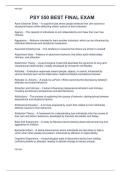
PSY 550 BEST FINAL EXAM Actor-Observer Effect - -A cognitive bias where people attribute their own actions to situational factors while attributing others' actions to their character. Agency - -The capacity of individuals to act independently and make their own free choices. Aggression - -Behavior intended to harm another individual, which can be influenced by individual differences and situational moderators. Assumed similarity bias - -The tendency to assume that others are similar to oneself. Attachment Style - -Patterns of attachment behavior that affect adult relationships, intimacy, and attraction. Attachment Theory - -A psychological model that describes the dynamics of long-term interpersonal relationships, notably developed by Ainsworth and Bowlby. Attitudes - -Evaluative responses toward people, objects, or events, influenced by various theories such as the Elaboration Likelihood Model and balance theories. Attitudes vs. Actions - -A study by LaPiere (1934) examining the discrepancy between attitudes and actual behaviors. Attraction and Intimacy - -Factors influencing interpersonal attraction and intimacy, including evolutionary perspectives and self-disclosure. Attributions - -The process of explaining the causes of behavior, distinguishing between dispositional and situational factors. Attributional Equation - -A formula proposed by Lewin that relates to how individuals attribute causes to their behaviors. Attribution Theory - -A framework for understanding how individuals infer the causes of their own and others' behaviors, developed by theorists like Heider and Kelley. Bobo Doll Experiment - -A study by Bandura demonstrating observational learning and aggression in children. Bystander Effect - -A social phenomenon where individuals are less likely to help a victim when other people are present, influenced by diffusion of responsibility. Cognitive Dissonance - -A psychological state of discomfort arising from holding conflicting beliefs or attitudes, leading to attitude change to reduce arousal. PSY 550 PSY 550 Conformity - -The act of matching attitudes, beliefs, and behaviors to group norms, often influenced by social pressure. False Consensus Effect - -The tendency to overestimate the extent to which others share our beliefs and behaviors. Fundamental Attribution Error - -The tendency to attribute others' behaviors to their character while attributing our own behaviors to situational factors. Good Samaritan Experiment - -A study by Darley and Batson examining the factors influencing helping behavior in strangers. Group Processes - -The dynamics of how groups function, including phenomena like groupthink and polarization. Influence Principles - -The strategies outlined by Cialdini that explain how individuals can influence others' behaviors. Looking Glass Self - -A concept by Cooley that describes how a person's self-concept is influenced by their perception of how others view them. Self-Perception Theory - -A theory proposed by Bem suggesting that individuals develop attitudes by observing their own behavior. Self-Serving Bias - -The tendency to attribute positive outcomes to oneself and negative outcomes to external factors. Social Influence - -The effect that the presence or actions of others have on an individual's thoughts, feelings, and behaviors. Stanford Prison Study - -An experiment by Zimbardo that investigated the psychological effects of perceived power by assigning college students to roles of guards and prisoners. Stanford Prison Experiment - -Study on power dynamics and role conformity. Stereotype Threat - -Fear of confirming negative stereotypes affects performance. Social Loafing - -Reduced effort in group tasks compared to individual. Crowd Behavior - -Collective behavior influenced by group dynamics. Social Facilitation - -Improved performance in the presence of others. Social Redefinition - -Transition process from childhood to adulthood. PSY 550 Emerging Adulthood - -Stage characterized by exploration and instability. Naïve Scientists - -Innate drive to explain behavior causes. Subtractive Rule - -Attribution process where negative factors diminish positive. Hostile Sexism - -Negative attitudes towards women based on gender. Benevolent Sexism - -Paternalistic attitudes that idealize women. Ambivalent Sexism - -Mix of hostile and benevolent attitudes towards women. Deindividuation - -Loss of self-awareness in groups leads to impulsivity. Collective Behavior - -Behavior of individuals in crowds or groups. Antisocial Personality Disorder (ASPD) - -Pattern of disregard for others' rights. Oppositional Defiant Disorder (ODD) - -Pattern of angry, irritable, and defiant behavior. Conduct Disorder (CD) - -Behavioral disorder involving violation of rules. Intermittent Explosive Disorder (IED) - -Recurrent outbursts of aggression and violence. Adolescent-Limited Antisocial Behavior - -Antisocial behavior that emerges during adolescence. Life Course Persistent Antisocial Behavior - -Chronic antisocial behavior from childhood into adulthood. Flirting Styles - -Different approaches to romantic interactions. LGBTQ Challenges - -Obstacles faced in heteronormative dating practices. Digital Transformation of Intimacy - -Impact of technology on romantic relationships. Peer Groups - -Social groups that influence adolescent behavior. Self-Esteem in Adolescence - -Adolescents' changing perceptions of self-worth. Cultural Psychology - -Study of how culture influences psychological processes.

Content preview

PSY 550


PSY 550 BEST FINAL EXAM
Actor-Observer Effect - -A cognitive bias where people attribute their own actions to
situational factors while attributing others' actions to their character.

Agency - -The capacity of individuals to act independently and make their own free
choices.

Aggression - -Behavior intended to harm another individual, which can be influenced by
individual differences and situational moderators.

Assumed similarity bias - -The tendency to assume that others are similar to oneself.

Attachment Style - -Patterns of attachment behavior that affect adult relationships,
intimacy, and attraction.

Attachment Theory - -A psychological model that describes the dynamics of long-term
interpersonal relationships, notably developed by Ainsworth and Bowlby.

Attitudes - -Evaluative responses toward people, objects, or events, influenced by
various theories such as the Elaboration Likelihood Model and balance theories.

Attitudes vs. Actions - -A study by LaPiere (1934) examining the discrepancy between
attitudes and actual behaviors.

Attraction and Intimacy - -Factors influencing interpersonal attraction and intimacy,
including evolutionary perspectives and self-disclosure.

Attributions - -The process of explaining the causes of behavior, distinguishing between
dispositional and situational factors.

Attributional Equation - -A formula proposed by Lewin that relates to how individuals
attribute causes to their behaviors.

Attribution Theory - -A framework for understanding how individuals infer the causes of
their own and others' behaviors, developed by theorists like Heider and Kelley.

Bobo Doll Experiment - -A study by Bandura demonstrating observational learning and
aggression in children.

Bystander Effect - -A social phenomenon where individuals are less likely to help a
victim when other people are present, influenced by diffusion of responsibility.

Cognitive Dissonance - -A psychological state of discomfort arising from holding
conflicting beliefs or attitudes, leading to attitude change to reduce arousal.


PSY 550

Document information

Uploaded on
September 2, 2025
Number of pages
3
Written in
2025/2026
Type
Exam (elaborations)
Contains
Questions & answers
$9.09

Wrong document? Swap it for free Within 14 days of purchase and before downloading, you can choose a different document. You can simply spend the amount again.
Written by students who passed
Immediately available after payment
Read online or as PDF

Seller avatar
Reputation scores are based on the amount of documents a seller has sold for a fee and the reviews they have received for those documents. There are three levels: Bronze, Silver and Gold. The better the reputation, the more your can rely on the quality of the sellers work.
AlexScorer
2.5
(2)
Sold
11
Followers
0
Items
1800
Last sold
2 weeks ago


Why students choose Stuvia

Created by fellow students, verified by reviews

Quality you can trust: written by students who passed their tests and reviewed by others who've used these notes.

Didn't get what you expected? Choose another document

No worries! You can instantly pick a different document that better fits what you're looking for.

Pay as you like, start learning right away

No subscription, no commitments. Pay the way you're used to via credit card and download your PDF document instantly.

Student with book image

“Bought, downloaded, and aced it. It really can be that simple.”

Alisha Student

Working on your references?

Create accurate citations in APA, MLA and Harvard with our free citation generator.

Working on your references?

Frequently asked questions
