NCTRC EXAM STUDY GUIDE
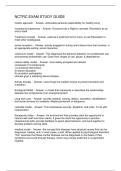
holistic approach - Answer -Advocates personal responsibility for healthy living
recreational experience - Answer -Everyone has a Right to recreate. Recreation as an
end to itself
Treatment concept - Answer -used as a treatment tool to cure> to use Recreation to
meet other needs/goals.
social recreation - Answer -activity engaged in during one's leisure time that involves, in
an appropriate setting, social interaction
continuum model - Answer -This diagnoses the behavior between non-problematic use
and severely problematic use. Goes from ranges of use, abuse, & dependence.
Leisure ability model - Answer -most widely accepted and utilized.
composed of 3 components
1) functional intervention
2) leisure education
3) recreation participation
ultimate goal: a satisfying leisure lifestyle.
Activity therapy - Answer -uses things the resident enjoys to prevent boredom and
frustration
Ecological Model - Answer -a model that represents or describes the relationships
between the components of an ecological system
Long term care - Answer -provide medical, nursing, dietary, recreation, rehabilitative
and social services for residents. Maybe permanent or temporary.
custodial model - Answer -This emphasizes security, discipline, and order. To do with
incarceration.
therapeutic milieu - Answer -An environment that provides client the opportunity to
interact with staff and other clients. It gives the client the opportunity to practice
interpersonal skills, provide feedback to peers about behavior, and work together to
develop problem-solving skills.
medical model - Answer -the concept that diseases have physical causes that can be
diagnosed, treated, and, in most cases, cured. When applied to psychological disorders,
*this* assumes that these mental illnesses can be diagnosed on the basis of their
symptoms and cured through therapy, which may include treatment in a psychiatric
hospital.
,human service model - Answer -A treatment approch that utilizes problems solving to
work with clients and their problems within the context of the environment.
leisure - Answer -freedom to choose a pastime or enjoyable activity
attribution model - Answer -A person's explanation of the course of events that
occurred in their life. External and internal.
learned helplessness - Answer -condition in which repeated attempts to control a
situation fail, resulting in the belief that the situation is uncontrollable
perceived freedom - Answer -feeling free to participate in an activity without a nagging
sense that you have to or that you should be doing something else
intrinsic motivation - Answer -A desire to perform a behavior for its own sake
extrinsic motivation - Answer -a desire to perform a behavior due to promised rewards
or threats of punishment
internal locus of control - Answer -the perception that one controls one's own fate
external locus of control - Answer -the perception that chance or outside forces beyond
one's personal control determine one's fate
play - Answer -spontaneous
psycho analytic - Answer -freud: superego and guilt, today: induction empathy based
guilt: ok to feel a bit of guilt but not too much/ with superego, fear of guilt, keeps us in
check fear of punishment, fear of losing love of parents
5-6 yo moral development done
catharsis theory - Answer -the idea that viewing violence actually reduces violent
behavior
diversional play - Answer -child's activities have no purpose, indicating boredom
compensation theory - Answer -leisure is used to *make up for* needs unfulfilled by
work.
surplus energy - Answer -The idea that children play to displace energy that is usually
used for survival is what
flow theory - Answer -high skill + high challenge.
high skill + medium challenge = control (most activities we do)
,intrinsic motivation, being in the zone
self-actualization - Answer -according to Maslow, the ultimate psychological need that
arises after basic physical and psychological needs are met and self-esteem is
achieved; the motivation to fulfill one's potential
maslow hierarchy of needs - Answer -theory of motivation based on unmet human
needs from basic physiological needs to safety, social, and esteem needs to self-
actualization needs
legally blind - Answer -20/200
hearing loss - Answer -deafness is when a person cannot understand speech from
hearing alone. ranges from mild to severe, symptoms include speaking too loudly,
leaning forwards to hear, cupping hand or turning head, inappropriate responses,
asking for repeating words - Nervous system disorder
stroke - Answer -a sudden loss of consciousness resulting when the rupture or
occlusion of a blood vessel leads to oxygen lack in the brain
signs of stroke - Answer -severe HA, slurred speech, weakness or paralysis, change in
cranial nerves, confusion or disorientation, dizziness or ataxia
autism - Answer -a disorder that appears in childhood and is marked by deficient
communication, social interaction, and understanding of others' states of mind
anxiety - Answer -An emotional state of high energy, with the stress response as the
body's reaction to it.
AXIS I - Answer -All clinical disorders EXCEPT personality disorders and mental
retardation
AXIS II - Answer -personality disorders and mental retardation
paranoid - Answer -a type of schizophrenia characterized by prominent delusions that
are persecutory or grandiose
passive-aggressive - Answer -an indirect expression of aggression delievered in a way
that allows the sender to maintain a facade of kindness
phobia - Answer -an anxiety disorder characterized by extreme and irrational fear of
simple things or social situations
anti-social - Answer -a personality disorder where the person has no respect for laws or
the rights of other human beings
, borderline - Answer -cluster B personality disorder: In a constant state of crisis,
promiscuous, unable to tolerate anxiety-causing situations, afraid of being alone, and
having intense but brief relationships
post traumatic stress disorder (PTSD) - Answer -Phenomenon in which victums of
catastrophes experience again the original event in the form of dreams or flash backs.
depression - Answer -a condition of general emotional dejection and withdrawal;
sadness greater and more prolonged than that warranted by any objective reason.
manic - Answer -affected with or marked by frenzy or mania uncontrolled by reason
mania - Answer -a mood disorder marked by a hyperactive, wildly optimistic state
bi-polar disorder - Answer -a mood disorder in which the person alternates between the
hopelessness and lethargy of depression and the overexcited state of mania.
mood disorder - Answer -conditions in which a person experiences extreme moods,
such as depression or mania; also called affective disorder
schizophrenia - Answer -any of several psychotic disorders characterized by distortions
of reality and disturbances of thought and language and withdrawal from social contact
aphasia - Answer -impairment of language, usually caused by left hemisphere damage
either to Broca's area (impairing speaking) or to wernicke's area (impairing
understanding)
addiction - Answer -being abnormally tolerant to and dependent on something that is
psychologically or physically habit-forming (especially alcohol or narcotic drugs)
chemical dependency - Answer -A physical and psychological habituation to a mood- or
mind-altering drug, such as alcohol or cocaine.
social impairment - Answer -lowering of performance on a given task in the pressence
of others - usually a task that is not well rehearsed
organic brain disorder - Answer -Condition resulting from neurological disturbance,
genetic abnormality, or tumor.
congestive heart failure - Answer -inability to pump enough blood to avoid congestion in
the tissues
burns - Answer -First degree (surface), second degree (epidermis, maybe upper part of
dermis), third degree (subcutaneous, if extensive may need grafting)
holistic approach - Answer -Advocates personal responsibility for healthy living
recreational experience - Answer -Everyone has a Right to recreate. Recreation as an
end to itself
Treatment concept - Answer -used as a treatment tool to cure> to use Recreation to
meet other needs/goals.
social recreation - Answer -activity engaged in during one's leisure time that involves, in
an appropriate setting, social interaction
continuum model - Answer -This diagnoses the behavior between non-problematic use
and severely problematic use. Goes from ranges of use, abuse, & dependence.
Leisure ability model - Answer -most widely accepted and utilized.
composed of 3 components
1) functional intervention
2) leisure education
3) recreation participation
ultimate goal: a satisfying leisure lifestyle.
Activity therapy - Answer -uses things the resident enjoys to prevent boredom and
frustration
Ecological Model - Answer -a model that represents or describes the relationships
between the components of an ecological system
Long term care - Answer -provide medical, nursing, dietary, recreation, rehabilitative
and social services for residents. Maybe permanent or temporary.
custodial model - Answer -This emphasizes security, discipline, and order. To do with
incarceration.
therapeutic milieu - Answer -An environment that provides client the opportunity to
interact with staff and other clients. It gives the client the opportunity to practice
interpersonal skills, provide feedback to peers about behavior, and work together to
develop problem-solving skills.
medical model - Answer -the concept that diseases have physical causes that can be
diagnosed, treated, and, in most cases, cured. When applied to psychological disorders,
*this* assumes that these mental illnesses can be diagnosed on the basis of their
symptoms and cured through therapy, which may include treatment in a psychiatric
hospital.
,human service model - Answer -A treatment approch that utilizes problems solving to
work with clients and their problems within the context of the environment.
leisure - Answer -freedom to choose a pastime or enjoyable activity
attribution model - Answer -A person's explanation of the course of events that
occurred in their life. External and internal.
learned helplessness - Answer -condition in which repeated attempts to control a
situation fail, resulting in the belief that the situation is uncontrollable
perceived freedom - Answer -feeling free to participate in an activity without a nagging
sense that you have to or that you should be doing something else
intrinsic motivation - Answer -A desire to perform a behavior for its own sake
extrinsic motivation - Answer -a desire to perform a behavior due to promised rewards
or threats of punishment
internal locus of control - Answer -the perception that one controls one's own fate
external locus of control - Answer -the perception that chance or outside forces beyond
one's personal control determine one's fate
play - Answer -spontaneous
psycho analytic - Answer -freud: superego and guilt, today: induction empathy based
guilt: ok to feel a bit of guilt but not too much/ with superego, fear of guilt, keeps us in
check fear of punishment, fear of losing love of parents
5-6 yo moral development done
catharsis theory - Answer -the idea that viewing violence actually reduces violent
behavior
diversional play - Answer -child's activities have no purpose, indicating boredom
compensation theory - Answer -leisure is used to *make up for* needs unfulfilled by
work.
surplus energy - Answer -The idea that children play to displace energy that is usually
used for survival is what
flow theory - Answer -high skill + high challenge.
high skill + medium challenge = control (most activities we do)
,intrinsic motivation, being in the zone
self-actualization - Answer -according to Maslow, the ultimate psychological need that
arises after basic physical and psychological needs are met and self-esteem is
achieved; the motivation to fulfill one's potential
maslow hierarchy of needs - Answer -theory of motivation based on unmet human
needs from basic physiological needs to safety, social, and esteem needs to self-
actualization needs
legally blind - Answer -20/200
hearing loss - Answer -deafness is when a person cannot understand speech from
hearing alone. ranges from mild to severe, symptoms include speaking too loudly,
leaning forwards to hear, cupping hand or turning head, inappropriate responses,
asking for repeating words - Nervous system disorder
stroke - Answer -a sudden loss of consciousness resulting when the rupture or
occlusion of a blood vessel leads to oxygen lack in the brain
signs of stroke - Answer -severe HA, slurred speech, weakness or paralysis, change in
cranial nerves, confusion or disorientation, dizziness or ataxia
autism - Answer -a disorder that appears in childhood and is marked by deficient
communication, social interaction, and understanding of others' states of mind
anxiety - Answer -An emotional state of high energy, with the stress response as the
body's reaction to it.
AXIS I - Answer -All clinical disorders EXCEPT personality disorders and mental
retardation
AXIS II - Answer -personality disorders and mental retardation
paranoid - Answer -a type of schizophrenia characterized by prominent delusions that
are persecutory or grandiose
passive-aggressive - Answer -an indirect expression of aggression delievered in a way
that allows the sender to maintain a facade of kindness
phobia - Answer -an anxiety disorder characterized by extreme and irrational fear of
simple things or social situations
anti-social - Answer -a personality disorder where the person has no respect for laws or
the rights of other human beings
, borderline - Answer -cluster B personality disorder: In a constant state of crisis,
promiscuous, unable to tolerate anxiety-causing situations, afraid of being alone, and
having intense but brief relationships
post traumatic stress disorder (PTSD) - Answer -Phenomenon in which victums of
catastrophes experience again the original event in the form of dreams or flash backs.
depression - Answer -a condition of general emotional dejection and withdrawal;
sadness greater and more prolonged than that warranted by any objective reason.
manic - Answer -affected with or marked by frenzy or mania uncontrolled by reason
mania - Answer -a mood disorder marked by a hyperactive, wildly optimistic state
bi-polar disorder - Answer -a mood disorder in which the person alternates between the
hopelessness and lethargy of depression and the overexcited state of mania.
mood disorder - Answer -conditions in which a person experiences extreme moods,
such as depression or mania; also called affective disorder
schizophrenia - Answer -any of several psychotic disorders characterized by distortions
of reality and disturbances of thought and language and withdrawal from social contact
aphasia - Answer -impairment of language, usually caused by left hemisphere damage
either to Broca's area (impairing speaking) or to wernicke's area (impairing
understanding)
addiction - Answer -being abnormally tolerant to and dependent on something that is
psychologically or physically habit-forming (especially alcohol or narcotic drugs)
chemical dependency - Answer -A physical and psychological habituation to a mood- or
mind-altering drug, such as alcohol or cocaine.
social impairment - Answer -lowering of performance on a given task in the pressence
of others - usually a task that is not well rehearsed
organic brain disorder - Answer -Condition resulting from neurological disturbance,
genetic abnormality, or tumor.
congestive heart failure - Answer -inability to pump enough blood to avoid congestion in
the tissues
burns - Answer -First degree (surface), second degree (epidermis, maybe upper part of
dermis), third degree (subcutaneous, if extensive may need grafting)