1|Page
CFEI STUDY GUIDE QUESTIONS AND ANSWERS WITH
COMPLETE SOLUTIONS
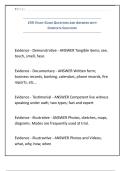
Evidence - Demonstrative - ANSWER Tangible items; see,
touch, smell, hear.
Evidence - Documentary - ANSWER Written form;
business records, banking, calendars, phone records, fire
reports, etc...
Evidence - Testimonial - ANSWER Competent live witness
speaking under oath; two types; fact and expert
Evidence - illustrative - ANSWER Photos, sketches, maps,
diagrams. Modes are frequently used at trial.
Evidence - illustravtive - ANSWER Photos and Videos;
what, why, how, when
,2|Page
Evidence collection - ANSWER Document in place,
document the collection, use proper container, (flag, bag,
& tag)
Evidence - collection - ANSWER Fuel gas powered tools
outside the perimeter. Find out where tools were refuels.
Heat transfer - ANSWER Conduction, convection,
radiation
Interviews - ANSWER Purpose of the interview; prepare
for the interview, document the interview
Vehicle Fires - ANSWER Sparks from an aluminum wheel
are not a competent ignition source.
,3|Page
Vehicle Fires - ANSWER The most common source of an
open flame in a vehicle is an exhaust system backfire out
of a carburetor.
Vehicle Fires - ANSWER Carburetor backfire leaves a
distinct pattern on the hood.
Vehicle Fires - ANSWER Two basic fuel systems:
vacuum/low pressure carbureted system, and high-
pressure, fuel injected system.
Vehicle Fires - ANSWER Loose battery connections; not
over-current protected; loose connections can result in
intermittent arcing.
Vehicle Fires - ANSWER Power steering fluid: Flashpoint
347-356*F, autoignition 680-720*F.
Vehicle Fires - ANSWER Automatic Transmission Fluid:
Flashpoint 302-536*F, autoignition 626-716*F.
, 4|Page
Vehicle Fires - ANSWER Overcharging a battery does not
cause it to explode.
Explosions - ANSWER Low order damage: characterized
by walls bulge out or laid down, virtually intact, next to
the structure. roofs slightly left.
Explosions - ANSWER High order damage: shattering of
the structure, producing small debris pieces.
Explosions - ANSWER Post blast effects: burned debris
away-fire preceded, unburned the debris away-no fire.
Explosions - ANSWER Dust explosions: most often occur
in confined areas of relatively wide dispersal.
Explosions - ANSWER Search 1.5 times further than the
farthest piece of debris.
CFEI STUDY GUIDE QUESTIONS AND ANSWERS WITH
COMPLETE SOLUTIONS
Evidence - Demonstrative - ANSWER Tangible items; see,
touch, smell, hear.
Evidence - Documentary - ANSWER Written form;
business records, banking, calendars, phone records, fire
reports, etc...
Evidence - Testimonial - ANSWER Competent live witness
speaking under oath; two types; fact and expert
Evidence - illustrative - ANSWER Photos, sketches, maps,
diagrams. Modes are frequently used at trial.
Evidence - illustravtive - ANSWER Photos and Videos;
what, why, how, when
,2|Page
Evidence collection - ANSWER Document in place,
document the collection, use proper container, (flag, bag,
& tag)
Evidence - collection - ANSWER Fuel gas powered tools
outside the perimeter. Find out where tools were refuels.
Heat transfer - ANSWER Conduction, convection,
radiation
Interviews - ANSWER Purpose of the interview; prepare
for the interview, document the interview
Vehicle Fires - ANSWER Sparks from an aluminum wheel
are not a competent ignition source.
,3|Page
Vehicle Fires - ANSWER The most common source of an
open flame in a vehicle is an exhaust system backfire out
of a carburetor.
Vehicle Fires - ANSWER Carburetor backfire leaves a
distinct pattern on the hood.
Vehicle Fires - ANSWER Two basic fuel systems:
vacuum/low pressure carbureted system, and high-
pressure, fuel injected system.
Vehicle Fires - ANSWER Loose battery connections; not
over-current protected; loose connections can result in
intermittent arcing.
Vehicle Fires - ANSWER Power steering fluid: Flashpoint
347-356*F, autoignition 680-720*F.
Vehicle Fires - ANSWER Automatic Transmission Fluid:
Flashpoint 302-536*F, autoignition 626-716*F.
, 4|Page
Vehicle Fires - ANSWER Overcharging a battery does not
cause it to explode.
Explosions - ANSWER Low order damage: characterized
by walls bulge out or laid down, virtually intact, next to
the structure. roofs slightly left.
Explosions - ANSWER High order damage: shattering of
the structure, producing small debris pieces.
Explosions - ANSWER Post blast effects: burned debris
away-fire preceded, unburned the debris away-no fire.
Explosions - ANSWER Dust explosions: most often occur
in confined areas of relatively wide dispersal.
Explosions - ANSWER Search 1.5 times further than the
farthest piece of debris.