
Human Population Dynamics
It took 200,000 years for humanity to reach the first billion people, but after that it only took 200
more years to hit seven billion.
Important points in section:
Trends: In human population growth up to 1650 and then from 1650 to the
. present moment, as well as possible reasons for the trends.
Forecasts: Of the population growth in South Africa over the next 20 years.
Interpretation: Of pyramids showing human population age and gender distributions of
. different types of countries.
Tensions and issues: Around human demands versus conservation of the natural environment.
. e.g. The hunting industry, the sustainable harvesting of natural resources
. and the creation and management of game reserves.
Implications: Of further human population growth for the natural environment.
. . e.g. The meaning of the term 'ecological footprint', the comparison of the
. ecological footprint of people in different types of countries and the
. effects of high population growth on the environment.
This population remained fairly constant as death rates were high because:
- People died from starvation and disease
- Infant mortality rates were very high
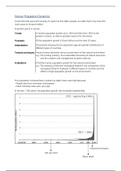
In the last 1 000 years, the population growth has increased exponentially.
2020 = approaching 8 billion
1804 = 1 billion
Industrial revolution
Life was hard
Black death
, Prediction = even out at 10 billion
China has the largest population, having 20% of the global population, and India has the
second, having 17% of the global population.
Causes of exponential growth
Humans have eliminated environmental resistance and have increased the carrying capacity of
the world’s food producing regions.
This have been done by: (as well as housing and tools)
1. Food production has increased substantially – Agriculture
/ This is due to:
. - More land being cultivated
. - Improved methods of food production
. (e.g. use of artificial fertilizers and insecticides to increase the yield of monoculture crops
. e.g. GMO food such as drought tolerant wheat)
2. Methods of treating diseases have improved greatly – Medicine
/ This has allowed more people to stay alive to reproduce. production
. (e.g. antibiotics, vaccines and technology such as incubators)
Countries in the world
Countries can be divided into two broad groups:
1. More developed countries (MDCs)
/ That have a:
. - Slow population growth
. - High standard of living
. - e.g. North America, Europe, Japan and Australia
2. Less developed countries (LDCs)
/ That have a:
. - Rapid population growth
. - Lower standard of living
. - e.g. Latin America, Africa and Asia
The future:
It is thought that for the next 150 years, human population growth will be less exponential, with a
more logistic type of growth form.
More developed or industrialised countries have already shifted to a stable population as
population growth has begun to decline. This is because birth rates have fallen due to late
marriages, birth control and sexual abstinence.
The populations of less developed countries will continue to grow as improved medical
treatments have enables more women in their reproductive years to live longer and produce
more off springs.
It took 200,000 years for humanity to reach the first billion people, but after that it only took 200
more years to hit seven billion.
Important points in section:
Trends: In human population growth up to 1650 and then from 1650 to the
. present moment, as well as possible reasons for the trends.
Forecasts: Of the population growth in South Africa over the next 20 years.
Interpretation: Of pyramids showing human population age and gender distributions of
. different types of countries.
Tensions and issues: Around human demands versus conservation of the natural environment.
. e.g. The hunting industry, the sustainable harvesting of natural resources
. and the creation and management of game reserves.
Implications: Of further human population growth for the natural environment.
. . e.g. The meaning of the term 'ecological footprint', the comparison of the
. ecological footprint of people in different types of countries and the
. effects of high population growth on the environment.
This population remained fairly constant as death rates were high because:
- People died from starvation and disease
- Infant mortality rates were very high
In the last 1 000 years, the population growth has increased exponentially.
2020 = approaching 8 billion
1804 = 1 billion
Industrial revolution
Life was hard
Black death
, Prediction = even out at 10 billion
China has the largest population, having 20% of the global population, and India has the
second, having 17% of the global population.
Causes of exponential growth
Humans have eliminated environmental resistance and have increased the carrying capacity of
the world’s food producing regions.
This have been done by: (as well as housing and tools)
1. Food production has increased substantially – Agriculture
/ This is due to:
. - More land being cultivated
. - Improved methods of food production
. (e.g. use of artificial fertilizers and insecticides to increase the yield of monoculture crops
. e.g. GMO food such as drought tolerant wheat)
2. Methods of treating diseases have improved greatly – Medicine
/ This has allowed more people to stay alive to reproduce. production
. (e.g. antibiotics, vaccines and technology such as incubators)
Countries in the world
Countries can be divided into two broad groups:
1. More developed countries (MDCs)
/ That have a:
. - Slow population growth
. - High standard of living
. - e.g. North America, Europe, Japan and Australia
2. Less developed countries (LDCs)
/ That have a:
. - Rapid population growth
. - Lower standard of living
. - e.g. Latin America, Africa and Asia
The future:
It is thought that for the next 150 years, human population growth will be less exponential, with a
more logistic type of growth form.
More developed or industrialised countries have already shifted to a stable population as
population growth has begun to decline. This is because birth rates have fallen due to late
marriages, birth control and sexual abstinence.
The populations of less developed countries will continue to grow as improved medical
treatments have enables more women in their reproductive years to live longer and produce
more off springs.



