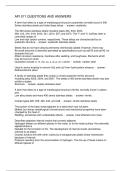
API 571 QUESTIONS AND ANSWERS
A term that refers to a type of metallurgical structure (austenite) normally found in 300
Series stainless steels and nickel base alloys. - answer -austenitic
The 300 series stainless steels including types 304, 304l, 304h,
309, 310, 316, 316l, 316h, 321, 321h, 347, and 347h. The "l" and "h" suffixes refer to
controlled ranges of
Low and high carbon content, respectively. These alloys are characterized by an
austenitic structure. - answer -austenitic stainless steels
Steels that do not have alloying elements intentionally added. However, there may
Be small amounts of elements permitted by specifications such as sa516 and sa106, for
example that can
Affect corrosion resistance, hardness after welding, and toughness. Elements which
may be found in small
Quantities include cr, ni, mo, cu, s, si, p, al, v and b. - answer -carbon steel
Used in amine treating to remove h2s and co2 from hydrocarbon streams. - answer -
diethanolamine (dea)
A family of stainless steels that contain a mixed austenitic-ferritic structure
Including alloy 2205, 2304, and 2507. The welds of 300 series stainless steels may also
exhibit a duplex
Structure. - answer -duplex stainless steel
A term that refers to a type of metallurgical structure (ferrite) normally found in carbon
and
Low alloy steels and many 400 series stainless steels. - answer -ferritic
Include types 405, 409, 430, 442, and 446. - answer -ferritic stainless steels
The portion of the base metal adjacent to a weld which has not been
Melted, but whose metallurgical microstructure and mechanical properties have been
changed by the heat of
Welding, sometimes with undesirable effects. - answer -heat affected zone (haz)
Describes stepwise internal cracks that connect adjacent
Hydrogen blisters on different planes in the metal, or to the metal surface. No externally
applied stress is
Needed for the formation of hic. The development of internal cracks (sometimes
referred to as blister
Cracks) tends to link with other cracks by a transgranular plastic shear mechanism
because of internal
Pressure resulting from the accumulation of hydrogen. The link-up of these cracks on
different planes in
,Steels has been referred to as stepwise cracking to characterize the nature of the crack
appearance. - answer -hydrogen induced cracking (hic)
A family of steels containing up to 9% chromium and other alloying additions for
High temperature strength and creep resistance. The materials include c-0.5mo, mn-
0.5mo, 1cr-0.5mo,
1.25 cr-0.5mo, 2.25cr-1.0mo, 5cr-0.5mo, and 9cr-1mo. These are considered ferritic
steels. - answer -low alloy steel
Term that refers to a type of metallurgical structure (martensite) normally found in
Some 400 series stainless steel. Heat treatment and or welding followed by rapid
cooling can produce this
Structure in carbon and low alloy steels. - answer -martensitic
Include types 410, 410s, 416, 420, 440a, 440b, and 440c. - answer -martensitic
stainless steel
Used in amine treating to remove h2s and co2 from hydrocarbon
Streams. - answer -methyldiethanolamine (mdea)
Used in amine treating to remove h2s and co2 from hydrocarbon
Streams. - answer -monoethanolamine (mea)
A family of alloys containing nickel as a major alloying element (>30%) including
Alloys 200, 400, k-500, 800, 800h, 825, 600, 600h, 617, 625, 718, x-750, and c276. -
answer -nickel base
Describes an array of cracks, aligned
Nearly perpendicular to the stress, that are formed by the link-up of small hic cracks in
steel. Tensile
Strength (residual or applied) is required to produce sohic. Sohic is commonly observed
in the base metal
Adjacent to the heat affected zone (haz) of a weld, oriented in the through-thickness
direction. Sohic may
Also be produced in susceptible steels at other high stress points, such as from the tip
of the mechanical
Cracks and defects, or from the interaction among hic on different planes in the steel. -
answer -stress oriented hydrogen induced cracking (sohic)
There are four categories of stainless steels that are characterized by their
Metallurgical structure at room temperature: austenitic, ferritic, martensitic and duplex.
These alloys have
Varying amounts of chromium and other alloying elements that give them resistance to
oxidation, sulfidation
And other forms of corrosion depending on the alloy content. - answer -stainless steel
,What hydrocarbon stream produced on a crude unit will hat the most sulfur.
A. Gas oil
B. Kerosene
C. Diesel
D. Gasoline - answer -a. Gas oil
A neutralizer injected into the crude unit atmospheric overhead condenser system, is
injected for the purpose of neutralizing what type of acid.
A. Hydrochloric
B. Sulfuric
C. Hydrofluoric
D. H2s - answer -a. Hydrochloric
A crude unit that is processing a high sulfur material operates consistently, which of the
following streams produced from the tower is most likely to contain the most sulfur
A. Diesel
B. Atmospheric tower bottoms
C. Kerosene
D. Gasoline - answer -b. Atmospheric tower bottoms
Which of the following streams from the crude unit are potentially going to have the
most nitrogen compounds
A. Heavy gas oil
B. Gasoline
C. Diesel
D. Kerosene - answer -a. Heavy gas oil
Is chloride ion corrosive.
A. Yes always
B. Yes but only when combined with water
C. Yes, but only when combined with both water and hydrocarbons
D. Yes, but only when combined with hydrocarbons - answer -b. Yes, but only when
combined with water
What is the typical length of time for a coke drum cycle on a dcu.
A. 1 hour
B. 10 hours
C. 1 day
D. 10 days - answer -c. 1 day
, When evaluation the water chemistry, what is the desired ph of the condensate (water)
that condensed in the main fractionator at the dcu
A. 1.0 to 2.0
B. 4.0 to 5.0
C. 6.0 to 7.0
D 9.0 to 10.0 - answer -c. 6.0 to 7.0
In many refinery units, water and h2s combine to form which of the following corrosive
agents.
A. Wet h2s
B. Sulfuric acid
C. Sodium hydroxide
D. Sulfur naptha acid - answer -a. Wet h2s
A catalytic cracking unit will do which of the following:
A. Combine small hydrocarbon chains
B. Thermally crack hydrocarbon chains into smaller chains
C. Produce significant amounts of gasoline
D. Produce significant amounts of coke that will need to be cut of the reactor - answer -
c. Produce significant amounts of gasoline
A catalytic cracking unit (fccu) will do which of the following?
A. Combine small hydrocarbons chains into bigger chains
B. Thermally cracking large hydrogen chains into smaller chains
C. Produce significant amounts of gasoline and diesel
D. Consume all hcn (cyanide) in the feed - answer -c. Produce significant amounts of
gasoline and diesel
In reference to the following list, what is the order of distillation on a crude distillation
unit? Start with the top stream.
A. Gasoline, diesel, kerosene
B. Diesel, gasoline, kerosene
C. Gasoline, reside, gas oil
D. Gasoline, kerosene, diesel - answer -d. Gasoline, kerosene, diesel
The gas oil stream on a crude distillation unit will go to what downstream unit for further
processing?
A. Catalytic cracking unit (fcc)
B. The desalter
C. The delayed coker unit (dcu)
A term that refers to a type of metallurgical structure (austenite) normally found in 300
Series stainless steels and nickel base alloys. - answer -austenitic
The 300 series stainless steels including types 304, 304l, 304h,
309, 310, 316, 316l, 316h, 321, 321h, 347, and 347h. The "l" and "h" suffixes refer to
controlled ranges of
Low and high carbon content, respectively. These alloys are characterized by an
austenitic structure. - answer -austenitic stainless steels
Steels that do not have alloying elements intentionally added. However, there may
Be small amounts of elements permitted by specifications such as sa516 and sa106, for
example that can
Affect corrosion resistance, hardness after welding, and toughness. Elements which
may be found in small
Quantities include cr, ni, mo, cu, s, si, p, al, v and b. - answer -carbon steel
Used in amine treating to remove h2s and co2 from hydrocarbon streams. - answer -
diethanolamine (dea)
A family of stainless steels that contain a mixed austenitic-ferritic structure
Including alloy 2205, 2304, and 2507. The welds of 300 series stainless steels may also
exhibit a duplex
Structure. - answer -duplex stainless steel
A term that refers to a type of metallurgical structure (ferrite) normally found in carbon
and
Low alloy steels and many 400 series stainless steels. - answer -ferritic
Include types 405, 409, 430, 442, and 446. - answer -ferritic stainless steels
The portion of the base metal adjacent to a weld which has not been
Melted, but whose metallurgical microstructure and mechanical properties have been
changed by the heat of
Welding, sometimes with undesirable effects. - answer -heat affected zone (haz)
Describes stepwise internal cracks that connect adjacent
Hydrogen blisters on different planes in the metal, or to the metal surface. No externally
applied stress is
Needed for the formation of hic. The development of internal cracks (sometimes
referred to as blister
Cracks) tends to link with other cracks by a transgranular plastic shear mechanism
because of internal
Pressure resulting from the accumulation of hydrogen. The link-up of these cracks on
different planes in
,Steels has been referred to as stepwise cracking to characterize the nature of the crack
appearance. - answer -hydrogen induced cracking (hic)
A family of steels containing up to 9% chromium and other alloying additions for
High temperature strength and creep resistance. The materials include c-0.5mo, mn-
0.5mo, 1cr-0.5mo,
1.25 cr-0.5mo, 2.25cr-1.0mo, 5cr-0.5mo, and 9cr-1mo. These are considered ferritic
steels. - answer -low alloy steel
Term that refers to a type of metallurgical structure (martensite) normally found in
Some 400 series stainless steel. Heat treatment and or welding followed by rapid
cooling can produce this
Structure in carbon and low alloy steels. - answer -martensitic
Include types 410, 410s, 416, 420, 440a, 440b, and 440c. - answer -martensitic
stainless steel
Used in amine treating to remove h2s and co2 from hydrocarbon
Streams. - answer -methyldiethanolamine (mdea)
Used in amine treating to remove h2s and co2 from hydrocarbon
Streams. - answer -monoethanolamine (mea)
A family of alloys containing nickel as a major alloying element (>30%) including
Alloys 200, 400, k-500, 800, 800h, 825, 600, 600h, 617, 625, 718, x-750, and c276. -
answer -nickel base
Describes an array of cracks, aligned
Nearly perpendicular to the stress, that are formed by the link-up of small hic cracks in
steel. Tensile
Strength (residual or applied) is required to produce sohic. Sohic is commonly observed
in the base metal
Adjacent to the heat affected zone (haz) of a weld, oriented in the through-thickness
direction. Sohic may
Also be produced in susceptible steels at other high stress points, such as from the tip
of the mechanical
Cracks and defects, or from the interaction among hic on different planes in the steel. -
answer -stress oriented hydrogen induced cracking (sohic)
There are four categories of stainless steels that are characterized by their
Metallurgical structure at room temperature: austenitic, ferritic, martensitic and duplex.
These alloys have
Varying amounts of chromium and other alloying elements that give them resistance to
oxidation, sulfidation
And other forms of corrosion depending on the alloy content. - answer -stainless steel
,What hydrocarbon stream produced on a crude unit will hat the most sulfur.
A. Gas oil
B. Kerosene
C. Diesel
D. Gasoline - answer -a. Gas oil
A neutralizer injected into the crude unit atmospheric overhead condenser system, is
injected for the purpose of neutralizing what type of acid.
A. Hydrochloric
B. Sulfuric
C. Hydrofluoric
D. H2s - answer -a. Hydrochloric
A crude unit that is processing a high sulfur material operates consistently, which of the
following streams produced from the tower is most likely to contain the most sulfur
A. Diesel
B. Atmospheric tower bottoms
C. Kerosene
D. Gasoline - answer -b. Atmospheric tower bottoms
Which of the following streams from the crude unit are potentially going to have the
most nitrogen compounds
A. Heavy gas oil
B. Gasoline
C. Diesel
D. Kerosene - answer -a. Heavy gas oil
Is chloride ion corrosive.
A. Yes always
B. Yes but only when combined with water
C. Yes, but only when combined with both water and hydrocarbons
D. Yes, but only when combined with hydrocarbons - answer -b. Yes, but only when
combined with water
What is the typical length of time for a coke drum cycle on a dcu.
A. 1 hour
B. 10 hours
C. 1 day
D. 10 days - answer -c. 1 day
, When evaluation the water chemistry, what is the desired ph of the condensate (water)
that condensed in the main fractionator at the dcu
A. 1.0 to 2.0
B. 4.0 to 5.0
C. 6.0 to 7.0
D 9.0 to 10.0 - answer -c. 6.0 to 7.0
In many refinery units, water and h2s combine to form which of the following corrosive
agents.
A. Wet h2s
B. Sulfuric acid
C. Sodium hydroxide
D. Sulfur naptha acid - answer -a. Wet h2s
A catalytic cracking unit will do which of the following:
A. Combine small hydrocarbon chains
B. Thermally crack hydrocarbon chains into smaller chains
C. Produce significant amounts of gasoline
D. Produce significant amounts of coke that will need to be cut of the reactor - answer -
c. Produce significant amounts of gasoline
A catalytic cracking unit (fccu) will do which of the following?
A. Combine small hydrocarbons chains into bigger chains
B. Thermally cracking large hydrogen chains into smaller chains
C. Produce significant amounts of gasoline and diesel
D. Consume all hcn (cyanide) in the feed - answer -c. Produce significant amounts of
gasoline and diesel
In reference to the following list, what is the order of distillation on a crude distillation
unit? Start with the top stream.
A. Gasoline, diesel, kerosene
B. Diesel, gasoline, kerosene
C. Gasoline, reside, gas oil
D. Gasoline, kerosene, diesel - answer -d. Gasoline, kerosene, diesel
The gas oil stream on a crude distillation unit will go to what downstream unit for further
processing?
A. Catalytic cracking unit (fcc)
B. The desalter
C. The delayed coker unit (dcu)