AP Statistics Unit 4: Probability Test With Complete Solutions |
Verified
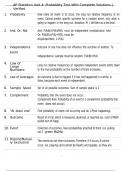
1. Probability How likely an event is to occur, the long run relative frequency of an
event. Cannot predict specific outcome for a random event, only what is
going to happen in the long run. Notation: P( ). Written as a decimal
2. And, Or, Not And: P(AnB)=P(A)xP(B), must be independent (multiplication rule)
Or: P(AUB)=P(A)+P(B), must be
disjointed Not: 1-P(A)
3. Independence Outcome of one trial does not influence the outcome of another. To
assume
independence, sample must be random. P(A/B)=P(A)
4. Law of
Large Long run relative frequencies of repeated independent events settle down
Numbers to the true probability as the number of trials increases.
5. Law of Averages An outcome is due to happen if it has not happened in a while. Is
false, because each event is independent.
6. Sample Space Set of all possible outcomes. Sum of sample space is 1
7. Complement Probability that the event does not occur.
Complement Rule: Probability of an event is 1-complement (probability that
event does not occur).
8. "At least one" Find probability of event not occurring and do 1-P(not happening).
9. Outcome Result of a trial, which is measured, observed, or reported (ex. color of M&M
pulled out of bag)
10. Event Collection of outcomes. Have probabilities attached to them. (ex. pulling
out 3 green M&Ms)
11. Disjoint/Mutual-
ly exclusive Two events do not share outcomes. Therefore, if A occurs, B cannot
occur. (ex. playing card cannot be hearts and spades, so they are
1/
6
, AP Statistics Unit 4: Probability Test With Complete Solutions |
Verified
disjoint)
2/
6
Verified
1. Probability How likely an event is to occur, the long run relative frequency of an
event. Cannot predict specific outcome for a random event, only what is
going to happen in the long run. Notation: P( ). Written as a decimal
2. And, Or, Not And: P(AnB)=P(A)xP(B), must be independent (multiplication rule)
Or: P(AUB)=P(A)+P(B), must be
disjointed Not: 1-P(A)
3. Independence Outcome of one trial does not influence the outcome of another. To
assume
independence, sample must be random. P(A/B)=P(A)
4. Law of
Large Long run relative frequencies of repeated independent events settle down
Numbers to the true probability as the number of trials increases.
5. Law of Averages An outcome is due to happen if it has not happened in a while. Is
false, because each event is independent.
6. Sample Space Set of all possible outcomes. Sum of sample space is 1
7. Complement Probability that the event does not occur.
Complement Rule: Probability of an event is 1-complement (probability that
event does not occur).
8. "At least one" Find probability of event not occurring and do 1-P(not happening).
9. Outcome Result of a trial, which is measured, observed, or reported (ex. color of M&M
pulled out of bag)
10. Event Collection of outcomes. Have probabilities attached to them. (ex. pulling
out 3 green M&Ms)
11. Disjoint/Mutual-
ly exclusive Two events do not share outcomes. Therefore, if A occurs, B cannot
occur. (ex. playing card cannot be hearts and spades, so they are
1/
6
, AP Statistics Unit 4: Probability Test With Complete Solutions |
Verified
disjoint)
2/
6