
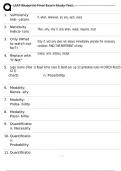
LSAT Blueprint Final Exam Study Test.
1. Sufficiency
If, when, whenever, all, any, each, every
Indi- cators
2. Necessity
Then, only, only if, only when, needs, requires, must
Indica- tors
3. Only (What
Only if, and only does not always immediately precede the necessary
to watch out
condition. FIND THE REFERENT of only
for?)
Unless, until, without, except
4. Replace with
"If Not"
5. Logic Game (Flow 1) Read intro/ rules 2) Build set- up 3) symbolize rules 4) CHECK RULES
X2 5)
chart) n: Possibility
6. Modality:
Neces- sity
7. Modality:
Proba- bility
8. Modality:
Possi- bility
9. Quantificatio
n: Necessity
10. Quantificatio
n:
Probability
11. Quantificatio
, LSAT Blueprint Final Exam Study Test.
Identify any randoms 6)
Make deductions 7) Time
for scenarios 8) Attack the
questions
Must, Is/are, will, do/does,
always
Probably, likely, usually
May, might, could, can,
occasionally
all, any, every (100%)
most, majority (>50%)
some, many, few, several
(>0%)
, LSAT Blueprint Final Exam Study Test.
12. Logical will, must, is, are, do, does, always, all, any, every, almost all
force:
Strong
probably, likely, usually, most of the time, majority of the time, most,
13. Logical majority
force:
Moderate
may, might, can, could, often, sometimes, occasionally, significant number,
14. Logical several, many, few,some
force:
Weak
15. Must be True Definitely proven true by the information in the stimulus (incorrect
answers could be false)
how to approach
-use only information present
-look for conditional statements
-pay close attention to the logical force of the propositions
If conditional
-diagram
-anticipate valid inferences (transitive conclusions, contrapositives)
If there are no conditional statements
-look for other relationships between the statements
-anticipate a weak answer choice
Common incorrect answers
-invalid conditional inferences (converse/ inverse)
-statements too strong/ outside of scope
-causes or explanation of phenomenon discussed in stimulus
-hypotheses about the future or what would have happened if something
changed

