
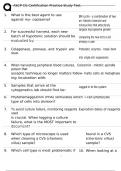
ASCP CG Certification Practice Study Test.
1. What is the best agent to use BM cyclin - a combination of two
against my- coplasma? an- tibiotics (tiamulin and
minocycline) that ettecticely
targets mycoplasma growth
2. For successful harvest, each new
batch of hypotonic solution should be comparing the new lot to a lot
evaluated by: already in use
3. Colagenase, pronase, and trypsin are: Proteolytic enzymes - break down
tissues
into single-cell suspensions
4. When harvesting peripheral blood cultures, Colcemid - mitotic spindle
poison that
asceptic technique no longer matters follow- halts cells at metaphase
ing incubation with:
5. Samples that arrive at the Logged in to the system
cytogenetics lab should first be:
6. Phytohemagglutinin (PHA) stimulates which T-cell lymphocytes
type of cells into division?
7. To avoid culture failure, monitoring reagents Expiration dates of reagents
used
is crucial. When logging a culture
failure, what is the MOST important to
document?
8. Which type of microscope is used found in a CVS
when cleaning a CVS (chorionic (chorionic villus)
villus) sample? sample?
9. Which cell type is most problematic if 10. When looking at a
1/
45
, ASCP CG Certification Practice Study Test.
slide under a phase con- trast scope Dissection
and a lot of cytoplasm is still seen
around the mets, what is the most
likely cause? Decidua (maternal tissue)
innappropriate slide drying time
2/
45
, ASCP CG Certification Practice Study Test.
11. What will help prevent microbial contamina- Asceptic technique
tion and cross contamination of cultures?
12. When there are not enough mets to com- prepare additional slides from
any re-
plete the study of a patient/case, what needs maining sample
to be done next?
13. When looking at a dropped slide Increading the drying time by
under a phase scope and mets are using warm slides
very spread out and sparse, what
could help fix the issue?
14. What is true of an inverted microscope? the objectives are beneath the stage
15. High-resolution banding is for turner syn-
indicated for a possible diagnosis drome?
of:
16. When verifying if a specimen is
appropriate for cytogenetic analysis,
what is the MOST important data to
accompany the specimen?
17. Which type of specimen should be
request- ed for a cytogenetic analysis
3/
45
, ASCP CG Certification Practice Study Test.
DiGenorge syndrome -- microdeletion of 22q11, also called Reason for referral
velocardiofacial syn- drome
"velo" - soft palette,
"cardio" - congenital heart defects, "facial" - unique abnormal Heparinized peripheral blood
facial fea- tures, short philtrum (upper lip indent), tubular nose, stored at room temperature
wide spread eyes, etc
(NOT FROZEN)
18.
4/
45

