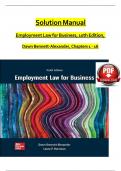
Solution Manual
Employment Law for Business, 10th Edition,
Dawn Bennett-Alexander, Chapters 1 - 16
,TABLE OF CONTENTS
Chapter 1 The Regulation of Employment
Chapter 2 The Employment Law Toolkit: Resources for Understanding the Law and Recurring
Legal Concepts
Chapter 3 Title VII of the Civil Rights Act of 1964
Chapter 4 Legal Construction of the Employment Environment Chapter 5
Affirmative Action
Chapter 6 Race and Color Discrimination
Chapter 7 National Origin Discrimination
Chapter 8 Gender Discrimination Chapter 9
Sexual Harassment
Chapter 10 Sexual Orientation and Gender Identity Discrimination Chapter 11
Religious Discrimination
Chapter 12 Age Discrimination Chapter 13
Disability Discrimination
Chapter 14 The Employee’s Right to Privacy and Management of Personal
Information
Chapter 15 Labor Law 857
Chapter 16 Selected Employment Benefits and Protections
Chapter 1
, The Regulation of Employment
Chapter Objective
The student is introduced to the regulatory environment of the employment relationship. The
chapter examines whether regulation is actually necessary or beneficial or if, perhaps, the
relationship would fare better with less governmental intervention. The concepts of ―freedom‖
to contract in the regulatory employment environment and non-compete agreements are
discussed. Since the regulations and case law discussed in this text rely on an individual‘s
classification as an employer or an employee, those definitions are delineated and explored.
Learning Objectives
(Click on the icon following the learning objective to be linked to the location in the outlinewhere
the chapter addresses that particular objective.)
At the conclusion of this chapter, the students should be able to:
1. Describe the balance between the freedom to contract and the current
regulatory environment for employment.
2. Identify who is subject to which employment laws and understand the implication of eachof
these laws for both the employer and employee.
3. Delineate the risks to the employer caused by employee misclassification.
4. Explain the difference between and employee and an independent contractor and the
tests that help us in that determination.
5. Articulate the various ways in which the concept ―employer‖ is defined by the
various employment-related regulations.
6. Describe the permissible parameters of non-compete agreements.
Detailed Chapter Outline
Scenarios—Points for Discussion
, Scenario One: fThis fscenario foffers fan fopportunity fto freview fthe fdistinctions fbetween fan
f employee fand fan findependent fcontractor fdiscussed fin fthe fchapter f(see f―The fDefinition fof
f Employee,‖ fparticularly fExhibits f1.3–1.5). fDiscuss fthe fIRS f20-factor fanalysis, fas fit fapplies
fto f Dalia‘s fposition. fIn flight fof fthe flow flevel fof fcontrol fthat fDalia fhad fover fher ffees fand
fher fwork f process, fand fthe flimits fupon fher fchoice fof fclients, fstudents fshould fcome fto fthe
fconclusion fthat f Dalia fis fan femployee f(therefore, feligible fto ffile fan funemployment fclaim),
frather fthan fan f independent fcontractor.
Scenario fTwo: fSoraya fwould fnot fhave fa fcause fof faction fthat fwould fbe frecognized fby fthe
fEEOC. f Review fthe fsection f―The fDefinition fof f‗Employer‘‖ fwith fstudents, fand fdiscuss fthe
frationale fthat f determines fthe fstatus fof fa fsupervisor fvis-à-vis fanti-discrimination flegislation.
fBecause fSoraya fis f Soraya‘s fsupervisor, fnot fher femployer, fhe fcannot fbe fthe ftarget fof fan
fEEOC fclaim fof fsexual f harassment.
CCC, fSoraya‘s femployer, fwould fbe fvulnerable fto fan fEEOC fclaim fif fthe fcompany flacked for
ffailedto f follow fa fsystem ffor femployee fredress fof fdiscrimination fgrievances. fHowever, fin fthis
fcase, f CCC f appears fto fhave fa fviable fanti-discrimination fpolicy fthat fit fadhered fto fdiligently;
f consequently, fSoraya f would fbe funlikely fto fwin fa fdecision fin fher ffavor. fThe fcourt fin f Williams
fv. fBanning f(1995) foffered fthe f following frationale ffor fits fdecision fin fa fsimilar fcase:
―She fhas fan femployer fwho fwas fsensitive fand fresponsive fto fher fcomplaint. fShe fcan
ftake f comfort fin fthe fknowledge fthat fshe fcontinues fto fwork ffor fthis fcompany, fwhile
fher fharasser f does fnot fand fthat fthe fcompany's fprompt faction fis flikely fto fdiscourage
fother fwould fbe f harassers. fThis fis fprecisely fthe fresult fTitle fVII fwas fmeant fto
fachieve.‖
Scenario fThree: fStudents fshould fdiscuss fwhether for fnot fMya fnon-compete fagreement fis flikely
ftobe f found freasonable fby fa fcourt, fand felaborate fthe faspects fof fthe fagreement fthat fMya
fmight fcontest fas f unreasonable f(see fsection fbelow, f―Covenants fNot fto fCompete‖). fDoes fMya
fhave fa fpersuasive f argument fthat fthe fterms fof fher fnon-compete fagreement fare funreasonable
fin fscope for fduration?
Might fshe fhave fgrounds fto fclaim fthat fthe fagreement fprohibits fher ffrom fmaking fa f living?
Given fthe fdiversity fof fstate flaws fregulating fnon-compete fagreements, fdiscuss fthe frange fof
flegal f restrictions fthat fmight fapply fto fMya‘s fparticular fagreement fwith fher femployer. fAs fan
femployeewho f works facross fseveral fstates, fMya‘s fdefense fmay fdepend fupon fthe
fpresence—and fspecific f language—of fa fforum fselection fclause fin fher fnon-compete
fagreement. fConsider fwhat flanguage f would fbe fmore flikely fto fprovide fNan fwith fa fstrong
fdefense fagainst fthe fbreach fof fcontract fclaim.
Mya fmight falso fargue fthat fthe fcompany‘s fclient flist fis favailable fthrough fpublic fmeans, fand
f therefore, fher faccess fto fthis flist fshould fnot fbe fprohibited.
General fLecture fNote ffor fEmployment fLaw fCourse
In forder fto fteach fthis fcourse, finstructors fhave ffound fthat fstudents fmust fbe fmade fto ffeel
frelatively f comfortable fwith ftheir fpeers. fInstructors fwill fbe fasking fthe fstudents fto fbe fhonest
fand fto fstay fin f their ftruth, feven fat ftimes fwhen fthey ffeel fthat ftheir fopinion fon fone fof fthese
fmatters fwill fnot fbe
Employment Law for Business, 10th Edition,
Dawn Bennett-Alexander, Chapters 1 - 16
,TABLE OF CONTENTS
Chapter 1 The Regulation of Employment
Chapter 2 The Employment Law Toolkit: Resources for Understanding the Law and Recurring
Legal Concepts
Chapter 3 Title VII of the Civil Rights Act of 1964
Chapter 4 Legal Construction of the Employment Environment Chapter 5
Affirmative Action
Chapter 6 Race and Color Discrimination
Chapter 7 National Origin Discrimination
Chapter 8 Gender Discrimination Chapter 9
Sexual Harassment
Chapter 10 Sexual Orientation and Gender Identity Discrimination Chapter 11
Religious Discrimination
Chapter 12 Age Discrimination Chapter 13
Disability Discrimination
Chapter 14 The Employee’s Right to Privacy and Management of Personal
Information
Chapter 15 Labor Law 857
Chapter 16 Selected Employment Benefits and Protections
Chapter 1
, The Regulation of Employment
Chapter Objective
The student is introduced to the regulatory environment of the employment relationship. The
chapter examines whether regulation is actually necessary or beneficial or if, perhaps, the
relationship would fare better with less governmental intervention. The concepts of ―freedom‖
to contract in the regulatory employment environment and non-compete agreements are
discussed. Since the regulations and case law discussed in this text rely on an individual‘s
classification as an employer or an employee, those definitions are delineated and explored.
Learning Objectives
(Click on the icon following the learning objective to be linked to the location in the outlinewhere
the chapter addresses that particular objective.)
At the conclusion of this chapter, the students should be able to:
1. Describe the balance between the freedom to contract and the current
regulatory environment for employment.
2. Identify who is subject to which employment laws and understand the implication of eachof
these laws for both the employer and employee.
3. Delineate the risks to the employer caused by employee misclassification.
4. Explain the difference between and employee and an independent contractor and the
tests that help us in that determination.
5. Articulate the various ways in which the concept ―employer‖ is defined by the
various employment-related regulations.
6. Describe the permissible parameters of non-compete agreements.
Detailed Chapter Outline
Scenarios—Points for Discussion
, Scenario One: fThis fscenario foffers fan fopportunity fto freview fthe fdistinctions fbetween fan
f employee fand fan findependent fcontractor fdiscussed fin fthe fchapter f(see f―The fDefinition fof
f Employee,‖ fparticularly fExhibits f1.3–1.5). fDiscuss fthe fIRS f20-factor fanalysis, fas fit fapplies
fto f Dalia‘s fposition. fIn flight fof fthe flow flevel fof fcontrol fthat fDalia fhad fover fher ffees fand
fher fwork f process, fand fthe flimits fupon fher fchoice fof fclients, fstudents fshould fcome fto fthe
fconclusion fthat f Dalia fis fan femployee f(therefore, feligible fto ffile fan funemployment fclaim),
frather fthan fan f independent fcontractor.
Scenario fTwo: fSoraya fwould fnot fhave fa fcause fof faction fthat fwould fbe frecognized fby fthe
fEEOC. f Review fthe fsection f―The fDefinition fof f‗Employer‘‖ fwith fstudents, fand fdiscuss fthe
frationale fthat f determines fthe fstatus fof fa fsupervisor fvis-à-vis fanti-discrimination flegislation.
fBecause fSoraya fis f Soraya‘s fsupervisor, fnot fher femployer, fhe fcannot fbe fthe ftarget fof fan
fEEOC fclaim fof fsexual f harassment.
CCC, fSoraya‘s femployer, fwould fbe fvulnerable fto fan fEEOC fclaim fif fthe fcompany flacked for
ffailedto f follow fa fsystem ffor femployee fredress fof fdiscrimination fgrievances. fHowever, fin fthis
fcase, f CCC f appears fto fhave fa fviable fanti-discrimination fpolicy fthat fit fadhered fto fdiligently;
f consequently, fSoraya f would fbe funlikely fto fwin fa fdecision fin fher ffavor. fThe fcourt fin f Williams
fv. fBanning f(1995) foffered fthe f following frationale ffor fits fdecision fin fa fsimilar fcase:
―She fhas fan femployer fwho fwas fsensitive fand fresponsive fto fher fcomplaint. fShe fcan
ftake f comfort fin fthe fknowledge fthat fshe fcontinues fto fwork ffor fthis fcompany, fwhile
fher fharasser f does fnot fand fthat fthe fcompany's fprompt faction fis flikely fto fdiscourage
fother fwould fbe f harassers. fThis fis fprecisely fthe fresult fTitle fVII fwas fmeant fto
fachieve.‖
Scenario fThree: fStudents fshould fdiscuss fwhether for fnot fMya fnon-compete fagreement fis flikely
ftobe f found freasonable fby fa fcourt, fand felaborate fthe faspects fof fthe fagreement fthat fMya
fmight fcontest fas f unreasonable f(see fsection fbelow, f―Covenants fNot fto fCompete‖). fDoes fMya
fhave fa fpersuasive f argument fthat fthe fterms fof fher fnon-compete fagreement fare funreasonable
fin fscope for fduration?
Might fshe fhave fgrounds fto fclaim fthat fthe fagreement fprohibits fher ffrom fmaking fa f living?
Given fthe fdiversity fof fstate flaws fregulating fnon-compete fagreements, fdiscuss fthe frange fof
flegal f restrictions fthat fmight fapply fto fMya‘s fparticular fagreement fwith fher femployer. fAs fan
femployeewho f works facross fseveral fstates, fMya‘s fdefense fmay fdepend fupon fthe
fpresence—and fspecific f language—of fa fforum fselection fclause fin fher fnon-compete
fagreement. fConsider fwhat flanguage f would fbe fmore flikely fto fprovide fNan fwith fa fstrong
fdefense fagainst fthe fbreach fof fcontract fclaim.
Mya fmight falso fargue fthat fthe fcompany‘s fclient flist fis favailable fthrough fpublic fmeans, fand
f therefore, fher faccess fto fthis flist fshould fnot fbe fprohibited.
General fLecture fNote ffor fEmployment fLaw fCourse
In forder fto fteach fthis fcourse, finstructors fhave ffound fthat fstudents fmust fbe fmade fto ffeel
frelatively f comfortable fwith ftheir fpeers. fInstructors fwill fbe fasking fthe fstudents fto fbe fhonest
fand fto fstay fin f their ftruth, feven fat ftimes fwhen fthey ffeel fthat ftheir fopinion fon fone fof fthese
fmatters fwill fnot fbe