NBCOT Exam Prep Upper Extremity Study Guide.
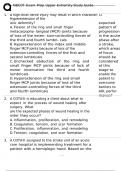
1. A high-level nerve injury may result in which character- D.
Hyperextension of the
istic deformity? expected
A. Flexion of the ring and small finger pattern of
metacarpopha- langeal (MCP) joints because progression
of loss of the exten- sion-controlling forces of in the acute
the third and fourth lumbri- cals phase after
B. Hyperextension of the index and middle a stroke,
finger MCP joints because of loss of the which areas
extension-controlling forces of the first and of focus
second lumbricals should be
C. Unchecked abduction of the ring and considered
small finger MCP joints because of lack of at this
motor innervation the third and fourth stage to
lumbricals enable the
D. Hyperextension of the ring and small patient to
finger MCP joints because of loss of the overcome
extension-controlling forces of the third barriers to
and fourth lumbricals ADL perfor-
mance?
2. A COTA® is educating a client about what to
expect in the process of wound healing after
surgery. What
are the expected phases of wound healing in the
order they occur?
A. Inflammation, proliferation, and remodeling
B. Coagulation, tension, and scar formation
C. Proliferation, inflammation, and remodeling
D. Tension, coagulation, and scar formation
3. A COTA® assigned to the stroke unit of an acute
care hospital is implementing treatment for a
patient with a hemiplegic hand. Based on the
, NBCOT Exam Prep Upper Extremity Study Guide.
ring and small finger MCP joints because of loss of the extension-
controlling forces of the third and fourth lumbricals
A. Inflammation, prolifera- tion, and remodeling
A. Passive range of mo- tion and positioning of the attected upper
extremity, bed mobility
, NBCOT Exam Prep Upper Extremity Study Guide.
A. Passive range of motion and positioning of
the af- fected upper extremity, bed mobility
B. Visual and cognition issues, upper-extremity
orthot- ic needs
C. Transfers, therapeutic exercise for upper-
extremity strengthening
D. Community mobility, fine motor coordination
4. A COTA® is treating a 77-year-old client who C. Use soft straps and
requires a resting hand splint. Which splint thick padding
characteristics
are MOST important in addressing the natural
aging process of skin and adipose tissue?
A. Use colored splints and no moving parts
B. Use D rings and mark where straps go
C. Use soft straps and thick padding
D. Label the splint with client's name
5. A COTA® is working with a client experiencing a cumu- C. Client can
brush teeth
lative trauma disorder of the right upper extremity. To using the
involved upper
document client improvement as a result of extremity without pain.
therapy, which occupation-based statement
would the COTA® be MOST likely to write?
A. Client's pain-free AROM of right elbow is now
15° to 110°.
B. Client can perform 30 repetitions of
elbow flex- ion-extension using a 1-lb
weight.
C. Client can brush teeth using the involved
upper extremity without pain.
D.Client demonstrates grip strength to
maintain grasp for 15 seconds.
, NBCOT Exam Prep Upper Extremity Study Guide.
6. A. Dexamethasone
1. A high-level nerve injury may result in which character- D.
Hyperextension of the
istic deformity? expected
A. Flexion of the ring and small finger pattern of
metacarpopha- langeal (MCP) joints because progression
of loss of the exten- sion-controlling forces of in the acute
the third and fourth lumbri- cals phase after
B. Hyperextension of the index and middle a stroke,
finger MCP joints because of loss of the which areas
extension-controlling forces of the first and of focus
second lumbricals should be
C. Unchecked abduction of the ring and considered
small finger MCP joints because of lack of at this
motor innervation the third and fourth stage to
lumbricals enable the
D. Hyperextension of the ring and small patient to
finger MCP joints because of loss of the overcome
extension-controlling forces of the third barriers to
and fourth lumbricals ADL perfor-
mance?
2. A COTA® is educating a client about what to
expect in the process of wound healing after
surgery. What
are the expected phases of wound healing in the
order they occur?
A. Inflammation, proliferation, and remodeling
B. Coagulation, tension, and scar formation
C. Proliferation, inflammation, and remodeling
D. Tension, coagulation, and scar formation
3. A COTA® assigned to the stroke unit of an acute
care hospital is implementing treatment for a
patient with a hemiplegic hand. Based on the
, NBCOT Exam Prep Upper Extremity Study Guide.
ring and small finger MCP joints because of loss of the extension-
controlling forces of the third and fourth lumbricals
A. Inflammation, prolifera- tion, and remodeling
A. Passive range of mo- tion and positioning of the attected upper
extremity, bed mobility
, NBCOT Exam Prep Upper Extremity Study Guide.
A. Passive range of motion and positioning of
the af- fected upper extremity, bed mobility
B. Visual and cognition issues, upper-extremity
orthot- ic needs
C. Transfers, therapeutic exercise for upper-
extremity strengthening
D. Community mobility, fine motor coordination
4. A COTA® is treating a 77-year-old client who C. Use soft straps and
requires a resting hand splint. Which splint thick padding
characteristics
are MOST important in addressing the natural
aging process of skin and adipose tissue?
A. Use colored splints and no moving parts
B. Use D rings and mark where straps go
C. Use soft straps and thick padding
D. Label the splint with client's name
5. A COTA® is working with a client experiencing a cumu- C. Client can
brush teeth
lative trauma disorder of the right upper extremity. To using the
involved upper
document client improvement as a result of extremity without pain.
therapy, which occupation-based statement
would the COTA® be MOST likely to write?
A. Client's pain-free AROM of right elbow is now
15° to 110°.
B. Client can perform 30 repetitions of
elbow flex- ion-extension using a 1-lb
weight.
C. Client can brush teeth using the involved
upper extremity without pain.
D.Client demonstrates grip strength to
maintain grasp for 15 seconds.
, NBCOT Exam Prep Upper Extremity Study Guide.
6. A. Dexamethasone