Nursing 155 Practice Complex Next-Gen NCLEX Questions & Answers.
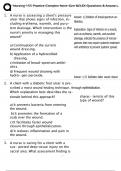
1. A nurse is assessing a client's pressure
Answer: c) Initiation of broad-spectrum an-
ulcer that shows signs of infection, in-
tibiotics.
cluding erythema, warmth, and puru-
lent drainage. Which intervention is the Explanation: Signs of infection in a wound,
nurse's priority in managing this such as erythema, warmth, and purulent
wound? drainage, indicate the presence of microor-
ganisms that may require systemic treatment
a) Continuation of the current
with antibiotics to prevent systemic spread.
wound dressing.
b) Application of a hydrocolloid
dressing.
c) Initiation of broad-spectrum antibi-
otics.
d) Frequent wound cleaning with
hydro- gen peroxide. Answer: c) It facilitates faster wound closure
2. A client with a diabetic foot ulcer is pre-
scribed a moist wound healing technique. through epithelialization.
Which explanation best describes the ra-
tionale behind this approach? charac- teristic of this
type of wound?
a) It prevents bacteria from entering
the wound.
b) It promotes the formation of a
scab over the wound.
c) It facilitates faster wound
closure through epithelialization.
d) It reduces inflammation and pain in
the wound.
3. A nurse is caring for a client with a
sus- pected deep tissue injury on the
sacral area. What assessment finding is
1/7
, Nursing 155 Practice Complex Next-Gen NCLEX Questions & Answers.
Explanation: Moist wound healing creates an optimal environment
for cell migration, pro- liferation, and angiogenesis, which promote
faster wound closure through the process of epithelialization. It also
reduces the risk of scab formation and promotes better wound
healing outcomes.
Answer: b) Sloughing and eschar formation.
Explanation: Deep tissue injuries typically manifest as localized
areas of discolored skin,
2/7
1. A nurse is assessing a client's pressure
Answer: c) Initiation of broad-spectrum an-
ulcer that shows signs of infection, in-
tibiotics.
cluding erythema, warmth, and puru-
lent drainage. Which intervention is the Explanation: Signs of infection in a wound,
nurse's priority in managing this such as erythema, warmth, and purulent
wound? drainage, indicate the presence of microor-
ganisms that may require systemic treatment
a) Continuation of the current
with antibiotics to prevent systemic spread.
wound dressing.
b) Application of a hydrocolloid
dressing.
c) Initiation of broad-spectrum antibi-
otics.
d) Frequent wound cleaning with
hydro- gen peroxide. Answer: c) It facilitates faster wound closure
2. A client with a diabetic foot ulcer is pre-
scribed a moist wound healing technique. through epithelialization.
Which explanation best describes the ra-
tionale behind this approach? charac- teristic of this
type of wound?
a) It prevents bacteria from entering
the wound.
b) It promotes the formation of a
scab over the wound.
c) It facilitates faster wound
closure through epithelialization.
d) It reduces inflammation and pain in
the wound.
3. A nurse is caring for a client with a
sus- pected deep tissue injury on the
sacral area. What assessment finding is
1/7
, Nursing 155 Practice Complex Next-Gen NCLEX Questions & Answers.
Explanation: Moist wound healing creates an optimal environment
for cell migration, pro- liferation, and angiogenesis, which promote
faster wound closure through the process of epithelialization. It also
reduces the risk of scab formation and promotes better wound
healing outcomes.
Answer: b) Sloughing and eschar formation.
Explanation: Deep tissue injuries typically manifest as localized
areas of discolored skin,
2/7