NUR2513 / NUR 2513 MATERNAL CHILD NURSING EXAM 3 STUDY GUIDE latest version
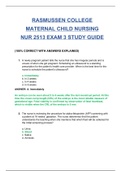
RASMUSSEN COLLEGE MATERNAL CHILD NURSING NUR 2513 EXAM 3 STUDY GUIDE (100% CORRECT WITH ANSWERS EXPLAINED) 1. A newly pregnant patient tells the nurse that she has irregular periods and is unsure of when she got pregnant. Scheduling an ultrasound is a standing prescription for the patient’s health care provider. When is the best time for the nurse to schedule the patient’s ultrasound? a. Immediately b. In 2 weeks c. In 4 weeks d. In 6 weeks ANSWER: A. Immediately An embryo can be seen about 5 to 6 weeks after the last menstrual period. At this time the crown-rump length (CRL) of the embryo is the most reliable measure of gestational age. Fetal viability is confirmed by observation of fetal heartbeat, which is visible when the CRL of the embryo is 5 mm. 2. The nurse is reviewing the procedure for alpha-fetoprotein (AFP) screening with a patient at 16 weeks’ gestation. The nurse determines that the patient understands the teaching when she mentions that which fluid will be collected for the initial screening process? a. Urine b. Blood c. Saliva d. Amniotic ANSWER: B. Blood Initial screening is completed with blood. AFP can be detected in amniotic fluid; however, that procedure is more costly and invasive. Procedures progress from least invasive to most invasive. 3. A patient at 36 weeks gestation is undergoing a non–stress (NST) test. The nurse observes the fetal heart rate baseline at 135 beats per minute (bpm) and four non episodic patterns of the fetal heart rate reaching 160 bpm for periods of 20 to 25 seconds each. How will the nurse record these findings? a. NST positive, non-reassuring b. NST negative, reassuring c. NST reactive, reassuring d. NST nonreactive, non-reassuring ANSWER: C. NST reactive, reassuring The presence of at least three accelerations of at least 15 beats, over at least 15 seconds, over a duration of at least 20 minutes, is considered reactive and reassuring. Nonreactive testing reveals no or fewer accelerations over the same or longer period. The NST test is not recorded as positive or negative. 4. Which clinical conditions are associated with increased levels of alpha fetoprotein (AFP)? (Select all that apply.) a. Down syndrome b. Molar pregnancy c. Twin gestation d. Incorrect gestational age assessment of a normal fetus—estimation is earlier in the pregnancy e. Threatened abortion ANSWER: c. Twin gestation d. Incorrect gestational age assessment of a normal fetus—estimation is earlier in the pregnancy e. Threatened abortion Elevated APF levels are seen in multiple gestations, underestimation of fetal age, and threatened abortion. Decreased levels are seen in Down syndrome and a molar pregnancy. 5. Transvaginal ultrasonography is often performed during the first trimester. A 6-week-gestation client expresses concerns over the necessity for this test. The nurse should explain that this diagnostic test may be necessary to determine which of the following? (Select all that apply.) a. Multifetal gestation b. Bicornuate uterus c. Presence and location of pregnancy d. Amniotic fluid volume e. Presence of ovarian cysts ANSWER: a. Multifetal gestation b. Bicornuate uterus c. Presence and location of pregnancy e. Presence of ovarian cysts A bicornuate uterus, multifetal gestation, presence of ovarian cysts, and presence and location of pregnancy can be determined by transvaginal ultrasound in the first trimester of pregnancy. This procedure is also used for estimating gestational age, confirming fetal viability, identifying fetal abnormalities or chromosomal defects, and identifying the maternal abnormalities mentioned, as well as fibroids. Amniotic fluid volume is assessed during the second and third trimesters. Conventional ultrasound would be used. 6. A woman who is 36 weeks pregnant asks the nurse to explain the vibroacoustic stimulator (VAS) test. Which should the nurse include in the response? (Select all that apply.) a. The test is invasive. b. The test uses sound to elicit fetal movements. c. The test may confirm nonreactive non–stress test results. d. The test can only be performed if contractions are present. e. Vibroacoustic stimulation can be repeated at 1-minute intervals up to three times. ANSWER: b. The test uses sound to elicit fetal movements. c. The test may confirm nonreactive non–stress test results. e. Vibroacoustic stimulation can be repeated at 1-minute intervals up to three times. Also referred to as VAS or acoustic stimulation, the vibroacoustic stimulator (similar to an electronic larynx) is applied to the maternal abdomen over the area of the fetal head. Vibration and sound are emitted for up to 3 seconds and may be repeated. A fetus near term responds by increasing the number of gross body movements, which can be easily seen and felt. The procedure can confirm reassuring NST findings and shorten the length of time necessary to obtain NST data. The test is noninvasive and contractions do not need to be present to perform the test.
Escuela, estudio y materia
Información del documento
- Subido en
- 25 de octubre de 2020
- Número de páginas
- 31
- Escrito en
- 2020/2021
- Tipo
- Examen
- Contiene
- Preguntas y respuestas
Temas
-
nur2513 nur 2513 maternal child nursing exam 3 study guide latest version
-
nur 2513 maternal child nursing exam 3 study guide latest version
-
maternal child nursing exam 3 study guide latest version
-
n

Documento también disponible en un lote