NUR2513 / NUR 2513 MATERNAL CHILD NURSING EXAM 2 STUDY GUIDE latest version
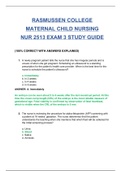
RASMUSSEN COLLEGE MATERNAL CHILD NURSING NUR 2513 EXAM 2 STUDY GUIDE (100% CORRECT WITH ANSWERS EXPLAINED) 1. A pregnant client would like to know a good food source of calcium other than dairy products. Which is the best answer that the nurse should give? a. Legumes b. Lean meat c. Whole grains d. Yellow vegetables ANSWER: A. Legumes Although dairy products contain the greatest amount of calcium, it can also be found in legumes, nuts, dried fruits, and some dark green leafy vegetables. Lean meats are rich in protein and phosphorus. Whole grains are rich in zinc and magnesium. Yellow vegetables are rich in vitamin A. 2. To determine cultural influences on a client’s diet, what should the nurse do first? a. Evaluate the client’s weight gain during pregnancy. b. Assess the socioeconomic status of the client. c. Discuss the four food groups with the client. d. Identify the food preferences and methods of food preparation common to the client’s culture. ANSWER: D. Identify the food preferences and methods of food preparation common to the client’s culture. Understanding the client’s food preferences and how she prepares food will assist the nurse in determining whether the client’s culture is adversely affecting her nutritional intake. Evaluating a client’s weight gain during pregnancy should be included for all clients, not just for those who are culturally different. The socioeconomic status of the clients may alter the nutritional intake, but not the cultural influence. Teaching the food groups to the client should come after assessing food preferences. 3. Which pregnant adolescent is most at risk for a nutritional deficit during pregnancy? a. A 16-year-old who is 10 lb. overweight b. A 17-year-old who is 10 lb. underweight c. A 15-year-old of normal height and weight d. A 16-year-old of normal height and weight ANSWER: B. A 17-year-old who is 10 lb. underweight The adolescent who is pregnant and underweight is most at risk because she is already deficient in nutrition and must now supply the nutritional intake for both herself and her fetus. An overweight pregnant teen is at risk for deficiency but is not at the highest risk. Being underweight is the riskiest because she is already deficient. A 15-year-old has special nutritional needs during pregnancy, but she is not at the highest risk for deficiency. A 16-year-old has special nutritional needs during pregnancy, but she is not at the highest risk for deficiency. 4. What should be the goal of a client with the nursing diagnosis “Imbalanced nutrition: Less than body requirements” (related to diet choices inadequate to meet the nutrient requirements of pregnancy)? a. Gain a total of 30 lb. b. Decrease intake of snack foods. c. Take daily supplements consistently. d. Increase intake of complex carbohydrates. ANSWER: A. Gain a total of 30 lb. A weight gain of 30 lb. is one indication that the client has gained a sufficient amount for the nutritional needs of pregnancy. Decreasing snack food may be the problem and should be assessed. However, assessing the weight gain is the best method of monitoring intake for this pregnancy. A daily supplement is not the best goal for this client. It does not meet the basic need of proper nutrition during pregnancy. Increasing the intake of complex carbohydrates is important for this client, but monitoring the weight gain should be the end goal. 5. A client who is in week 28 of gestation is concerned about her weight gain of 17 lb. Which is the nurse’s best response? a. “You should not gain any more weight until you reach the third trimester.” b. “You should try to decrease your amount of weight gain for the next 12 weeks.” c. “You have not gained enough weight for the number of weeks of your pregnancy.” d. “You have gained an appropriate amount for the number of weeks of your pregnancy.” ANSWER: D. You have gained an appropriate amount for the number of weeks of your pregnancy.” A woman in her 28th week of gestation should have gained between 17 and 20 lb. The normal pattern of weight gain is about 3.5 lb. total in the first trimester (by 13 weeks) and 1 lb. per week after that. The client has gained the appropriate amount of weight. It would be inappropriate to have her decrease her weight gain. She has gained an appropriate amount of weight and should not increase the weight gain. Weight gain needs to be consistent during the last part of the pregnancy and should not be suppressed. 6. In teaching a pregnant adolescent about nutrition, what should the nurse plan to do? a. Determine the weight gain needed to meet adolescent growth and add 35 lb. b. Suggest that she not eat at fast food restaurants to avoid foods of poor nutritional value. c. Realize that most adolescents are unwilling to make dietary changes during pregnancy. d. Emphasize the need to eliminate common teen snack foods because they are too high in fat and sodium.
Escuela, estudio y materia
Información del documento
- Subido en
- 25 de octubre de 2020
- Número de páginas
- 29
- Escrito en
- 2020/2021
- Tipo
- Examen
- Contiene
- Preguntas y respuestas

Documento también disponible en un lote