Page | 1
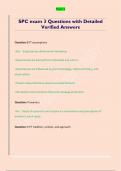
SPC exam 3 Questions with Detailed
Verified Answers
Question:EVT assumptions
Ans: -Expectancies drive human interaction
-Expectancies are learned from individuals and culture
-Expectancies are influenced by prior knowledge, relational history, and
observations
-People make predictions about nonverbal behavior
-Nonverbal communication influences message production
Question: Proxemics
Ans: Study of a person's use of space in conversations and perceptions of
another's use of space.
Question: EVT tradition, context, and approach
, Page | 2
Ans: tradition: Socio-psychological
approach: objective/positivist/empirical
context: Intrapersonal and Interpersonal
Question: Proxemic Zones
Ans: -Hall (1966) identified primary zones of personal space expectations
among North Americans.
-intimate, personal, social, public
-for F2F, vary when we are communicating side-by-side.
Question: Intimate distance
Ans: 0 to 18 inches
Question: Personal distance
Ans: 18 inches to 4 feet
Question: Social distance
Ans: 4 to 12 feet
Question: Public distance
, Page | 3
Ans: 12 feet and beyond
Question: two competing needs for space (Burgoon, 1978)
Ans: • Affiliation: Relational; Integration, Close
• Personal space: Individual Body Space; Autonomy
Question: Territoriality
Ans: Person's ownership of an area or object
Question: types of territories (Altman, 1975)
Ans: • Primary territories (home)
• Secondary territories
• Public territories (no personal affiliations)
Question: Expectancies
Ans: -Cognitions and behaviors anticipated and prescribed in conversations
with another person
-can be verbal and nonverbal
Question: Types of expectations
SPC exam 3 Questions with Detailed
Verified Answers
Question:EVT assumptions
Ans: -Expectancies drive human interaction
-Expectancies are learned from individuals and culture
-Expectancies are influenced by prior knowledge, relational history, and
observations
-People make predictions about nonverbal behavior
-Nonverbal communication influences message production
Question: Proxemics
Ans: Study of a person's use of space in conversations and perceptions of
another's use of space.
Question: EVT tradition, context, and approach
, Page | 2
Ans: tradition: Socio-psychological
approach: objective/positivist/empirical
context: Intrapersonal and Interpersonal
Question: Proxemic Zones
Ans: -Hall (1966) identified primary zones of personal space expectations
among North Americans.
-intimate, personal, social, public
-for F2F, vary when we are communicating side-by-side.
Question: Intimate distance
Ans: 0 to 18 inches
Question: Personal distance
Ans: 18 inches to 4 feet
Question: Social distance
Ans: 4 to 12 feet
Question: Public distance
, Page | 3
Ans: 12 feet and beyond
Question: two competing needs for space (Burgoon, 1978)
Ans: • Affiliation: Relational; Integration, Close
• Personal space: Individual Body Space; Autonomy
Question: Territoriality
Ans: Person's ownership of an area or object
Question: types of territories (Altman, 1975)
Ans: • Primary territories (home)
• Secondary territories
• Public territories (no personal affiliations)
Question: Expectancies
Ans: -Cognitions and behaviors anticipated and prescribed in conversations
with another person
-can be verbal and nonverbal
Question: Types of expectations