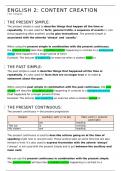
ENGLISH 2: CONTENT CREATION
THE TENSES
THE PRESENT SIMPLE:
The present simple is used to describe things that happen all the time or
repeatedly. It’s also used for facts, general truths, a sequence of events (= one
thing happening after another) and to give instructions. The present simple is
associated with the adverbs ‘always’ and ‘usually’.
When using the present simple in combination with the present continuous,
the present simple describes a (sudden) action happening in contrast to a background
action (that happens for a longer period of time)
Example: The lecturer is explaining an exercise when a student walks in.
THE PAST SIMPLE:
The past simple is used to describe things that happened all the time or
repeatedly. It’s also used for facts that are no longer true or to make a
statement about the past.
When using the past simple in combination with the past continuous, the past
simple will describe a (sudden) action happening in contrast to a background action
(that happened for a longer period of time)
Example: The lecturer was explaining an exercise when a student walked in.
THE PRESENT CONTINUOUS:
The present continuous = the present progressive
Subject Auxiliary verb (= to be) Main verb (= present
participle)
I am reading
The car is running
My sisters are reading
The present continuous is used to describe actions going on at the time of
speaking (right now or around now). These actions take up some time but are also
limited in time. It’s also used to express frustration with the adverb ‘always’
(‘always’ is not used with the present simple and is put between the auxiliary and
main verb)
We can use the present continuous in combination with the present simple.
The present simple will describe a (sudden) action happening in contrast to a
, background action (that happens for a longer period of time)
Example: The lecturer is explaining an exercise when a student walks in.
! Abstract verbs and verbs expressing possession/emotion, aren’t commonly used in
their continuous form
> to be, to want, to cost, to seem, to exist, to possess, to own, to belong, to love, to
hate, to (dis)like, to fear,…
THE PRESENT PERFECT:
A ‘perfect’ tens in English always connects 2 points in time. In the present perfect,
1 of those 2 points in time is now.
Subject Auxiliary verb (= simple Main verb (= past participle)
present/ to have)
You have read
The car has ran
My sisters have read
We introduce information that is new to us now. The information that follow can
be put in the simple past again.
Example: The shop is closed because there’s been a fire. The whole building burnt
down.
We make a reference to a situation that is still applicable at the time of
speaking.
Example: I have made cookies. Would you like some?
We make a statement that something has never happened to us (yet) or is
still ever to happen to us.
Example: She has seen that series twice now. It must be great!
Comparison with the simple past:
Simple past Present perfect
I lost my glasses. I have lost my glasses.
= at one point in the past, you didn’t = at one point in the past, you lost your
have your glasses. It’s also not clear glasses and right now, you still don’t have
whether you have them or not right them.
now.
The present perfect connects the point in
This sentence only wants to tell us you the past where you lost them with now
lost your glasses, nothing more (you still don’t have them)
THE TENSES
THE PRESENT SIMPLE:
The present simple is used to describe things that happen all the time or
repeatedly. It’s also used for facts, general truths, a sequence of events (= one
thing happening after another) and to give instructions. The present simple is
associated with the adverbs ‘always’ and ‘usually’.
When using the present simple in combination with the present continuous,
the present simple describes a (sudden) action happening in contrast to a background
action (that happens for a longer period of time)
Example: The lecturer is explaining an exercise when a student walks in.
THE PAST SIMPLE:
The past simple is used to describe things that happened all the time or
repeatedly. It’s also used for facts that are no longer true or to make a
statement about the past.
When using the past simple in combination with the past continuous, the past
simple will describe a (sudden) action happening in contrast to a background action
(that happened for a longer period of time)
Example: The lecturer was explaining an exercise when a student walked in.
THE PRESENT CONTINUOUS:
The present continuous = the present progressive
Subject Auxiliary verb (= to be) Main verb (= present
participle)
I am reading
The car is running
My sisters are reading
The present continuous is used to describe actions going on at the time of
speaking (right now or around now). These actions take up some time but are also
limited in time. It’s also used to express frustration with the adverb ‘always’
(‘always’ is not used with the present simple and is put between the auxiliary and
main verb)
We can use the present continuous in combination with the present simple.
The present simple will describe a (sudden) action happening in contrast to a
, background action (that happens for a longer period of time)
Example: The lecturer is explaining an exercise when a student walks in.
! Abstract verbs and verbs expressing possession/emotion, aren’t commonly used in
their continuous form
> to be, to want, to cost, to seem, to exist, to possess, to own, to belong, to love, to
hate, to (dis)like, to fear,…
THE PRESENT PERFECT:
A ‘perfect’ tens in English always connects 2 points in time. In the present perfect,
1 of those 2 points in time is now.
Subject Auxiliary verb (= simple Main verb (= past participle)
present/ to have)
You have read
The car has ran
My sisters have read
We introduce information that is new to us now. The information that follow can
be put in the simple past again.
Example: The shop is closed because there’s been a fire. The whole building burnt
down.
We make a reference to a situation that is still applicable at the time of
speaking.
Example: I have made cookies. Would you like some?
We make a statement that something has never happened to us (yet) or is
still ever to happen to us.
Example: She has seen that series twice now. It must be great!
Comparison with the simple past:
Simple past Present perfect
I lost my glasses. I have lost my glasses.
= at one point in the past, you didn’t = at one point in the past, you lost your
have your glasses. It’s also not clear glasses and right now, you still don’t have
whether you have them or not right them.
now.
The present perfect connects the point in
This sentence only wants to tell us you the past where you lost them with now
lost your glasses, nothing more (you still don’t have them)