
---------------------------------------------------------------------------------------------------------------------------
HEMOSURF
---------------------------------------------------------------------------------------------------------------------------
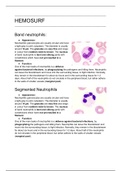
Band neutrophils:
● Appearance:
Neutrophilic granulocytes are usually circular and have
a light-grey to pink cytoplasm. The diameter is usually
around 14 µm. The granules are very fine and range
in colour from reddish-violet to brown. The nucleus
of band neutrophils is bent and oblong partly with
constrictions which have not yet resulted in a
filament.
● Function:
One of the main tasks of neutrophils is a defence
against bacterial infections, by phagocytizing the pathogens and killing them. Neutrophils
can leave the bloodstream and move into the surrounding tissue, to fight infection. Normally,
they remain in the bloodstream for about six hours and in the surrounding tissue for 1-2
days. About half of the neutrophils do not circulate in the peripheral blood, but rather adhere
to the walls of smaller vessels (marginal pool).
Segmented Neutrophils
● Appearance:
Neutrophilic granulocytes are usually circular and have
a light-grey to pink cytoplasm. The diameter is usually
around 14 µm. The granules are very fine and range
in colour from reddish-violet to brown. The nucleus
of band neutrophils is bent and oblong partly with
constrictions which have not yet resulted in a
filament.
● Function:
One of the main tasks of neutrophils is a defence against bacterial infections, by
phagocytizing the pathogens and killing them. Neutrophils can leave the bloodstream and
move into the surrounding tissue, to fight infection. Normally, they remain in the bloodstream
for about six hours and in the surrounding tissue for 1-2 days. About half of the neutrophils
do not circulate in the peripheral blood, but rather adhere to the walls of smaller vessels
(marginal pool).
, Eosinophils
● Appearance:
With a diameter of 16 µm, eosinophil granulocytes are
round and slightly larger than neutrophil granulocytes. The
granules are coarse, bright red to honey-yellow and
very densely packed. The nucleus is usually bilobed.
● Function:
The function of the eosinophils is not completely clear. They play an important role in allergic
diseases as well as in parasitic infections. Like neutrophils, they are capable of phagocytosis
and migration.
Basophils
● Appearance:
The basophilic granulocyte at 10 to 14 µm is smaller than
the other granulocytes. The coarse, dark violet granules
are tightly packed and extensively overlay the nucleus and
cytoplasm.
● Function:
Basophils have an important role to play in hypersensitivity reactions. They are also able
to leave the bloodstream and to emigrate to the surrounding tissue.
Monocytes
● Appearance:
With a diameter of 15 to 20 µm, monocytes are the
largest cells in the peripheral blood. Their form is
diverse. Monocytes may have a pseudo-podi formation
on their outer membrane. The cytoplasm is bluish-grey.
Fine azure granules and vacuoles are often present as
well. The nucleus can be bean-shaped or lobulated. Its
chromatin is medium-fine.
● Function:
Monocytes may have a distinct migration ability. When
they have emigrated to the tissue, they are referred to as macrophages. Monocytes take on
an important role in acute and chronic infections. They actively phagocytize and are
important components of cell-mediated immunity.
HEMOSURF
---------------------------------------------------------------------------------------------------------------------------
Band neutrophils:
● Appearance:
Neutrophilic granulocytes are usually circular and have
a light-grey to pink cytoplasm. The diameter is usually
around 14 µm. The granules are very fine and range
in colour from reddish-violet to brown. The nucleus
of band neutrophils is bent and oblong partly with
constrictions which have not yet resulted in a
filament.
● Function:
One of the main tasks of neutrophils is a defence
against bacterial infections, by phagocytizing the pathogens and killing them. Neutrophils
can leave the bloodstream and move into the surrounding tissue, to fight infection. Normally,
they remain in the bloodstream for about six hours and in the surrounding tissue for 1-2
days. About half of the neutrophils do not circulate in the peripheral blood, but rather adhere
to the walls of smaller vessels (marginal pool).
Segmented Neutrophils
● Appearance:
Neutrophilic granulocytes are usually circular and have
a light-grey to pink cytoplasm. The diameter is usually
around 14 µm. The granules are very fine and range
in colour from reddish-violet to brown. The nucleus
of band neutrophils is bent and oblong partly with
constrictions which have not yet resulted in a
filament.
● Function:
One of the main tasks of neutrophils is a defence against bacterial infections, by
phagocytizing the pathogens and killing them. Neutrophils can leave the bloodstream and
move into the surrounding tissue, to fight infection. Normally, they remain in the bloodstream
for about six hours and in the surrounding tissue for 1-2 days. About half of the neutrophils
do not circulate in the peripheral blood, but rather adhere to the walls of smaller vessels
(marginal pool).
, Eosinophils
● Appearance:
With a diameter of 16 µm, eosinophil granulocytes are
round and slightly larger than neutrophil granulocytes. The
granules are coarse, bright red to honey-yellow and
very densely packed. The nucleus is usually bilobed.
● Function:
The function of the eosinophils is not completely clear. They play an important role in allergic
diseases as well as in parasitic infections. Like neutrophils, they are capable of phagocytosis
and migration.
Basophils
● Appearance:
The basophilic granulocyte at 10 to 14 µm is smaller than
the other granulocytes. The coarse, dark violet granules
are tightly packed and extensively overlay the nucleus and
cytoplasm.
● Function:
Basophils have an important role to play in hypersensitivity reactions. They are also able
to leave the bloodstream and to emigrate to the surrounding tissue.
Monocytes
● Appearance:
With a diameter of 15 to 20 µm, monocytes are the
largest cells in the peripheral blood. Their form is
diverse. Monocytes may have a pseudo-podi formation
on their outer membrane. The cytoplasm is bluish-grey.
Fine azure granules and vacuoles are often present as
well. The nucleus can be bean-shaped or lobulated. Its
chromatin is medium-fine.
● Function:
Monocytes may have a distinct migration ability. When
they have emigrated to the tissue, they are referred to as macrophages. Monocytes take on
an important role in acute and chronic infections. They actively phagocytize and are
important components of cell-mediated immunity.


