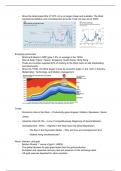
- Since the Arab-Israeli War of 1973, oil is no longer cheap and available. The West
experienced inflation and unemployment at levels it had not seen since WWII.
Emerging economies
- Brazil and Mexico’s GDP grew 7.5% on average in the 1970s
- Rise of Asian Tigers: Taiwan, Singapore, South Korea, Hong Kong
- These six countries supplied 40% of clothing to the West (soon to add shipbuilding
and electronics)
- Since the 1970s, the West began to lose its economic edge vs. the “rest” in Industry,
Skilled labor, Technology, and Modern management
Crises:
- Economic crisis in the West → Productivity gains stopped. Inflation. Recession. Social
unrest.
- Industrial crisis 60-70s → Loss of competitiveness. Beginning of decentralization.
- Unemployment, 1970s → Highest in the West since the Great Depression
- The flaw in the Keynesian Model → Why and how are unemployment and
inflation rising simultaneously?
Nixon, Vietnam, and gold
- Bretton Woods: 1 ounce of gold = US$35
- The global demand for gold grew faster than the gold production
- European and Japanese recovery also put pressure on the exchange rates
- US gold reserves departed for other countries
, - In parallel, US expenses (Vietnam War and other Cold War-related military priorities)
led to an increase in the printing of dollars that were not properly backed by gold
reserves.
- The value of the US dollar-gold became uncertain and led to speculation
- Richard Nixon (1913-94), 37th US President (1969-74)
- In 1971, President Nixon suspended the convertibility of 1 ounce of gold = US$35
- This measure made other currencies float according to demand and supply
fluctuations
- By 1973, the fixed currency system was abandoned (it had lasted almost three
decades from 1944 to 1973)
- The new context (1973 Oil shock) and the growing inflation also helped to end the
system. The US (and the West) realized how dependent they were on Middle
Eastern oil.
- The IMF's function of keeping stable currency exchange rates ended.
Shifting Paradigm in the West
- Disenchantment with the system (Vietnam, Watergate, Oil shocks ’73 and 79)
- Loss of faith in institutions, ideals, elites, and experts
- Erosion of economic expectations, Skepticism towards politics
- Weakening sense about 'everything’
- Conservative and neoliberal revolution
- ‘Reaganomics,’ led by the University of Chicago (Hayek vs. Keynes)
- Economic policies shift to privatization, deregulation, and liberalization of sectors and
industries
- Could resume economic growth, but couldn’t fix the productivity problem
- Rise of inequality
,Late Cold War and Collapse in 1989-1991
Last USSR leaders
Yuri Andropov
- Ambassador to Hungary after the Budapest Revolt (1956)
- KGB Director, operationally responsible for crushing the Prague Spring (1968)
- Repression of artists, writers, and intellectuals in the USSR
- Deployed "mental hospitals" for USSR dissidents
- Considered the election of Pope John Paul II a KGB failure
Economic and social hardship
- The gap between real-life conditions and official propaganda
- The party’s monopoly over politics, history, culture, and lifestyle (‘monopoly over
truth’)
- Productivity stalled in the 1970s
- Modest innovation
- Overall economic and political rigidity, social apathy
Reforms and openness (1986-89)
Late Cold War, 1985-1989
- Gorbachev, the last leader of the USSR, came to power in 1985 with a vision of
reform led by two ideas: Perestroika and Glasnost.
- Under Gorbachev’s plan for Perestroika, the Soviet Union would begin to move
towards a hybrid Communist-Capitalist system.
- Reforms to the economy were coupled with a reorganization of the Party elite that
would bring younger members to the forefront.
- Glasnost aimed to relax personal restrictions on Soviet people
- Gorbachev’s reforms did more to speed the fall of the Soviet Union than they did to
save it
Intermediate-Range Nuclear Forces (INF) Treaty, 1987
- None will have, produce, or test ground or cruise missiles of 500-5,500 km range
(exceptions: air-delivered, sea-based)
- Affects both conventional and nuclear weapons
, - Existing weapons to be destroyed, mutual inspections allowed
- On-site inspections were allowed until 2001, since then mostly by satellite
- A withdrawal from the treaty will require a 6-month notice
Ronald Reagan
- Ronald Reagan became president in Jan 1981 and became a declared and harsh
opponent to the USSR (called it ‘the evil empire’)
- He led a massive increase in American military spending, as well as R&D for better
weapons.
- Reagan fostered the Strategic Defense Initiative (SDI), which nullified the Soviet
nuclear arsenal by destroying missiles as they fell and made a nuclear war
theoretically winnable for the US.
- The USSR was unable to catch up with this program.
Why did the USSR collapse?
- War in Afghanistan (1979-89)
- Chernobyl nuclear accident, 1986
- Economy stalled (from the 1980s)
- Non-Russian nationalities resisted assimilation
- A planned economy is inefficient in a changing world
- New generations, new mindsets
Nationalism movements
- The USSR was a very complex state, composed of many different republics (often
resentful of Russia for historical reasons)
- Dozens of oppressed ethnicities, languages, and cultures created tensions along the
outlying provinces, especially those in continental Europe and Central Asia.
- During the 1980s, nationalist movements in Eastern Europe drove regime change in
Poland, and the movement soon spread to neighboring countries in Eastern Europe.
- Former Soviet parts began to split along ethnic lines, and separatist movements grew
in Ukraine, Belarus, and the Baltic States.
Aging and less ideological Politburo
- Khrushchev was the last of the Soviet leaders to work directly under the leadership of
the original revolutionaries, and from 1963, the Politburo drifted toward conservative
and inconsistent policies.
- The increasing wealth and power of the Communist Party elite became evident and
did not help their popularity.
- Younger soviet generations began to disengage from communist orthodoxy and
sought new material and political horizons.
Inefficient Economy
- The USSR had a rigid economy, led by central planning and limited exposure to the
world economy in a moment of higher global dynamism.
- Economic resources had to be consistently devoted (up to 10-15% of GDP) to catch
up with the geopolitical logics of the Cold War, putting pressure on the consumption
of goods.
experienced inflation and unemployment at levels it had not seen since WWII.
Emerging economies
- Brazil and Mexico’s GDP grew 7.5% on average in the 1970s
- Rise of Asian Tigers: Taiwan, Singapore, South Korea, Hong Kong
- These six countries supplied 40% of clothing to the West (soon to add shipbuilding
and electronics)
- Since the 1970s, the West began to lose its economic edge vs. the “rest” in Industry,
Skilled labor, Technology, and Modern management
Crises:
- Economic crisis in the West → Productivity gains stopped. Inflation. Recession. Social
unrest.
- Industrial crisis 60-70s → Loss of competitiveness. Beginning of decentralization.
- Unemployment, 1970s → Highest in the West since the Great Depression
- The flaw in the Keynesian Model → Why and how are unemployment and
inflation rising simultaneously?
Nixon, Vietnam, and gold
- Bretton Woods: 1 ounce of gold = US$35
- The global demand for gold grew faster than the gold production
- European and Japanese recovery also put pressure on the exchange rates
- US gold reserves departed for other countries
, - In parallel, US expenses (Vietnam War and other Cold War-related military priorities)
led to an increase in the printing of dollars that were not properly backed by gold
reserves.
- The value of the US dollar-gold became uncertain and led to speculation
- Richard Nixon (1913-94), 37th US President (1969-74)
- In 1971, President Nixon suspended the convertibility of 1 ounce of gold = US$35
- This measure made other currencies float according to demand and supply
fluctuations
- By 1973, the fixed currency system was abandoned (it had lasted almost three
decades from 1944 to 1973)
- The new context (1973 Oil shock) and the growing inflation also helped to end the
system. The US (and the West) realized how dependent they were on Middle
Eastern oil.
- The IMF's function of keeping stable currency exchange rates ended.
Shifting Paradigm in the West
- Disenchantment with the system (Vietnam, Watergate, Oil shocks ’73 and 79)
- Loss of faith in institutions, ideals, elites, and experts
- Erosion of economic expectations, Skepticism towards politics
- Weakening sense about 'everything’
- Conservative and neoliberal revolution
- ‘Reaganomics,’ led by the University of Chicago (Hayek vs. Keynes)
- Economic policies shift to privatization, deregulation, and liberalization of sectors and
industries
- Could resume economic growth, but couldn’t fix the productivity problem
- Rise of inequality
,Late Cold War and Collapse in 1989-1991
Last USSR leaders
Yuri Andropov
- Ambassador to Hungary after the Budapest Revolt (1956)
- KGB Director, operationally responsible for crushing the Prague Spring (1968)
- Repression of artists, writers, and intellectuals in the USSR
- Deployed "mental hospitals" for USSR dissidents
- Considered the election of Pope John Paul II a KGB failure
Economic and social hardship
- The gap between real-life conditions and official propaganda
- The party’s monopoly over politics, history, culture, and lifestyle (‘monopoly over
truth’)
- Productivity stalled in the 1970s
- Modest innovation
- Overall economic and political rigidity, social apathy
Reforms and openness (1986-89)
Late Cold War, 1985-1989
- Gorbachev, the last leader of the USSR, came to power in 1985 with a vision of
reform led by two ideas: Perestroika and Glasnost.
- Under Gorbachev’s plan for Perestroika, the Soviet Union would begin to move
towards a hybrid Communist-Capitalist system.
- Reforms to the economy were coupled with a reorganization of the Party elite that
would bring younger members to the forefront.
- Glasnost aimed to relax personal restrictions on Soviet people
- Gorbachev’s reforms did more to speed the fall of the Soviet Union than they did to
save it
Intermediate-Range Nuclear Forces (INF) Treaty, 1987
- None will have, produce, or test ground or cruise missiles of 500-5,500 km range
(exceptions: air-delivered, sea-based)
- Affects both conventional and nuclear weapons
, - Existing weapons to be destroyed, mutual inspections allowed
- On-site inspections were allowed until 2001, since then mostly by satellite
- A withdrawal from the treaty will require a 6-month notice
Ronald Reagan
- Ronald Reagan became president in Jan 1981 and became a declared and harsh
opponent to the USSR (called it ‘the evil empire’)
- He led a massive increase in American military spending, as well as R&D for better
weapons.
- Reagan fostered the Strategic Defense Initiative (SDI), which nullified the Soviet
nuclear arsenal by destroying missiles as they fell and made a nuclear war
theoretically winnable for the US.
- The USSR was unable to catch up with this program.
Why did the USSR collapse?
- War in Afghanistan (1979-89)
- Chernobyl nuclear accident, 1986
- Economy stalled (from the 1980s)
- Non-Russian nationalities resisted assimilation
- A planned economy is inefficient in a changing world
- New generations, new mindsets
Nationalism movements
- The USSR was a very complex state, composed of many different republics (often
resentful of Russia for historical reasons)
- Dozens of oppressed ethnicities, languages, and cultures created tensions along the
outlying provinces, especially those in continental Europe and Central Asia.
- During the 1980s, nationalist movements in Eastern Europe drove regime change in
Poland, and the movement soon spread to neighboring countries in Eastern Europe.
- Former Soviet parts began to split along ethnic lines, and separatist movements grew
in Ukraine, Belarus, and the Baltic States.
Aging and less ideological Politburo
- Khrushchev was the last of the Soviet leaders to work directly under the leadership of
the original revolutionaries, and from 1963, the Politburo drifted toward conservative
and inconsistent policies.
- The increasing wealth and power of the Communist Party elite became evident and
did not help their popularity.
- Younger soviet generations began to disengage from communist orthodoxy and
sought new material and political horizons.
Inefficient Economy
- The USSR had a rigid economy, led by central planning and limited exposure to the
world economy in a moment of higher global dynamism.
- Economic resources had to be consistently devoted (up to 10-15% of GDP) to catch
up with the geopolitical logics of the Cold War, putting pressure on the consumption
of goods.