
1
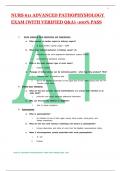
NURS 611 ADVANCED PATHOPHYSIOLOGY
EXAM (WITH VERIFIED Q&A) -100% PASS
1. Acute .unilateral .renal .obstruction .and .hypertension.
a. What .amount .of .cardiac .output .to .kidneys . require?
i. at .least .20-25% .cardiac .output .– .MAP
b. What .does .reduced .perfusion .of .kidneys .cause? .(2)
i. Activation .of .the .renin-angiotensin-aldosterone .system .(RAAS)
ii. constriction .of .peripheral .arterioles
c. What .is .the .most .common .type .of .renal .stone?
i. Calcium .oxalate
d. Passage .of .kidney .stones .can .be .extremely .painful . - .what .may .they .produce? .Why?
i. ―referred .pain‖ .to .umbilicus .area
ii. due .to .the .sensory .innervation .of .the .upper .part .of .the .ureter .arising .from .the .10th
. thoracic .nerve .roots.
2. Urinary .tract .infections:
a. What .are .the .two .common .clinical .manifestations .of .a .urinary .tract .infection .in .an
.older .adult?
i. confusion .and .poorly .localized .abdominal .discomfort
b. Why .can .they .be .very .difficult .to . diagnose?
i. due .to .vague .symptoms.
3. Pyelonephritis
a. What .is .pyelonephritis?
i. An .infection .of .one .or .both .upper .urinary .tracts .(ureter, .renal .pelvis, .and
.kidney .interstitium)
b. What .are .the .two .most .common .underlying .risk .factors .to .pyleonphritis?
i. Urinary .obstruction .and .reflux .of .urine .from .the .bladder .(vesicoureteral .reflux)
c. Name .3 .microorganisms .usually .associated .with .acute .pyelonephritis:
i. E. .coli
ii. Proteus
NURS .611 .ADVANCED .PATHOPHYSIOLOGY .EXAM .(WITH .VERIFIED .Q&A) .-100%
.PASS
, 2
iii. Pseudomonas
d. How .do .pyelonephritis .associated .microorganisms .increase .the .risk .of .stone .formation?
i. They .split .urea .into .ammonia, .making .alkaline . urine
4. Painful .bladder .syndrome/interstitial .cystitis
a. What .does .PBS/IC .include?
i. nonbacterial .infectious .cystitis .(viral, .mycobacterial, .chlamydial, .fungal)
ii. noninfectious .cystitis .(radiation, .chemical, .autoimmune, .hypersensitivity)
b. What .is .the .cause .of .PBS/IC?
i. The .exact .cause .is .unknown, .but .an .autoimmune .reaction .may .be .responsible
.for .the .inflammatory .response
c. What .4 .autoimmune .reactions .are . included .in .the .inflammatory .response .in .PBS/IC?
i. Mast .cell .activation
ii. altered .epithelial .permeability
iii. Neuroinflammation
iv. increased .sensory .nerve .sensitivity.
d. What .is .difficult .when .looking .at .s/s .of .cystitis .and . pyelonephritis?
i. Differentiating .symptoms .by .clinical .assessment .alone
e. How .is .the .specific .diagnosis .is .established?
i. urine .culture
ii. Urinalysis
iii. Clinical .signs .and .symptoms
f. urine ?
What .indicates .pyelonephritis, .but .are .not .always .present .in .the
i. White .blood .cell .casts
5. Glomerular .disorders
a. What .is .reduced .GFR .during .glomerular .disease .is .evidenced .by? .(3)
i. elevated .plasma .urea
ii. creatinine .concentration
iii. reduced .renal .creatinine .clearance
NURS .611 .ADVANCED .PATHOPHYSIOLOGY .EXAM .(WITH .VERIFIED .Q&A) .-100%
.PASS
, 3
6. Acute .glomerulonephritis
a. What .does .acute .glomerulonephritis .include?
i. renal .diseases .in .which .glomerular .inflammation .is .caused .by .immune .mechanisms
.that .damage .the .glomerular .capillary .filtration .membrane
b. What .parts .of .the .glomerular .capillary .filtration .membrane .can .be .damaged .in
.acute .glomerulonephritis?
i. Endothelium
ii. basement .membrane
iii. epithelium .(podocytes)
c. What .are .the .classic .symptoms .of .acute .glomerulonephritis?
i. Sudden .onset .of .hematuria .including .red .blood .cell .casts .and .proteinuria .(milder
.than .nephrotic .syndrome
ii. In .more .severe .cases, .these .symptoms .are .also .accompanied .by .edema,
.hypertension, .and .impaired .renal .function.
7. Nephrotic .syndrome
a. What .is .seen .in .nephrotic .system? .(4)
i. a) .in the .urine .per .day
The .excretion .of .3.0 .g .or .more .of .protein .(massive .proteinuri
ii. hypoalbuminemia .(less .than .3.0 .g/dl)
iii. Hyperlipidemia
iv. peripheral .edema
b. What .is .nephrotic .syndrome .the .characteristic .of?
i. glomerular .injury
c. What .are .the .[rimary .causes .of .nephrotic .syndrome?
i. minimal .change .disease .(lipoid .nephrosis)
ii. membranous .glomerulonephritis
iii. focal .segmental .glomerulosclerosis
d. Where .do .secondary .forms .of .nephrotic .syndrome .occur? .(3)
i. systemic .diseases .including .diabetes .mellitus, .amyloidosis, .and .systemic
.lupus .erythematosus
e. Where .is .Nephrotic .syndrome .also .is .seen .with? .(4)
i. certain .drugs, .infections, .malignancies, .and .vascular .disorders.
8. Acute .Kidney .injury
a. What .do .we .know .about .the .progression .of .AKI? .(2)
i. Can .be .acute .and .rapidly .progressive .(within .hours)
ii. the .process .may .be .reversible
NURS .611 .ADVANCED .PATHOPHYSIOLOGY .EXAM .(WITH .VERIFIED .Q&A) .-100%
.PASS
, 4
b. What .do .we .know .about .chronic .kidney .failure?
i. Can .progress .slowly .into .end-stage .kidney .failure .over .a .period .of .months .or .years
c. What .does .Renal .insufficiency .refers .to?
i. a .decline .in .renal .function .to .about .25% .of .normal .or .an .eGFR .of .25 .to .30 . ml/minute.
d. What .is .eGFR .is .extremely .useful .in?
i. Determining .improvement .or .decline .in .kidney .function!!)
e. What .do . you .see .(lab .wise) .in .renal .insufficiency?
i. Levels .of .serum .creatinine .and .urea .are .mildly .elevated.
f. Changes .in .serum .creatinine .level .occur .only .if .more .than % .of .glomerular .filtration
.is .lost .and .are .often .delayed .by .more .than . hours?
i. 50 .,24
g. What .does .diagnostic .delays .make .more .difficult? .What .does .this .contribute .to . (2)?
i. The .implementation .of .early .therapy .- .contributing .to .disease .progression .and .mortality.
h. What .are .renal .insufficiency .patients .prone .to? .(4)
i. Hyperkalemia
ii. metabolic .acidosis
iii. Hyperphosphatemia
iv. Fluid .retention .which .may .cause .edema
i. What .may .you .see .with .those .in .cardiac .disease .r/t .renal .insufficiency?
i. Symptoms .of .congestive .heart .failure .develop .in .persons .with .cardiac .disease.
.Nausea, .vomiting, .and .fatigue .accompany .uremia .and .electrolyte .imbalances.
.Wound .healing .is .delayed, .and .the .risk .of .infection, .particularly .pneumonia, .is
.greater.
j. What .does .AKI .commonly .result .from?
i. extracellular .volume .depletion .and .decreased .renal .blood .flow
ii. toxic/inflammatory .injury .to .kidney .cells .that .result .in .alterations .in .renal .function .that
.may .be .minimal .or .severe
NURS .611 .ADVANCED .PATHOPHYSIOLOGY .EXAM .(WITH .VERIFIED .Q&A) .-100%
.PASS
NURS 611 ADVANCED PATHOPHYSIOLOGY
EXAM (WITH VERIFIED Q&A) -100% PASS
1. Acute .unilateral .renal .obstruction .and .hypertension.
a. What .amount .of .cardiac .output .to .kidneys . require?
i. at .least .20-25% .cardiac .output .– .MAP
b. What .does .reduced .perfusion .of .kidneys .cause? .(2)
i. Activation .of .the .renin-angiotensin-aldosterone .system .(RAAS)
ii. constriction .of .peripheral .arterioles
c. What .is .the .most .common .type .of .renal .stone?
i. Calcium .oxalate
d. Passage .of .kidney .stones .can .be .extremely .painful . - .what .may .they .produce? .Why?
i. ―referred .pain‖ .to .umbilicus .area
ii. due .to .the .sensory .innervation .of .the .upper .part .of .the .ureter .arising .from .the .10th
. thoracic .nerve .roots.
2. Urinary .tract .infections:
a. What .are .the .two .common .clinical .manifestations .of .a .urinary .tract .infection .in .an
.older .adult?
i. confusion .and .poorly .localized .abdominal .discomfort
b. Why .can .they .be .very .difficult .to . diagnose?
i. due .to .vague .symptoms.
3. Pyelonephritis
a. What .is .pyelonephritis?
i. An .infection .of .one .or .both .upper .urinary .tracts .(ureter, .renal .pelvis, .and
.kidney .interstitium)
b. What .are .the .two .most .common .underlying .risk .factors .to .pyleonphritis?
i. Urinary .obstruction .and .reflux .of .urine .from .the .bladder .(vesicoureteral .reflux)
c. Name .3 .microorganisms .usually .associated .with .acute .pyelonephritis:
i. E. .coli
ii. Proteus
NURS .611 .ADVANCED .PATHOPHYSIOLOGY .EXAM .(WITH .VERIFIED .Q&A) .-100%
.PASS
, 2
iii. Pseudomonas
d. How .do .pyelonephritis .associated .microorganisms .increase .the .risk .of .stone .formation?
i. They .split .urea .into .ammonia, .making .alkaline . urine
4. Painful .bladder .syndrome/interstitial .cystitis
a. What .does .PBS/IC .include?
i. nonbacterial .infectious .cystitis .(viral, .mycobacterial, .chlamydial, .fungal)
ii. noninfectious .cystitis .(radiation, .chemical, .autoimmune, .hypersensitivity)
b. What .is .the .cause .of .PBS/IC?
i. The .exact .cause .is .unknown, .but .an .autoimmune .reaction .may .be .responsible
.for .the .inflammatory .response
c. What .4 .autoimmune .reactions .are . included .in .the .inflammatory .response .in .PBS/IC?
i. Mast .cell .activation
ii. altered .epithelial .permeability
iii. Neuroinflammation
iv. increased .sensory .nerve .sensitivity.
d. What .is .difficult .when .looking .at .s/s .of .cystitis .and . pyelonephritis?
i. Differentiating .symptoms .by .clinical .assessment .alone
e. How .is .the .specific .diagnosis .is .established?
i. urine .culture
ii. Urinalysis
iii. Clinical .signs .and .symptoms
f. urine ?
What .indicates .pyelonephritis, .but .are .not .always .present .in .the
i. White .blood .cell .casts
5. Glomerular .disorders
a. What .is .reduced .GFR .during .glomerular .disease .is .evidenced .by? .(3)
i. elevated .plasma .urea
ii. creatinine .concentration
iii. reduced .renal .creatinine .clearance
NURS .611 .ADVANCED .PATHOPHYSIOLOGY .EXAM .(WITH .VERIFIED .Q&A) .-100%
.PASS
, 3
6. Acute .glomerulonephritis
a. What .does .acute .glomerulonephritis .include?
i. renal .diseases .in .which .glomerular .inflammation .is .caused .by .immune .mechanisms
.that .damage .the .glomerular .capillary .filtration .membrane
b. What .parts .of .the .glomerular .capillary .filtration .membrane .can .be .damaged .in
.acute .glomerulonephritis?
i. Endothelium
ii. basement .membrane
iii. epithelium .(podocytes)
c. What .are .the .classic .symptoms .of .acute .glomerulonephritis?
i. Sudden .onset .of .hematuria .including .red .blood .cell .casts .and .proteinuria .(milder
.than .nephrotic .syndrome
ii. In .more .severe .cases, .these .symptoms .are .also .accompanied .by .edema,
.hypertension, .and .impaired .renal .function.
7. Nephrotic .syndrome
a. What .is .seen .in .nephrotic .system? .(4)
i. a) .in the .urine .per .day
The .excretion .of .3.0 .g .or .more .of .protein .(massive .proteinuri
ii. hypoalbuminemia .(less .than .3.0 .g/dl)
iii. Hyperlipidemia
iv. peripheral .edema
b. What .is .nephrotic .syndrome .the .characteristic .of?
i. glomerular .injury
c. What .are .the .[rimary .causes .of .nephrotic .syndrome?
i. minimal .change .disease .(lipoid .nephrosis)
ii. membranous .glomerulonephritis
iii. focal .segmental .glomerulosclerosis
d. Where .do .secondary .forms .of .nephrotic .syndrome .occur? .(3)
i. systemic .diseases .including .diabetes .mellitus, .amyloidosis, .and .systemic
.lupus .erythematosus
e. Where .is .Nephrotic .syndrome .also .is .seen .with? .(4)
i. certain .drugs, .infections, .malignancies, .and .vascular .disorders.
8. Acute .Kidney .injury
a. What .do .we .know .about .the .progression .of .AKI? .(2)
i. Can .be .acute .and .rapidly .progressive .(within .hours)
ii. the .process .may .be .reversible
NURS .611 .ADVANCED .PATHOPHYSIOLOGY .EXAM .(WITH .VERIFIED .Q&A) .-100%
.PASS
, 4
b. What .do .we .know .about .chronic .kidney .failure?
i. Can .progress .slowly .into .end-stage .kidney .failure .over .a .period .of .months .or .years
c. What .does .Renal .insufficiency .refers .to?
i. a .decline .in .renal .function .to .about .25% .of .normal .or .an .eGFR .of .25 .to .30 . ml/minute.
d. What .is .eGFR .is .extremely .useful .in?
i. Determining .improvement .or .decline .in .kidney .function!!)
e. What .do . you .see .(lab .wise) .in .renal .insufficiency?
i. Levels .of .serum .creatinine .and .urea .are .mildly .elevated.
f. Changes .in .serum .creatinine .level .occur .only .if .more .than % .of .glomerular .filtration
.is .lost .and .are .often .delayed .by .more .than . hours?
i. 50 .,24
g. What .does .diagnostic .delays .make .more .difficult? .What .does .this .contribute .to . (2)?
i. The .implementation .of .early .therapy .- .contributing .to .disease .progression .and .mortality.
h. What .are .renal .insufficiency .patients .prone .to? .(4)
i. Hyperkalemia
ii. metabolic .acidosis
iii. Hyperphosphatemia
iv. Fluid .retention .which .may .cause .edema
i. What .may .you .see .with .those .in .cardiac .disease .r/t .renal .insufficiency?
i. Symptoms .of .congestive .heart .failure .develop .in .persons .with .cardiac .disease.
.Nausea, .vomiting, .and .fatigue .accompany .uremia .and .electrolyte .imbalances.
.Wound .healing .is .delayed, .and .the .risk .of .infection, .particularly .pneumonia, .is
.greater.
j. What .does .AKI .commonly .result .from?
i. extracellular .volume .depletion .and .decreased .renal .blood .flow
ii. toxic/inflammatory .injury .to .kidney .cells .that .result .in .alterations .in .renal .function .that
.may .be .minimal .or .severe
NURS .611 .ADVANCED .PATHOPHYSIOLOGY .EXAM .(WITH .VERIFIED .Q&A) .-100%
.PASS

