INDEX
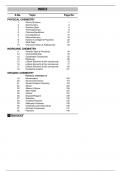
S.No. Topic Page No.
PHYSICAL CHEMISTRY
1. Atomic Structure 1
2. Stoichiometry 2
3. Gaseous State 6
4. Thermodynamics 8
5. Chemical Equilibrium 12
6. Ionic Equilibrium 15
7. Electrochemistry 18
8. Solution & Colligative Properties 22
9. Solid State 27
10. Chemical Kinetics & Radioactivity 30
INORGANIC CHEMISTRY
11. Periodic Table & Periodicity 34
12. Chemical Bonding 42
13. Coordination Compounds 53
14. Metallurgy 66
15. s-Block Elements & their compounds 73
16. p-Block Elements & their compounds 77
17. d-Block Elements & their compounds 95
18. Qualitative Analysis 101
ORGANIC CHEMISTRY
Points to remember in
19. Nomenclature 109
20. Structure Isomerism 114
21. General Organic Chemistry 119
22. Alkane 126
23. Alkene & Alkyne 126
24. Alkyl Halide 127
25. Alcohol 127
26. Grignard Reagent 129
27. Reduction 130
28. Oxidation Reaction 132
29. Aldehyde & Ketones 135
30. Carboxylic acid & Derivatives 139
31. Aromatic Compounds 141
32. Polymers 145
, PHYSICAL CHEMISTRY
ATOMIC STRUCTURE
Planck's Quantum Theory :
hc
Energy of one photon = h =
Photoelectric Effect :
1
h = h0 + m 2
2 e
Bohr’s Model for Hydrogen like atoms :
h
1. mvr = n (Quantization of angular momentum)
2
E1 z2 z2
2. En = – 2 z2 = –2.178 × 10⁻¹⁸ 2 J/atom = –13.6 eV
n n n2
2 2 me 4
E1 =
n2
2
n2 h 0 . 529 n2
3. rn = × 2 2 = Å
Z 4 e m Z
2 ze 2 2 .18 10 6 z
4. v= = m/s
nh n
De–Broglie wavelength :
h h
= (for photon)
mc p
Wavelength of emitted photon :
1
1
1
= = RZ2 2 2
n
1 n2
Page # 1
,No. of photons emitted by a sample of H atom :
n ( n 1)
2
Heisenberg’s uncertainty principle :
h h h
x.p > or m x.v or x.v
4 4 4m
Quantum Numbers :
* Principal quantum number (n) = 1, 2, 3, 4 .... to .
nh
* Orbital angular momentum of electron in any orbit = .
2
* Azimuthal quantum number () = 0, 1, ..... to (n – 1).
* Number of orbitals in a subshell = 2 + 1
* Maximum number of electrons in particular subshell = 2 × (2 + 1)
h
* Orbital angular momentum L = ( 1) = ( 1)
2
h
2
STOICHIOMETRY
Mass of one atom of an element
Relative atomic mass (R.A.M) =
1
mass of one carbon atom
12
= Total Number of nucleons
Y-map
Number lt Volume at STP
2.4
×N
A 2
× lt
N
A 2 2.4
Mole
mol. wt. × mol. wt.
At. wt. × At. wt.
Mass
Page # 2
, Density :
density of the subs tance
Specific gravity = density of water at 4C
For gases :
Molar mass of the gas
Absolute density (mass/volume) = Molar volume of the gas
PM
=
RT
dgas PMgas RT Mgas M gas
Vapour density V.D.= d = PM = M =
H2 H2 RT H2 2
Mgas = 2 V.D.
Mole-mole analysis :
At. wt. / Mol. Wt. Mole-mole
Mass Mole relationship Mole
of equation t.
t. w
t./A × 22.4 lt
l. w
× mo
Mass Volume at STP
Concentration terms :
Molarity (M) :
w 1000
Molarity (M) = (Mol. wt of solute ) V
inml
Molality (m) :
number of moles of solute
Molality = 1000 = 1000 w / M w
mass of solvent in gram 1 1 2
Mole fraction (x) :
n
Mole fraction of solution (x1) =
nN
N
Mole fraction of solvent (x2) =
nN
x1 + x 2 = 1
Page # 3
S.No. Topic Page No.
PHYSICAL CHEMISTRY
1. Atomic Structure 1
2. Stoichiometry 2
3. Gaseous State 6
4. Thermodynamics 8
5. Chemical Equilibrium 12
6. Ionic Equilibrium 15
7. Electrochemistry 18
8. Solution & Colligative Properties 22
9. Solid State 27
10. Chemical Kinetics & Radioactivity 30
INORGANIC CHEMISTRY
11. Periodic Table & Periodicity 34
12. Chemical Bonding 42
13. Coordination Compounds 53
14. Metallurgy 66
15. s-Block Elements & their compounds 73
16. p-Block Elements & their compounds 77
17. d-Block Elements & their compounds 95
18. Qualitative Analysis 101
ORGANIC CHEMISTRY
Points to remember in
19. Nomenclature 109
20. Structure Isomerism 114
21. General Organic Chemistry 119
22. Alkane 126
23. Alkene & Alkyne 126
24. Alkyl Halide 127
25. Alcohol 127
26. Grignard Reagent 129
27. Reduction 130
28. Oxidation Reaction 132
29. Aldehyde & Ketones 135
30. Carboxylic acid & Derivatives 139
31. Aromatic Compounds 141
32. Polymers 145
, PHYSICAL CHEMISTRY
ATOMIC STRUCTURE
Planck's Quantum Theory :
hc
Energy of one photon = h =
Photoelectric Effect :
1
h = h0 + m 2
2 e
Bohr’s Model for Hydrogen like atoms :
h
1. mvr = n (Quantization of angular momentum)
2
E1 z2 z2
2. En = – 2 z2 = –2.178 × 10⁻¹⁸ 2 J/atom = –13.6 eV
n n n2
2 2 me 4
E1 =
n2
2
n2 h 0 . 529 n2
3. rn = × 2 2 = Å
Z 4 e m Z
2 ze 2 2 .18 10 6 z
4. v= = m/s
nh n
De–Broglie wavelength :
h h
= (for photon)
mc p
Wavelength of emitted photon :
1
1
1
= = RZ2 2 2
n
1 n2
Page # 1
,No. of photons emitted by a sample of H atom :
n ( n 1)
2
Heisenberg’s uncertainty principle :
h h h
x.p > or m x.v or x.v
4 4 4m
Quantum Numbers :
* Principal quantum number (n) = 1, 2, 3, 4 .... to .
nh
* Orbital angular momentum of electron in any orbit = .
2
* Azimuthal quantum number () = 0, 1, ..... to (n – 1).
* Number of orbitals in a subshell = 2 + 1
* Maximum number of electrons in particular subshell = 2 × (2 + 1)
h
* Orbital angular momentum L = ( 1) = ( 1)
2
h
2
STOICHIOMETRY
Mass of one atom of an element
Relative atomic mass (R.A.M) =
1
mass of one carbon atom
12
= Total Number of nucleons
Y-map
Number lt Volume at STP
2.4
×N
A 2
× lt
N
A 2 2.4
Mole
mol. wt. × mol. wt.
At. wt. × At. wt.
Mass
Page # 2
, Density :
density of the subs tance
Specific gravity = density of water at 4C
For gases :
Molar mass of the gas
Absolute density (mass/volume) = Molar volume of the gas
PM
=
RT
dgas PMgas RT Mgas M gas
Vapour density V.D.= d = PM = M =
H2 H2 RT H2 2
Mgas = 2 V.D.
Mole-mole analysis :
At. wt. / Mol. Wt. Mole-mole
Mass Mole relationship Mole
of equation t.
t. w
t./A × 22.4 lt
l. w
× mo
Mass Volume at STP
Concentration terms :
Molarity (M) :
w 1000
Molarity (M) = (Mol. wt of solute ) V
inml
Molality (m) :
number of moles of solute
Molality = 1000 = 1000 w / M w
mass of solvent in gram 1 1 2
Mole fraction (x) :
n
Mole fraction of solution (x1) =
nN
N
Mole fraction of solvent (x2) =
nN
x1 + x 2 = 1
Page # 3