
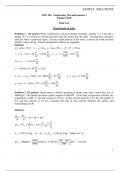
SAMPLE SOLUTIONS
MAE 201: Engineering Thermodynamics I
Summer 2020
Final Test
Closed books & notes
Problem 1. (25 points) Water contained in a piston-cylinder assembly, initially at 1.5 bar and a
quality 20 % is heated at constant pressure until the piston hits the stops. Heating then continues
until the water is saturated vapor. For the overall process of the water, evaluate the work and heat
transfer, each in kJ/kg. Kinetic and potential effects are negligible.
Solution:
Q = m∆u + P∆∀ ⇒ q = ∆u + w = ∆u + P∆v ; P1 = P2 = 1.5bar
m3 m3 0.08 m3
v1 ≈ xv g = 0.2 ⋅ 1.16 = 0.232 , v 2 = v3 = v1 = 0.371
kg kg 0.05 kg
m3
∆v = v 2 − v1 = 0.139
kg
m3
w = 150 kPa ⋅ 0.139 ≈ 21 kJ
kg
kJ kJ kJ
u1 = u f + xu fg = (467 + 0.2 ⋅ 2052 ) = 877 ; u 2 = u g (v3 ) ≈ 2561
kg kg kg
kJ kJ
q = ∆u + w = (2561 − 877 + 21) = 1705
kg kg
Problem 2. (25 points) Steam enters a turbine operating at steady state with a mass flow rate of
4600 kg/h. The turbine develops a power output of 1000 kW. At the inlet, the pressure is 60 bar, the
temperature is 400 ˚C, and the velocity is 10 m/s. At the exit the pressure is 0.1 bar, the quality is
0.9, and the velocity is 30 m/s. Calculate the rate of heat transfer between the turbine and
surroundings in kW.
Solution:
Q net W net
− = ∆h + ∆ke + ∆pe
m m
v 2 − v12
Q net = W net + m (h2 − h1 ) + 2
2
h1 = 3178.3 kJ kg , h2 = h f 2 + x 2 h fg 2 = 2345.4 kJ kg , Tables A6, A5
4600
Q net = 1000kW + (2345.4 − 3178.3) + 900 − 100 kW = −63.8 kW
3600 2000
1
MAE 201: Engineering Thermodynamics I
Summer 2020
Final Test
Closed books & notes
Problem 1. (25 points) Water contained in a piston-cylinder assembly, initially at 1.5 bar and a
quality 20 % is heated at constant pressure until the piston hits the stops. Heating then continues
until the water is saturated vapor. For the overall process of the water, evaluate the work and heat
transfer, each in kJ/kg. Kinetic and potential effects are negligible.
Solution:
Q = m∆u + P∆∀ ⇒ q = ∆u + w = ∆u + P∆v ; P1 = P2 = 1.5bar
m3 m3 0.08 m3
v1 ≈ xv g = 0.2 ⋅ 1.16 = 0.232 , v 2 = v3 = v1 = 0.371
kg kg 0.05 kg
m3
∆v = v 2 − v1 = 0.139
kg
m3
w = 150 kPa ⋅ 0.139 ≈ 21 kJ
kg
kJ kJ kJ
u1 = u f + xu fg = (467 + 0.2 ⋅ 2052 ) = 877 ; u 2 = u g (v3 ) ≈ 2561
kg kg kg
kJ kJ
q = ∆u + w = (2561 − 877 + 21) = 1705
kg kg
Problem 2. (25 points) Steam enters a turbine operating at steady state with a mass flow rate of
4600 kg/h. The turbine develops a power output of 1000 kW. At the inlet, the pressure is 60 bar, the
temperature is 400 ˚C, and the velocity is 10 m/s. At the exit the pressure is 0.1 bar, the quality is
0.9, and the velocity is 30 m/s. Calculate the rate of heat transfer between the turbine and
surroundings in kW.
Solution:
Q net W net
− = ∆h + ∆ke + ∆pe
m m
v 2 − v12
Q net = W net + m (h2 − h1 ) + 2
2
h1 = 3178.3 kJ kg , h2 = h f 2 + x 2 h fg 2 = 2345.4 kJ kg , Tables A6, A5
4600
Q net = 1000kW + (2345.4 − 3178.3) + 900 − 100 kW = −63.8 kW
3600 2000
1


