Natasha Hussain
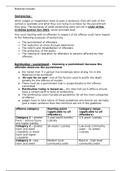
Sentencing –
when judges or magistrates have to pass a sentence, they will look at the
sentence available and what they are trying to achieve by the punishment
they give. The purposes of adult sentencing were set out in s142 of the
Criminal Justice Act 2003, which provides that:
Any court dealing with an offender in respect of his offence must have regard
to the following purposes of sentencing –
The punishment of offenders
The reduction of crime through deterrence
The reform and rehabilitation of offenders
The protection of the public
The making of reparation by offenders to persons affected by their
offences
Retribution / punishment – imposing a punishment because the
offender deserves the punishment
the notion that ‘if a person has knowingly done wrong, he or she
deserves to be punished’
‘An eye for an eye’- one of the factors used to justify the death
penalty for the offence of murder
There must be a punishment that is proportionate to the offence
committed
Retribution today is based on… the idea that each offence should
have a certain tariff or level of sentencing
The sentencing council produces guidelines for all the main categories
of offence
judges have to take notice of these guidelines and should not normally
give a lower sentence than the minimum set out in the guideline
offence category Starting point Category range
(applicable to all (applicable to all
offenders) offenders)
Category 1 – greater 1 year and 6 months’ 1-3 years’ custody
harm – serious injury custody
and higher liability
Category 2 – greater 26 weeks’ custody Low level community
harm and lower order – 51 weeks’
culpability or lesser custody
harm and higher
culpability
Category 3 – less Medium level Band A – high level
harm and lower community order community order
Sentencing –
when judges or magistrates have to pass a sentence, they will look at the
sentence available and what they are trying to achieve by the punishment
they give. The purposes of adult sentencing were set out in s142 of the
Criminal Justice Act 2003, which provides that:
Any court dealing with an offender in respect of his offence must have regard
to the following purposes of sentencing –
The punishment of offenders
The reduction of crime through deterrence
The reform and rehabilitation of offenders
The protection of the public
The making of reparation by offenders to persons affected by their
offences
Retribution / punishment – imposing a punishment because the
offender deserves the punishment
the notion that ‘if a person has knowingly done wrong, he or she
deserves to be punished’
‘An eye for an eye’- one of the factors used to justify the death
penalty for the offence of murder
There must be a punishment that is proportionate to the offence
committed
Retribution today is based on… the idea that each offence should
have a certain tariff or level of sentencing
The sentencing council produces guidelines for all the main categories
of offence
judges have to take notice of these guidelines and should not normally
give a lower sentence than the minimum set out in the guideline
offence category Starting point Category range
(applicable to all (applicable to all
offenders) offenders)
Category 1 – greater 1 year and 6 months’ 1-3 years’ custody
harm – serious injury custody
and higher liability
Category 2 – greater 26 weeks’ custody Low level community
harm and lower order – 51 weeks’
culpability or lesser custody
harm and higher
culpability
Category 3 – less Medium level Band A – high level
harm and lower community order community order