
Anth 275 Exam 1
Study online at https://quizlet.com/_746qcj
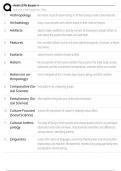
1. Anthropology the holistic study of human beings in all their biological and cultural diversity
2. Archaeology study of past peoples and cultures based on their material remains
3. Artifacts objects made, modified, or used by humans. Archaeologists analyze artifacts to
learn about the people who made and used them.
4. Features Non-portable artifacts; such as soil stains (where storage pits, structures, or fences
once were)
5. Ecofacts natural remains related to human activity.
6. Holism the perspective on the human condition that assumes that mind, body, society,
individuals, and the environment interpenetrate, and even define one another.
7. Holism (in an- tries to integrate all that is known about human beings and their activities
thropology)
8. Comparative (So- finds patterns by comparing groups
cial Science)
9. Evolutionary (So- often explains things because of biocultural evolution
cial Science)
10. Culture-Focused stresses the importance of culture in shaping human affairs
(Social Science)
11. Cultural Anthro- The study of living or recent people and cultures based primarily on participant
pology observation and native interviews. They illuminate similarities and differences
among cultures, identifying patterns.
12. Linguistics study of the nature of languages, examining how they work and retracing their
relationships and evolution. Renowned for reconstructing language family trees
and decipher ancient writing.
1/5
, Anth 275 Exam 1
Study online at https://quizlet.com/_746qcj
13. Biological or The study of interactions among our bodies, culture, and the environment, based
Physical Anthro- principally on analysis of the human form.
pology
14. Academic Ar- focused on research, traditionally practiced in universities and museums, until
chaeology recently the major share
15. Commercial Ar- For profit, especially cultural resource management (CRM), documenting and
chaeology saving endangered remains, now majority in US
16. Archaeology vs both focus on the human past, but history relies primarily on written documents
History while archaeology employs all material remains, including texts.
17. Culture a learned body of beliefs, behaviors, and materials that characterize a way of life;
primary means of human adaptation
18. Cultural Com- the main way in which cultures differ
plexity
19. Cultural Evolu- the principle mechanism by which cultures and complexity change in adaptation
tion to the environment
20. Learned (Culture) not instinctive
21. Integrative (Cul- shared, unites members
ture)
22. Distinctive (Cul- differentiates groups
ture)
23. Systematic (Cul- composed of interacting systems
ture)
24. encodes and analyzes the world
2/5
Study online at https://quizlet.com/_746qcj
1. Anthropology the holistic study of human beings in all their biological and cultural diversity
2. Archaeology study of past peoples and cultures based on their material remains
3. Artifacts objects made, modified, or used by humans. Archaeologists analyze artifacts to
learn about the people who made and used them.
4. Features Non-portable artifacts; such as soil stains (where storage pits, structures, or fences
once were)
5. Ecofacts natural remains related to human activity.
6. Holism the perspective on the human condition that assumes that mind, body, society,
individuals, and the environment interpenetrate, and even define one another.
7. Holism (in an- tries to integrate all that is known about human beings and their activities
thropology)
8. Comparative (So- finds patterns by comparing groups
cial Science)
9. Evolutionary (So- often explains things because of biocultural evolution
cial Science)
10. Culture-Focused stresses the importance of culture in shaping human affairs
(Social Science)
11. Cultural Anthro- The study of living or recent people and cultures based primarily on participant
pology observation and native interviews. They illuminate similarities and differences
among cultures, identifying patterns.
12. Linguistics study of the nature of languages, examining how they work and retracing their
relationships and evolution. Renowned for reconstructing language family trees
and decipher ancient writing.
1/5
, Anth 275 Exam 1
Study online at https://quizlet.com/_746qcj
13. Biological or The study of interactions among our bodies, culture, and the environment, based
Physical Anthro- principally on analysis of the human form.
pology
14. Academic Ar- focused on research, traditionally practiced in universities and museums, until
chaeology recently the major share
15. Commercial Ar- For profit, especially cultural resource management (CRM), documenting and
chaeology saving endangered remains, now majority in US
16. Archaeology vs both focus on the human past, but history relies primarily on written documents
History while archaeology employs all material remains, including texts.
17. Culture a learned body of beliefs, behaviors, and materials that characterize a way of life;
primary means of human adaptation
18. Cultural Com- the main way in which cultures differ
plexity
19. Cultural Evolu- the principle mechanism by which cultures and complexity change in adaptation
tion to the environment
20. Learned (Culture) not instinctive
21. Integrative (Cul- shared, unites members
ture)
22. Distinctive (Cul- differentiates groups
ture)
23. Systematic (Cul- composed of interacting systems
ture)
24. encodes and analyzes the world
2/5

